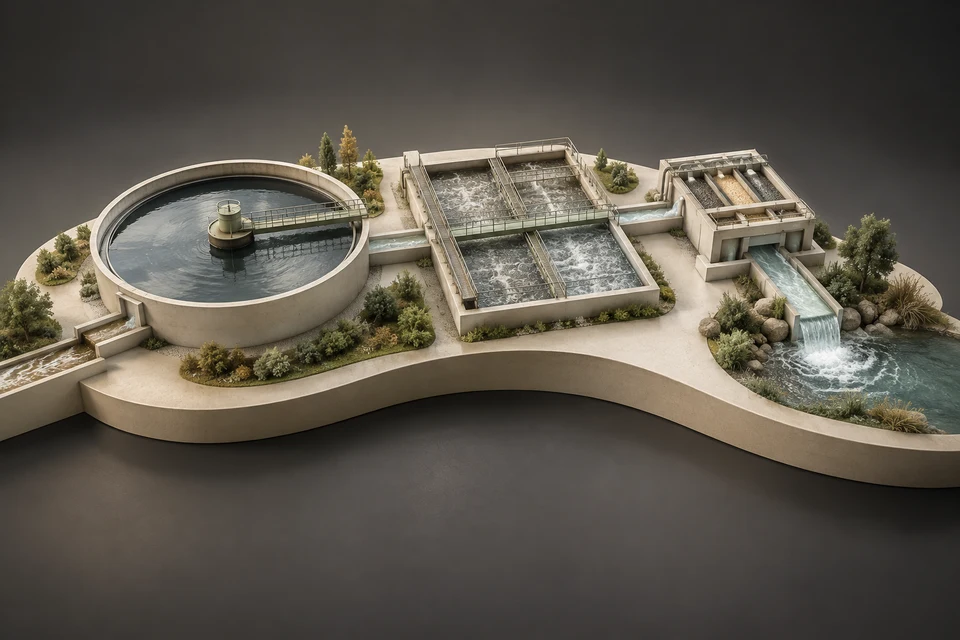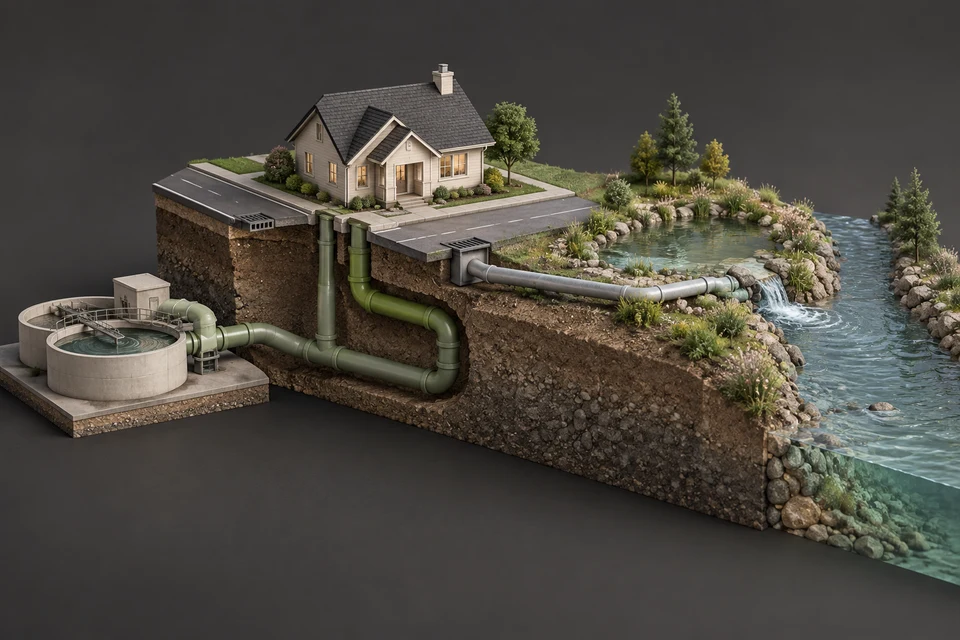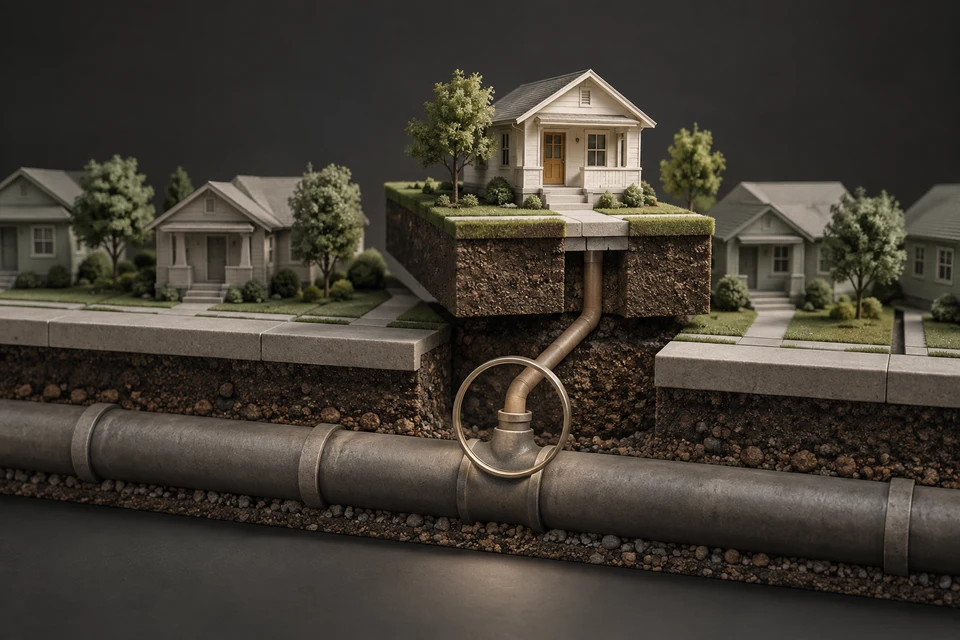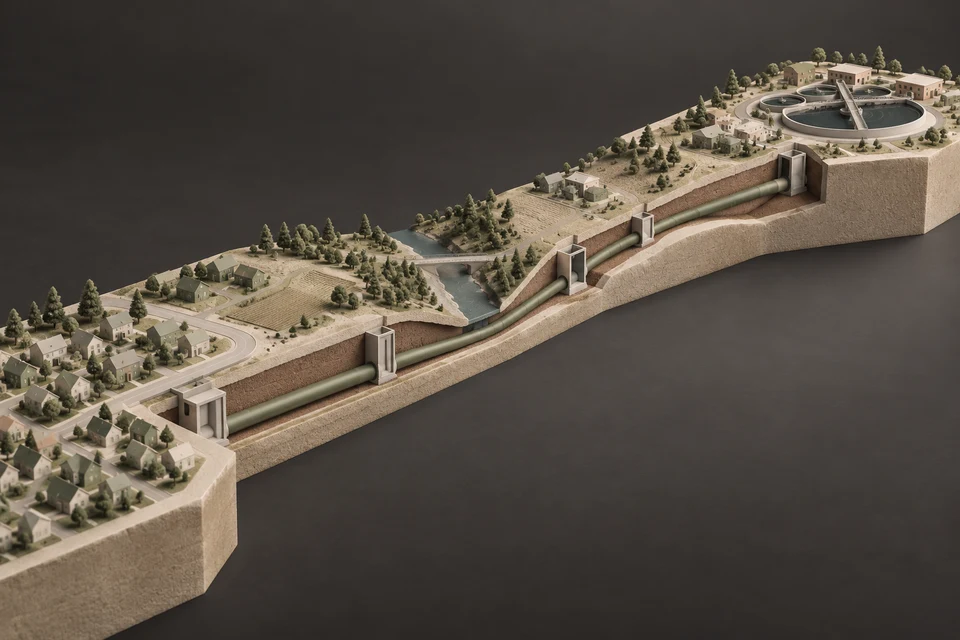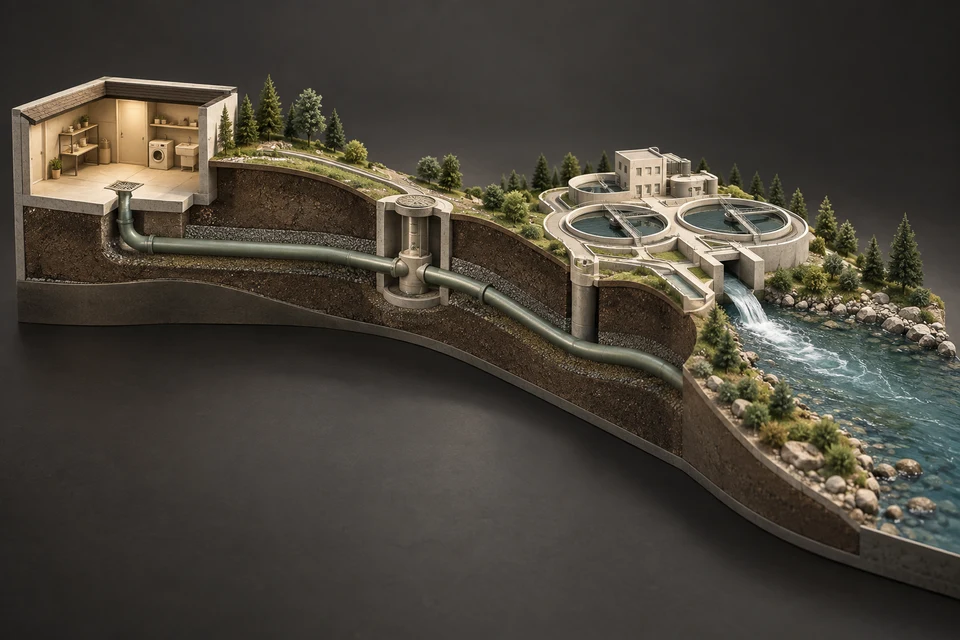
A sanitary sewer carries used water from toilets, sinks, tubs and laundry to treatment. In Calgary, each building drains through a service line to a City sanitary main; wastewater then moves by gravity and pump stations to the Bonnybrook, Fish Creek or Pine Creek treatment plant and is released, treated, into the Bow River. Stormwater runs in a separate system that is not treated.
- Calgary runs separate sanitary and storm systems: sanitary flow is treated, while the City says storm drain water reaches rivers and streams without treatment.
- The City records 367,397 residential and small-building sanitary service lines; 94% are 100 mm (4 in) pipe on the City side.
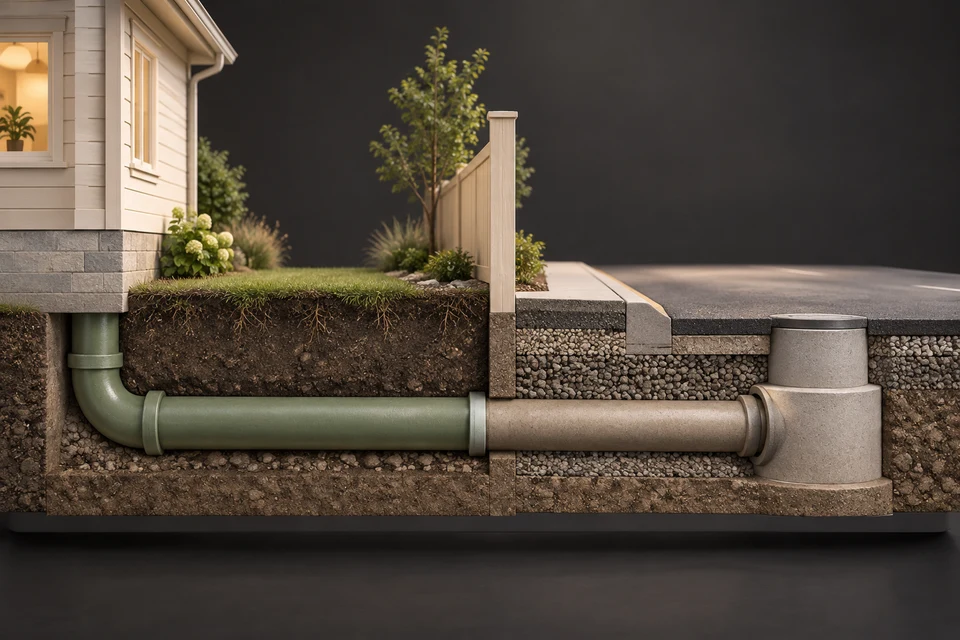
- Ownership of each connection changes hands at the property line: municipal toward the street, private toward the house.
- Wastewater moves by gravity and pump stations to one of three treatment plants, then to the Bow River.
- The City says it responds to more than 8,000 sewer backups a year, most caused by blockages that start with what goes down drains.
01 /What is a sanitary sewer?
A sanitary sewer is the pipe network that carries wastewater, the used water from toilets, showers, sinks, dishwashers and washing machines, away from buildings to a treatment plant. It is called sanitary to separate it from the storm sewer, which carries rain and snowmelt from streets, roofs and yards.
Calgary keeps the two apart. The City describes its storm drains, more than 60,000 of them, as a system that sends water to Calgary's rivers and streams without treatment, and separate from the sanitary sewers. Everything that leaves a house through a toilet or a drain goes the other way, into the sanitary system and on to treatment. That separation is why a basement floor drain, which connects to the sanitary side, must never be used for paint, oil or solvents, and why a street catch basin is not a place for anything but rain.
For the full comparison, including why heavy rain still affects sanitary flows, see sanitary vs storm sewers in Calgary.
02 /What path does wastewater take through Calgary?
Wastewater follows a chain of progressively larger pipes, almost all of it flowing downhill. Each link has a different owner and a different public record.
- Fixtures and the building drain
Each fixture drains through a trap into branch pipes, which join the building drain under the basement floor. This plumbing belongs to the owner and is governed by the plumbing code and City permits.
- The private service line
The building drain leaves the foundation and becomes the service line, also called the lateral. From the house to the property line, it is the owner's pipe.
- The City service line
From the property line to the main, the same connection is City-owned. This is the segment the City publishes in its Public Sanitary Service Lines open data.
- Sanitary mains and trunks
Service lines tap into a sanitary main under the street or lane. Mains join larger trunk sewers that follow the land toward the river valleys.
- Pump stations
Where gravity alone cannot carry flow over high ground, pump stations (also called lift stations) raise it into the next gravity section. The City says wastewater moves through its pipes by gravity and pump stations. Lift stations are also a common source of the outdoor odours described in sewer smells in Calgary.
- Treatment and the river
Flow reaches the Bonnybrook, Fish Creek or Pine Creek wastewater treatment plant. After treatment it is released into the Bow River. Wastewater from Airdrie and other regional customers joins this chain at the city limits; see the Airdrie–Calgary wastewater pipeline.
03 /What do the City's records say about the service-line layer?
The service line is the part of the system most Calgarians have a stake in, and it is the part the City documents in detail. Its open dataset lists 367,397 active sanitary service lines, and this site's analysis of that data (fetched 2026-09-24) gives a clear picture of what sits under Calgary's lawns and boulevards. The figures describe the City-owned portion only, from the main to the property line; the private portion on each lot can be a different material and age.
| Measure | Value | What it tells you |
|---|---|---|
| Active service lines | 367,397 | Excludes large commercial and multi-family services |
| Median install year | 1995 | Half the City-side lines were installed after 1995 |
| Oldest installed date | 1901 | Pre-1950 records are mostly coded OTHER |
| PVC share | 66.5% | Plastic has dominated new work since about 1980 |
| TIL share | 20.2% | The City's TIL (tile) code, generally clay tile; about one line in five |
| Cast iron share | 3.3% | Concentrated in 1950s and 1960s installs |
| Relined (CIPP) | 1.1% | Mostly relined from 2017 onward |
| Installed before 1960 | 8.4% | Heavily concentrated in the Centre sector |
| Recorded diameter 100 mm | 94.4% of all lines | Almost every house connection is 4-inch pipe on the City side |
| Average public-side length | About 8.1 m | Most City segments are 5 to 10 m long |
Building type is recorded too. Single-family services make up 86.1% of the lines, duplexes 10.9%, commercial services 1.9% and triplexes 1.1%. The age profile differs by type: 32.1% of commercial services and 12.0% of duplex services carry the cast iron code, compared with 1.6% of single-family services.
To see what your own address shows, use the Service Line Lookup. To compare communities, use the Community Sewer Atlas.
04 /What are the mains made of?
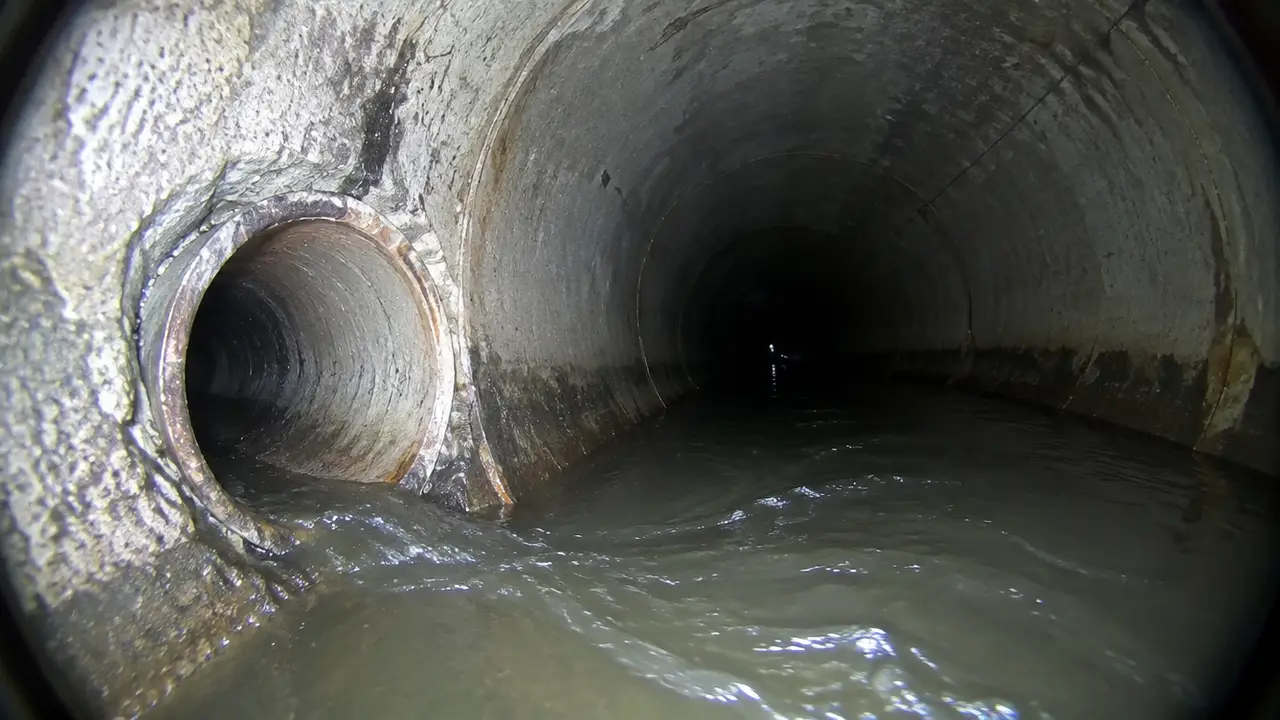
The mains under Calgary's streets span more than a century of materials. On its page about sanitary main and sewer pipe breaks, the City lists the types of pipe used in Calgary sanitary repairs by era.
| Era | Material |
|---|---|
| Pre-1915 | Brick tunnels |
| 1910–1968 | Cast iron |
| 1911–1981 | Concrete |
| 1951–1980 | Steel with concrete coating |
| 1976–present | PVC |
| 1980–present | HDPE |
The PVC start date on the City's list, 1976, matches the service-line data closely: the first sizeable batch of PVC service lines on the City's record, 422 of them, is dated 1976, and PVC overtook the tile code in 1979.
When a main does break, the City's page describes excavating through 8 to 24 feet (about 2.4 to 7.3 m) of asphalt, soil and other material to reach it, then repairing, backfilling and paving. Those depths are a useful reminder of how far below the surface the public system sits.
05 /What goes wrong in the collection system?
Most sewer trouble starts in the collection system, not at the treatment plant. The City's homeowner guide to the wastewater system says sanitary backups occur in the collection system and names the usual culprits: flushable wipes, fats, oils and grease, cotton swabs and dental floss.
The scale is significant. On its Protect Your Pipes page, the City states that every year it responds to over 8,000 sewer backups and spends approximately $3 million to repair damage caused by blockages. The same page notes that this figure does not include what homeowners pay to fix clogged pipes on their own property.
- Grease cools and sticks to pipe walls, narrowing the bore until solids catch on it. The City asks residents to scrape fats into the green cart instead.
- Wipes and hygiene products do not break down like toilet paper. The City's guidance is that only pee, poo and toilet paper belong in the toilet.
- Roots find their way into joints on older service lines, a pattern most common where the record shows clay tile or other jointed pipe.
- Age and ground movement crack, offset or sag older pipe, especially where freeze-thaw cycles and clay soils shift the ground.
The City has also said it is retrofitting some of its own wastewater pipes that are vulnerable to backups with new liners, and that some of its pipes are on a regular flushing schedule. The service-line record shows that renewal clearly; see Calgary sewer history and renewal. The City's standing inspection, lining and main replacement programs are described in how the City of Calgary maintains its sewers, and how all of it is paid for is explained in Calgary water and sewer rates.
06 /Who looks after each part?
Responsibility follows ownership. The dataset description leaves no doubt: the City owns and maintains the stretch between its main and the lot line, and the stretch between the lot line and the building is the homeowner's to own and maintain. The mains, trunks, pump stations and plants are City infrastructure.
| Part | Owner | What the City publishes |
|---|---|---|
| Plumbing inside the house | Owner | Permit records, outside the service line dataset |
| Service line, house to property line | Owner | Nothing; only a camera shows it |
| Service line, property line to main | City | Material, installed date, diameter, length and building type in open data |
| Sanitary mains and manholes | City | Sanitary Utility Section Maps, sold through City Online |
| Treatment plants | City | Effluent quality and flow data in open data |
When sewage backs up, the City's instructions are to call 311. A City crew can run a snake through the cleanout to judge whether the blockage is on private or public property. How that works, and what the City will and will not do, is covered in who owns the sewer line in Calgary. The downstream half of the journey is explained in Calgary's wastewater treatment plants.
If you want your own side assessed, a camera inspection is the starting point. You can request quotes from contractors who inspect and repair private service lines.
FAQQuestions people ask
Does Calgary have combined sewers?
The City describes its storm drains as a separate system that carries water to rivers and streams without treatment, while wastewater from homes goes to the treatment plants. Rain and groundwater can still enter sanitary pipes through defects and wrong connections.
How big is the sewer pipe from a Calgary house?
On the City side, 94.4% of recorded service lines are 100 mm, about 4 inches. Larger 150 mm and 200 mm services exist but are rare in the residential record.
How long is the City's part of my sewer line?
The City's public-side lengths average about 8.1 m. Of lines with a recorded length, 55.9% are between 5 and 10 m. Your private segment from the property line to the house is additional.
Where does Calgary's wastewater end up?
At one of three treatment plants, Bonnybrook, Fish Creek or Pine Creek. The City says treated water is released into the Bow River.
Which number handles sewer trouble in Calgary?
For a backup or a suspected problem in the City's pipes, call 311. For your private side, hire a drain or sewer contractor; the City's crews do not repair private lines.
NETWORKGo deeper across the HAUSE Sewer network
Where is my backwater valve? How to find it, recognize it and open the cover
Where is the backwater valve in a house? How to find it, what it looks like, what access box, sleeve and cover mean, how to open it safely, and valve alarms.
SewerQuotes.comSewer permits, inspections and who pays: owner or city?
Sewer line permits and who pays in Canada: the usual owner vs city split, permit and inspection costs, road cuts, city tree roots and what to confirm.
SewerJetting.caPressure vs flow: why gallons per minute does most of the cleaning
Jetter psi vs gpm explained: pressure breaks debris loose, flow carries it away and pulls the nozzle. Typical residential numbers and hose loss.