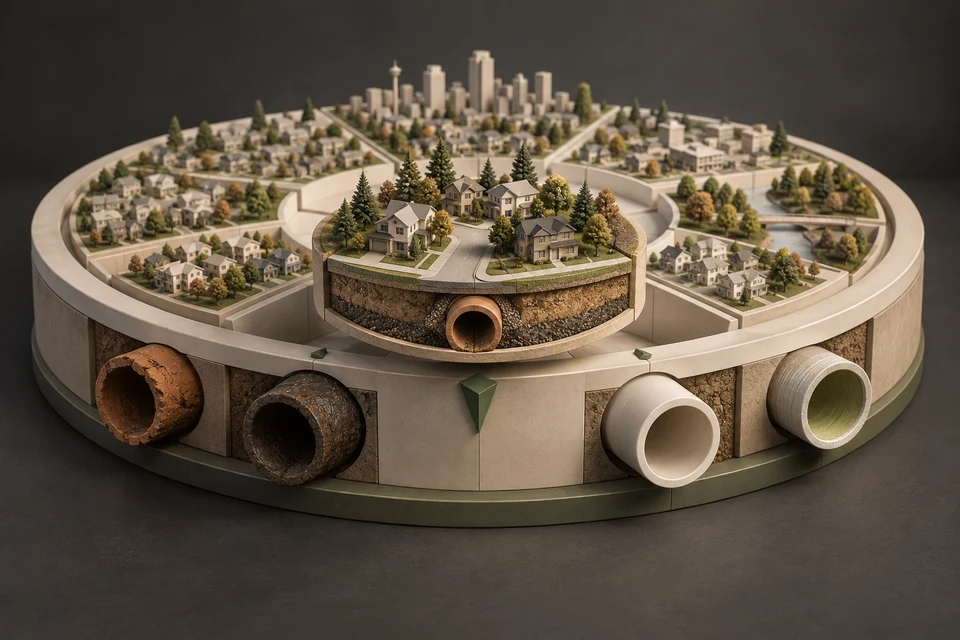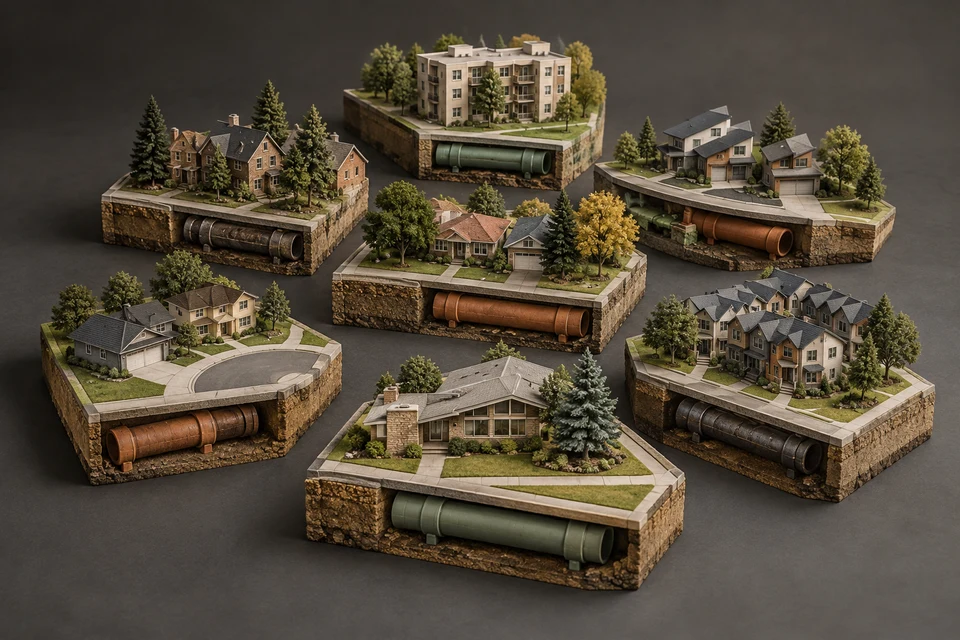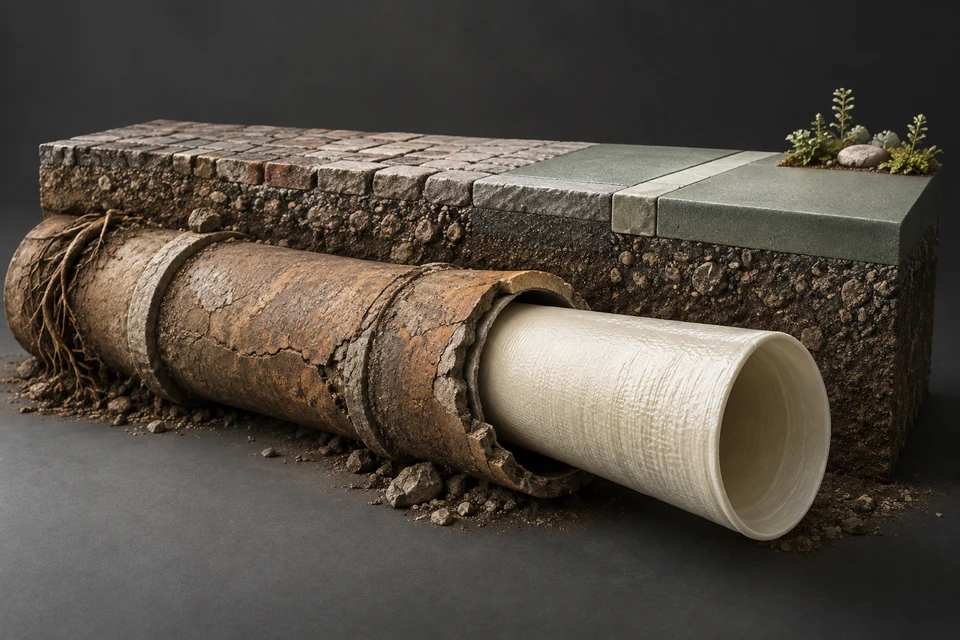
Calgary's 1950s communities have the most mixed sewer records in the city. Across the 42 communities the City classes as 1950s, City-side service lines split between the TIL tile code (23.1%), PVC (22.7%), cast iron (18.5%), TP (15.2%) and OTHER (15.2%), and 3.8% have been relined. Cast iron clusters in western, northwestern and central communities, TP in places like Wildwood and Kingsland.
- The City's 1950s structure class covers 42 communities and 46,833 City-side lines, 42.1% of them dated before 1960.
- The City's records switch abruptly in 1954 from mostly OTHER to cast iron and the unexplained TP code; the TIL tile code arrives in 1958.
- TP dominates Wildwood (73.0%), Kingsland (64.8%), Glendale (52.5%) and Highwood (51.1%); the City does not define the code.
- Cast iron leads in Rosscarrock (56.6%), St. Andrews Heights (53.1%), Spruce Cliff (46.8%), Cambrian Heights (43.7%) and Bowness (41.6%).
- At 3.8%, this class has one of the highest relined shares, just behind the Inner City class (3.9%), led by Highwood and Glendale at around 20%.
01 /What makes Calgary's 1950s communities different?
They were serviced during a decade when the City's records change character every few years. Before 1954, nearly every service line on the record is coded OTHER, a code the City does not define. In 1954, cast iron (1,108 lines) and the TP code (325 lines) suddenly appear, and OTHER drops from 1,668 lines in 1953 to 276. TP peaks at 2,224 lines in 1956. In 1958, the TIL tile code arrives with 2,991 lines. A community built in the middle of that decade can carry all four codes.
| Structure class | Communities | Lines | % TIL | % CI | % TP | % OTHER | % PVC | % CIPP | % pre-1960 |
|---|---|---|---|---|---|---|---|---|---|
| 1950s | 42 | 46,833 | 23.1 | 18.5 | 15.2 | 15.2 | 22.7 | 3.8 | 42.1 |
| Inner City | 25 | 23,906 | 0.1 | 11.7 | 1.7 | 38.7 | 41.6 | 3.9 | 41.6 |
| 1960s/1970s | 44 | 71,348 | 77.5 | 0.3 | 0.1 | 1.6 | 17.4 | 1.7 | 1.0 |
| 1980s/1990s | 31 | 70,484 | 9.1 | 0.0 | 0.0 | 0.2 | 87.6 | 0.2 | 0.0 |
02 /Where does the TP code dominate?
TP is the most tightly dated code in the dataset: 7,600 lines, almost all installed from 1954 to 1960, half of them between 1956 and 1958. The City's metadata do not define it. What the data can say is where it is concentrated.
| Community | Lines | % TP | Median year | % relined |
|---|---|---|---|---|
| Wildwood | 1,050 | 73.0 | 1956 | 6.5 |
| Kingsland | 920 | 64.8 | 1957 | 0.3 |
| Glendale | 972 | 52.5 | 1958 | 19.9 |
| Highwood | 865 | 51.1 | 1956 | 22.1 |
| Westgate | 971 | 38.1 | 1958 | 6.4 |
| Rutland Park | 375 | 36.8 | 1956 | 0.5 |
| Thorncliffe | 2,511 | 36.3 | 1962 | 5.9 |
| Cambrian Heights | 769 | 32.6 | 1957 | 1.3 |
| Bowness | 3,571 | 28.6 | 1968 | 0.1 |
| Glamorgan | 1,237 | 23.3 | 1959 | 12.5 |
Every one of these communities sits in the City's 1950s structure class. Several of them, notably Highwood, Glendale and Glamorgan, are also among the most relined communities in Calgary. The data show the overlap but not the reason for it; the City's lining work is discussed in Calgary sewer history and renewal.
03 /Which communities have the most cast iron?
Cast iron is only 3.3% of City-side lines citywide, but in a group of western, northwestern and central communities it is the leading code. Most cast iron service lines on the City's record are dated between 1954 and 1980, with a median of 1965.
| Community | Lines | % cast iron | Median year | Sector |
|---|---|---|---|---|
| Rosscarrock | 1,008 | 56.6 | 1963 | West |
| St. Andrews Heights | 409 | 53.1 | 1958 | Centre |
| Spruce Cliff | 489 | 46.8 | 1958 | West |
| Cambrian Heights | 769 | 43.7 | 1957 | Centre |
| Bowness | 3,571 | 41.6 | 1968 | Northwest |
| Montgomery | 1,638 | 34.9 | 1979 | Northwest |
| Rutland Park | 375 | 34.7 | 1956 | West |
| Forest Lawn | 1,909 | 27.6 | 1969 | East |
| Highland Park | 1,321 | 27.5 | 1958 | Centre |
| Banff Trail | 1,340 | 24.9 | 1955 | Centre |
Three names on that list, Bowness, Montgomery and Forest Lawn, were once separate towns; the City of Calgary Archives says it holds original records created by those towns before their annexation to the City. The service line data cannot say who laid which pipe, but it is a reasonable place to look if you are researching a house in one of them.
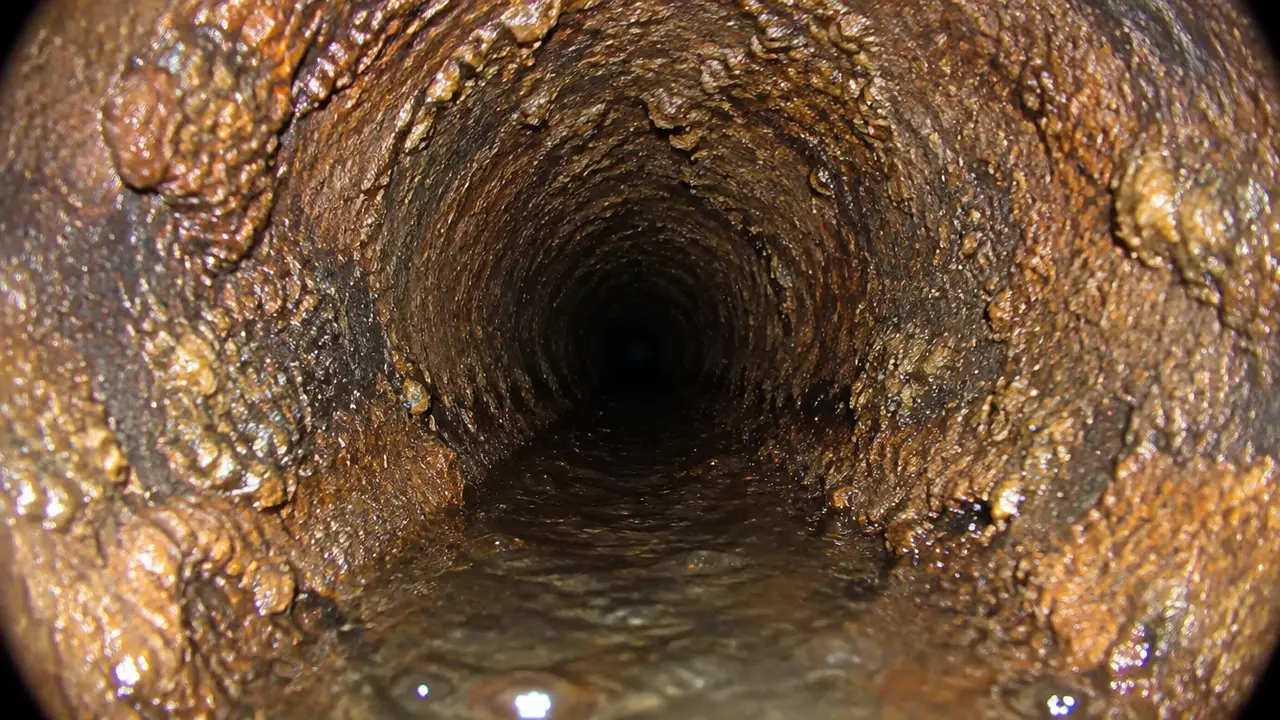
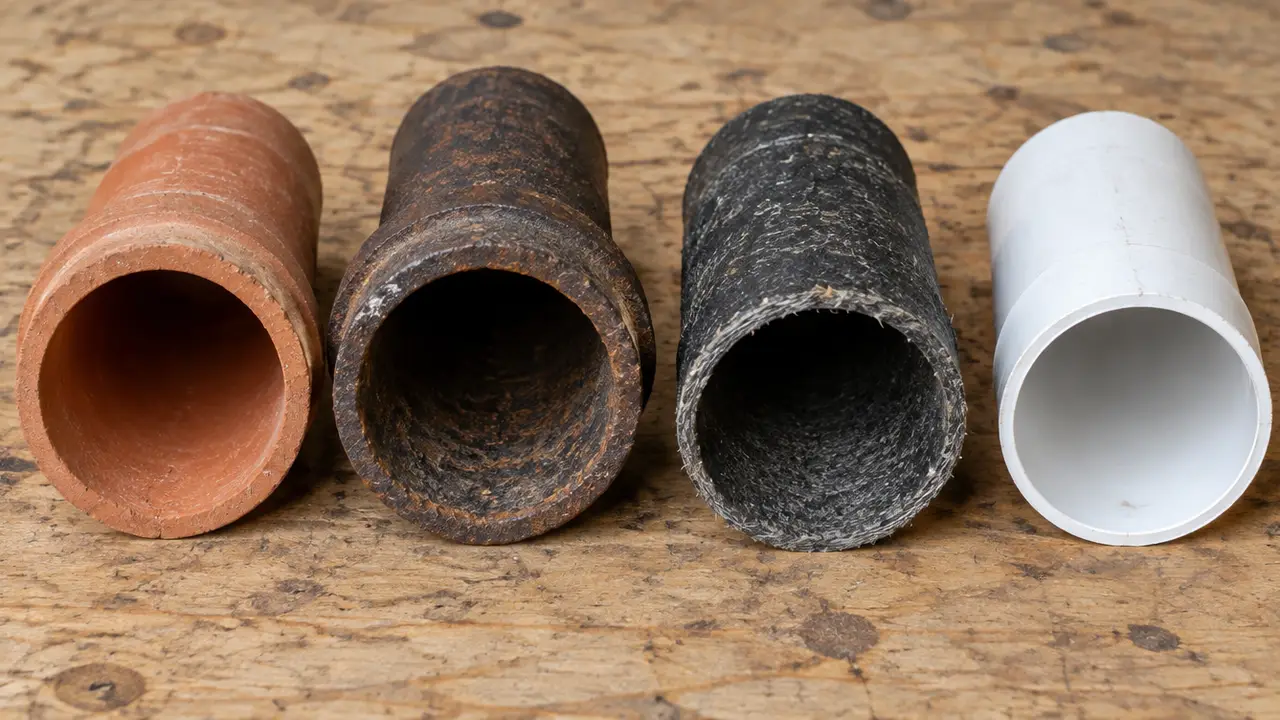
Cast iron ages from the inside. Corrosion roughens and narrows the bore with scale, and the invert, the bottom of the pipe where water runs, can thin and crack along its length. On a camera that looks very different from the joint problems typical of clay.
04 /Where did clay tile start?
Some 1950s-class communities were serviced just as the tile code arrived in 1958 and are already overwhelmingly tile on the City side: Fairview (94.5%, median 1959), Chinook Park (89.5%, 1959), Charleswood (82.2%, 1961), Haysboro (78.4%, 1958) and Collingwood (73.2%, 1959). Haysboro, with 1,526 of its 1,860 lines dated to the 1950s, is one of the first large tile communities on the record. The fuller tile story is in Calgary's clay tile belt.
05 /How mixed can a single 1950s community be?
Very. Many communities in the class were built over two decades, and each phase carries the code of its year. The table shows five that split their City-side records among three or more codes, which is why a community average says little about one street.
| Community | Lines | % TIL | % CI | % TP | % OTHER | % PVC | Median year |
|---|---|---|---|---|---|---|---|
| Ogden | 2,765 | 44.0 | 24.2 | 8.3 | 9.4 | 9.4 | 1973 |
| Thorncliffe | 2,511 | 44.7 | 5.0 | 36.3 | 2.8 | 4.9 | 1962 |
| Glenbrook | 1,716 | 29.3 | 24.5 | 2.4 | 7.3 | 31.1 | 1964 |
| North Glenmore Park | 955 | 47.9 | 21.4 | 0.7 | 2.6 | 23.5 | 1960 |
| Albert Park/Radisson Heights | 1,466 | 27.4 | 25.0 | 0.1 | 17.5 | 25.0 | 1971 |
Ogden is a good example of phasing: 670 City-side lines dated to the 1950s, 154 to the 1960s and 1,447 to the 1970s, with cast iron, TP and tile each prominent. Thorncliffe splits almost evenly between TP, from its 1950s streets, and tile, from its 1960s and 1970s streets. In both, the Service Line Lookup is the only way to know which era your address belongs to.
Some smaller communities, below the 300-line threshold used in the tables above, are almost entirely TP: Mayfair (70.5% of 156 lines) and Meadowlark Park (67.1% of 283 lines), both with medians in 1956 and 1957. Britannia, with 265 lines, is 30.2% TP and 23.8% cast iron.
06 /Is OTHER always an old code?
Usually, but not everywhere. Citywide, OTHER lines have a median installed year of 1951, and most pre-1950 records carry the code. Forest Lawn breaks the pattern. It has 904 OTHER lines, 47.4% of its City-side total, yet only 4 of its 1,909 lines are dated before 1960; 1,004 are dated to the 1960s and 577 to the 1970s. So at least 900 of Forest Lawn's OTHER records belong to the 1960s or later.
Southview shows the opposite mix: 66.2% OTHER with a median of 1961 and 41.7% of lines dated before 1960. Capitol Hill has 35.6% OTHER spread across records from the 1910s to the 1970s. The lesson is the one that applies to every unexplained code: OTHER tells you the City's record does not name the material, not how old or what the pipe is. A camera answers that, and the City invites corrections through 311 when a record is wrong.
07 /Why do some 1950s communities show recent medians?
Because redevelopment replaces service lines, and each replacement gets a new date. Several communities in the City's 1950s class have median install years decades later than the class label suggests.
| Community | Lines | Median year | % PVC | % OTHER |
|---|---|---|---|---|
| Parkdale | 766 | 2005 | 58.2 | 31.5 |
| Richmond | 1,815 | 1999 | 56.9 | 32.6 |
| Killarney/Glengarry | 2,348 | 1996 | 51.1 | 27.6 |
| Windsor Park | 721 | 1985 | 49.9 | 17.6 |
Killarney/Glengarry shows the pattern clearly: 629 lines dated to the 1950s, then 324 in the 2000s, 551 in the 2010s and 271 so far in the 2020s. Each redeveloped lot swaps an old City segment, often OTHER or cast iron, for a new PVC one. The same process shapes the inner city; see Calgary inner-city sewers.
08 /What should owners of 1950s homes do?
Assume the private line is at least as old as the house unless a record says otherwise, and find out what it is. A 1950s house may have cast iron under the basement floor, a different material outside, and a City segment of yet another type.
- Read your City record
Use the Service Line Lookup. CI, TP, OTHER or TIL on the City side all lead to the same advice: camera-inspect your side.
- Ask for material changes on the video
Have the camera operator call out every material change and its distance. A 1950s line can change material two or three times between the stack and the main.
- Locate the property line on the video
Match the public-side length from the City record to the footage counter so any defect can be placed on the right side of the ownership split.
- Keep the video
It is the baseline for later comparisons and useful evidence for insurers, buyers and 311.
When you are ready to have your side inspected or repaired, request quotes. The Community Sewer Atlas shows how your community compares with its 1950s neighbours.
FAQQuestions people ask
What sewer pipe do 1950s Calgary houses have?
On the City side, 1950s communities mix the TIL tile code, cast iron, the unexplained TP code, OTHER and PVC replacements. The private side is not recorded; a camera inspection shows what is there.
What is TP in Calgary's sewer data?
The City does not define TP in its metadata. It appears on 7,600 City-side lines, almost all installed from 1954 to 1960, and dominates Wildwood, Kingsland, Glendale and Highwood.
Which Calgary communities have cast iron sewer lines?
On the City side, Rosscarrock, St. Andrews Heights, Spruce Cliff, Cambrian Heights and Bowness have the highest cast iron shares, each above 40%.
Why are so many 1950s Calgary communities relined?
The City's 1950s class has 3.8% of City-side lines coded CIPP, close to the Inner City class (3.9%) and well above newer classes, led by Highwood (22.1%) and Glendale (19.9%). The data show where relining happened, not why.
Does a relined City side mean my 1950s sewer is fine?
No. Relining the City segment does not touch your private pipe, which may still be original. A camera inspection of your side is the only way to know.
NETWORKGo deeper across the HAUSE Sewer network
How to prevent sewer backup in your basement: a layered plan
How to prevent sewer backup in a basement: keep your lateral clear, maintain a backwater valve, disconnect downspouts, manage weeping tile, plan for storms.
SewerJetting.caIs hydro jetting safe for old pipes?
Is hydro jetting safe for old pipes? How jetting affects vitrified clay, cast iron, Orangeburg, concrete and plastic, and why camera-first matters.
SewerInspector.caSewer inspection points and cleanouts: how to find, use or move one
What a sewer inspection point, chamber or cleanout is, how to find yours in a Canadian house, whether you can move or add one, and scoping through a toilet.