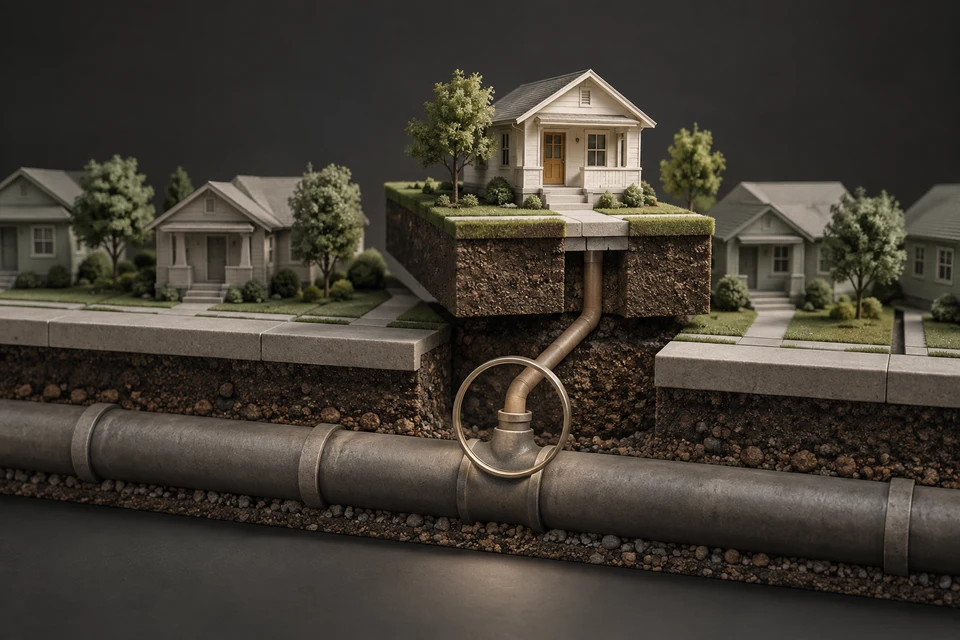
Type an address and this tool asks the City of Calgary's open data service, directly from your browser, for the matching sanitary service line record. Enter a house number and street name and it returns the City's record for the public part of your sewer connection: material code and meaning, installed year, diameter, public-side length and building type, plus citywide context and a plain next step. It covers the City-owned portion only.
- The lookup reads the City's own open data live (dataset xesp-3jc3); this site does not store the address you enter.
- Every result describes only the City-owned pipe between the sanitary main and your property line; the private pipe on your side can be a different material and age.
- Clay tile, cast iron, TP and OTHER records trigger advice to camera-inspect your private side; CIPP means the City side has been relined; PVC means the City side is modern.
- No result usually means a spelling or quadrant mismatch, or a large commercial or multi-family service that the dataset does not include.
- If the record looks wrong, the City asks residents to report errors through 311.
Calgary Service Line Lookup
01 /What does the Calgary Service Line Lookup do?
The lookup finds the City of Calgary's record for the sanitary service line that serves one address. It sends a query from your browser to the City's open data portal (data.calgary.ca, dataset xesp-3jc3, *Public Sanitary Service Lines*) and shows what comes back. The dataset is maintained by the City's Water Services business unit, which lists its update frequency as monthly. The 367,397-record reference total belongs to this site's September 24, 2026 atlas snapshot, not a count of the live response.
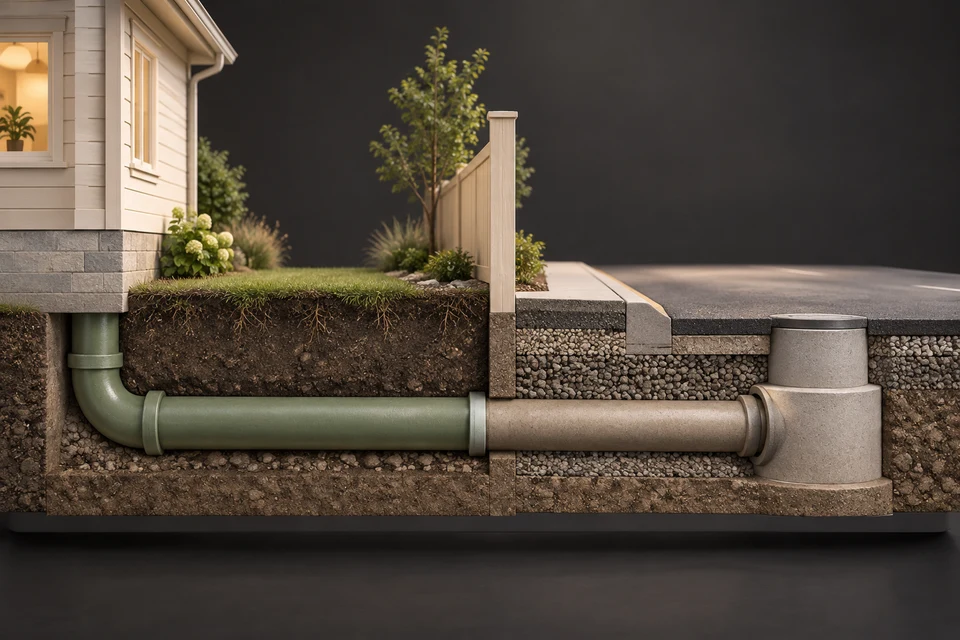
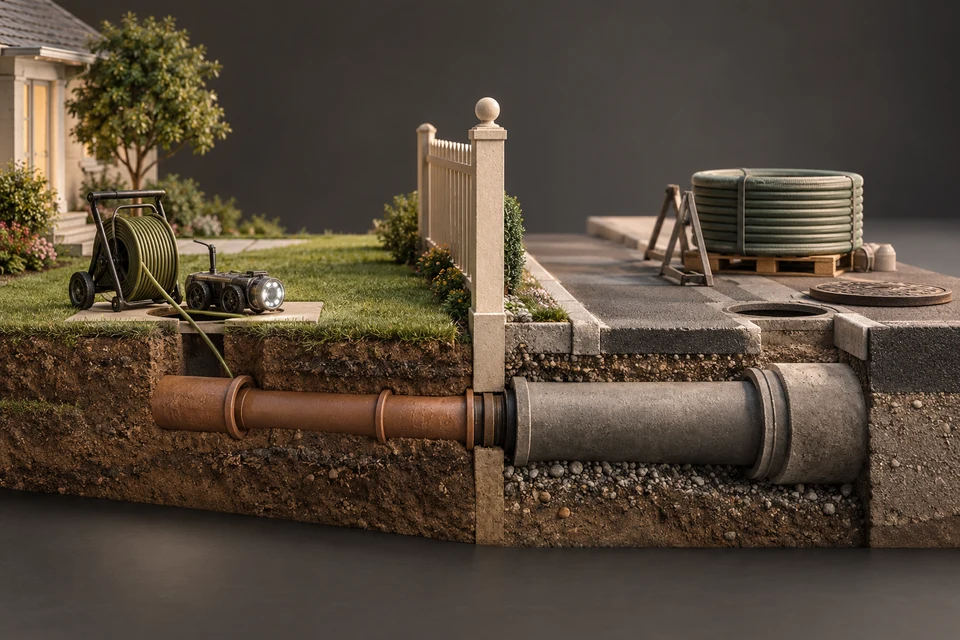
A sanitary service line is the pipe that carries wastewater from a house to the sewer main in the street or lane. The City's dataset description splits it into two parts, and this split drives everything the tool shows. In the City's published words: from the sanitary main to the property line, “this part of the pipe is owned and maintained by The City of Calgary”; from the property line to your house, “this part of the pipe is owned and maintained by the homeowner.” The dataset records only the first part.
Nothing about your search is kept by this site. The query goes straight to the City's public service, the result is drawn on the page, and closing the tab discards it. You do not need an account, and the tool does not ask for your name or contact details.
02 /How do you enter an address so the City's data recognises it?
Type the house number in the first box and the street name, street type and quadrant in the second. For example, enter “60” and “Crestbrook View SW”. The tool normalizes common street types and the quadrant into the abbreviations the City uses in its records before it sends the query.
| You type | Sent to the City's data as | Why it matters |
|---|---|---|
| Crestbrook View SW | CRESTBROOK VW SW | The City stores street names in capitals with abbreviated street types |
| Street | ST | Street type abbreviation |
| Avenue | AV | The City's records use AV rather than AVE |
| View | VW | Suburban crescent-style names use many short types |
| SW, NW, NE, SE | Kept as the quadrant suffix | The same street name can exist in more than one quadrant |
Other common street types are shortened the same way. The quadrant matters more than people expect: Calgary reuses street names across quadrants, so “1 Street” exists in several of them and the quadrant is the only thing that tells the records apart. If you are unsure of your quadrant, it appears on your property tax notice and on most mail addressed to the house.
03 /What does a result show?
A successful search returns the public-side record for that address. Each field comes directly from the City's dataset; the tool adds a plain-language reading of the material code.
| Field | What it means | Source column in the City's data |
|---|---|---|
| Material code and plain meaning | What the City has recorded for the public part of the pipe, such as PVC, CI (cast iron) or CIPP (cured-in-place liner) | MATERIAL_TYPE |
| Installed year | The year on the City's record; for CIPP it is usually the year the pipe was relined | INSTALLED_DATE |
| Diameter (mm) | The recorded pipe size; 100 mm (4 in) is by far the most common | PIPE_DIAMETER |
| Public-side length (m) | The length of the City-owned segment, from the main to the property line | PIPE_LENGTH |
| Building type | Single family, duplex, triplex or commercial, as the City classifies the service | BLDG_TYPE |
Below the record the tool adds context from the citywide atlas that this site built from the same dataset: how common that material is across the September 24, 2026 snapshot's 367,397 lines and the era in which it typically appears. The reference figures below are the ones behind that context. A fresh address record and these dated contextual figures have different update dates.
| Code | Share of all lines | Typical era on the record | Reading |
|---|---|---|---|
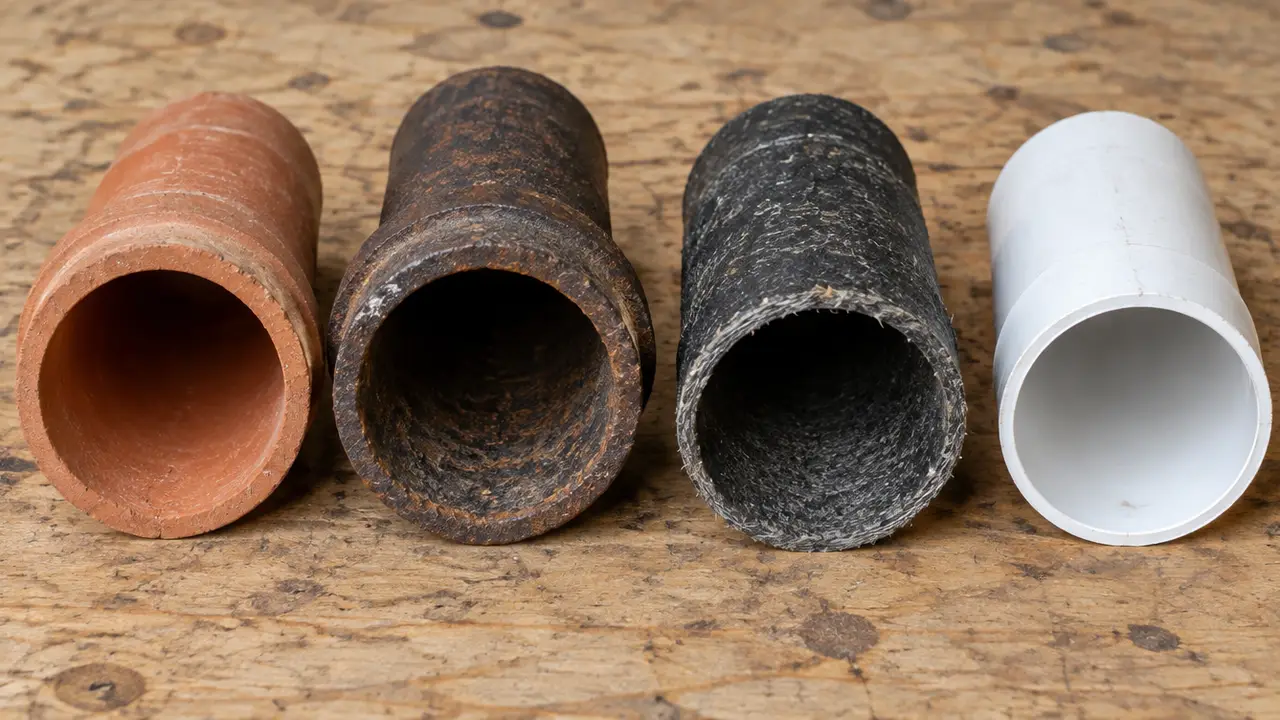
| PVC | 66.5% | From 1976; median 2003 | Modern plastic sewer pipe |
| TIL | 20.2% | 1958 to 1981; median 1972 | The City's TIL (tile) code, generally clay tile |
| OTHER | 5.0% | Mostly before 1960; median 1951 | Not defined in the City's metadata |
| CI | 3.3% | Mostly 1954 to 1981; median 1965 | Cast iron |
| TP | 2.1% | Almost entirely 1954 to 1960 | Not defined in the City's metadata |
| CIPP | 1.1% | Mostly relined 2017 to 2025 | Cured-in-place liner inside an older pipe |
| No material recorded | 1.6% | Clustered in the late 1990s | The City's record is blank for material |
04 /How does the tool decide what to tell you?
The advice line follows three fixed rules keyed to the material code. The rules are deliberately short, because the City's record cannot tell anyone the condition of a pipe, only what it was made of and when it went in.
| City-side code | What the tool says | Why |
|---|---|---|
| TIL (clay tile), CI (cast iron), TP or OTHER | A camera inspection of your private side is advised | These codes belong to older installs; the private pipe built at the same time is often the same era, and joints or corrosion are the usual weak points |
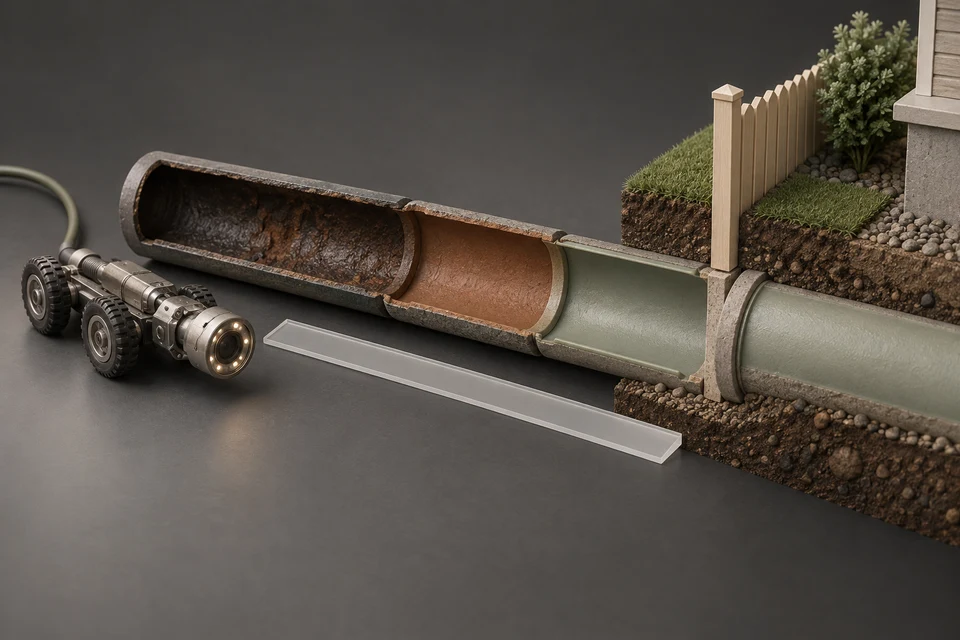
| CIPP | The City side has been relined | A cured-in-place liner now forms a new pipe inside the old one on the public segment |
| PVC | The City side is modern; your private side may still be original | The City may have renewed its segment, or the house may be newer; only a camera shows what is on your side |
Two cautions apply to every result. First, the rule reads the City-side code only; it has no information about your side of the property line. Second, a PVC City side on an older house is common after redevelopment, repairs or City work, and it says nothing reliable about the pipe under your yard or basement floor.
05 /Why might the lookup return no result?
When nothing matches, the tool suggests checking the spelling and the quadrant. Those two cause most misses. It also explains that large commercial and multi-family services are not in the City's data, so an apartment building, a large condominium complex or a commercial property may simply not appear.
- Street type or spelling: try the full word (Avenue, Crescent, Close) and let the tool abbreviate it, or check how the street is written on a City notice.
- Quadrant: confirm SW, NW, NE or SE; the same street name often exists in two quadrants.
- House number: use the civic number of the building, not a suite or unit number.
- Building type: large commercial and multi-family service lines are excluded from the dataset by design.
- Brand-new lots: a recently serviced lot may not appear until the City's monthly refresh adds it.
If you are confident the address is right and it is a house, duplex or triplex, the gap may be in the record itself. The City's dataset description invites anyone who believes the pipe material shown is wrong or missing to contact 311, and the same route applies to a missing record.
06 /What are the limits of the City's record?
The record is a City asset inventory, not an inspection. It is useful for knowing what the City installed or renewed and roughly when; it is not evidence of condition, grade, roots or blockages. Treat each field with the right level of confidence.
- Material codes: PVC, CI, CIPP, HDPE, PEX, PE, DI and CON are standard abbreviations. TIL, TP, PLA and OTHER are not defined in the City's metadata. TIL is generally read as clay tile; this site does not guess what TP means.
- Dates: the installed date is the date on the City's record. Pre-1950 lines are mostly coded OTHER, and a CIPP date is usually the relining year rather than the original install year.
- Length: the public-side length averages about 8 m citywide. Your private side, from the property line to the house, is a separate length the City does not record.
- Changes: the City notes that its data changes with parcel redevelopment and City repair or maintenance activities.
- Depth: the dataset has no depth field. A locate during a camera inspection is the practical way to estimate depth on your property.
For a full walk through every field and code, see how to read Calgary's service line records. For what the City and the homeowner each own and maintain, see who owns the sewer line in Calgary.
07 /What should you do with the result?
- Note the City-side code and year
Write down the material, the installed year and the public-side length. They help any contractor read your camera video, because a material change on the video often lines up with the property line.
- Compare with your community
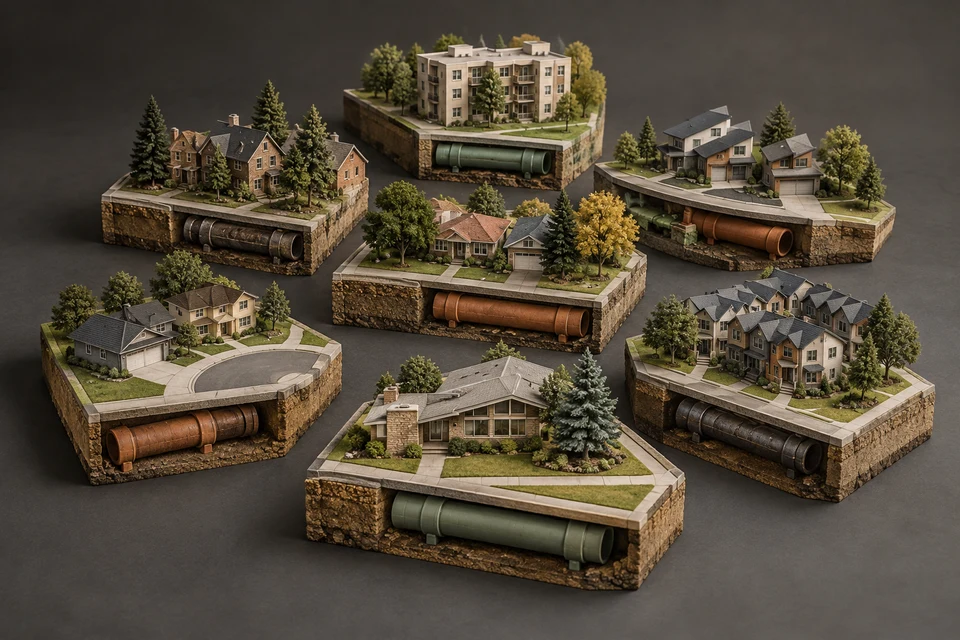
Open the Community Sewer Atlas to see whether your record is typical for your community or an outlier, for example a PVC record in a community that is 90% clay tile.
- Inspect the private side if the code is older
For TIL, CI, TP or OTHER results, a camera inspection of your own side is the next step. It shows the material on your side, its joints and any roots, sags or cracks, with distances from the access point.
- Report errors or City-side defects through 311
If the record is wrong, or a camera shows a problem at or beyond the property line, contact 311 with the address, the video and the distances.
- Get options if your side needs work
When a camera shows defects on your side, request quotes from contractors who can scope and price the work.
Cost questions follow naturally from the record. The Calgary sewer line costs page explains planning ranges by era, side of the property line and length.
FAQQuestions people ask
Does the lookup show my private sewer line?
No. The City's dataset covers only the City-owned segment from the sanitary main to the property line. Whatever runs under your yard and basement is outside the record; a camera inspection is how you find out what it is.
Is my address saved when I use the lookup?
No. The query runs from your browser to the City's open data service and the result is drawn on the page. This site does not store the address or the result.
What does TIL mean in the City's sewer record?
TIL is the City's tile code. It is not defined in the City's metadata but is generally read as clay tile (vitrified clay). It is the most common code on lines installed from 1958 to about 1980.
Why does my 1960s house show a PVC City side?
The City side may have been replaced during redevelopment, a repair or City work, or the record may reflect a later connection. The private side can still be original, so a camera inspection is the way to know.
My address returns nothing. Is something wrong?
Check the spelling, street type and quadrant first. Large commercial and multi-family services are not in the dataset. If a house address is missing, the City asks people to report record errors or omissions through 311.
How current is the data?
The City lists the dataset's update frequency as monthly. The atlas context in this tool uses a snapshot fetched on 2026-09-24, when the rows had last been updated on 2026-09-01.
NETWORKGo deeper across the HAUSE Sewer network
CCTV sewer inspection: crawlers, lateral launch cameras and coded surveys
What CCTV sewer inspection is: crawler cameras, lateral launch and zoom cameras, PACP-coded municipal surveys, and what city camera work means for your lateral.
PipeCleaning.caWhat pipe do I have? Identify your drain pipe material
What pipe do I have? Identify a drain pipe from its look, joints, markings and house age, with a confidence rating, safe cleaning methods and camera advice.
SewerRoots.caPlanting Distance Checker
Planting Distance Checker: pick a tree, shrub or perennial group, enter its distance from the sewer lateral, and see if the spot meets the guideline.