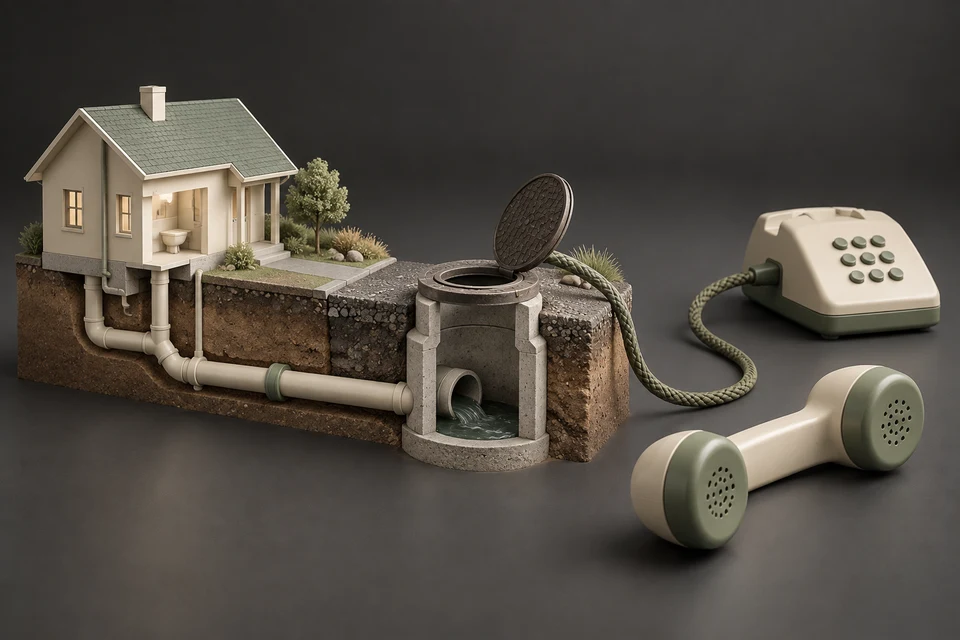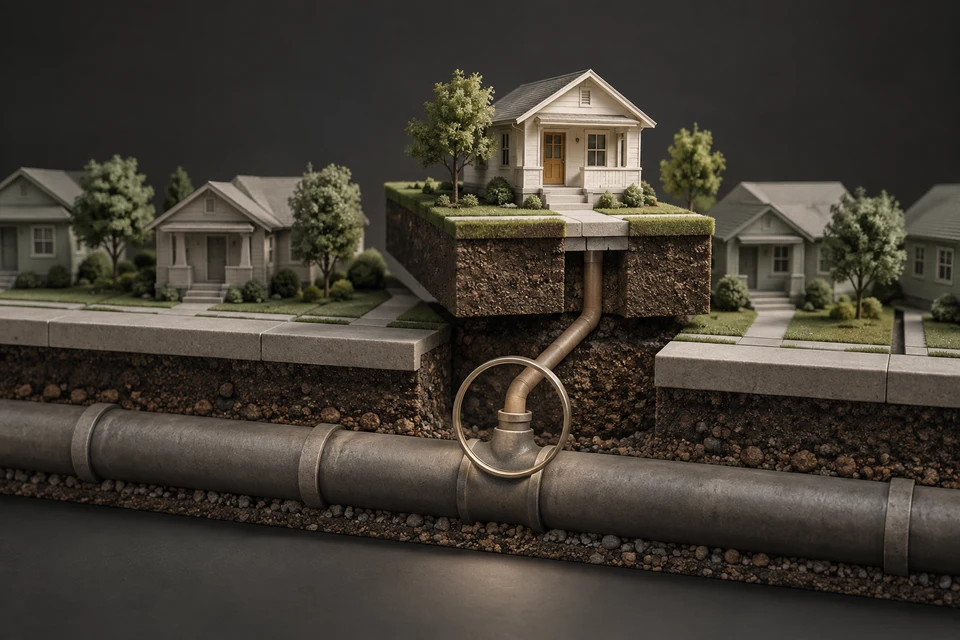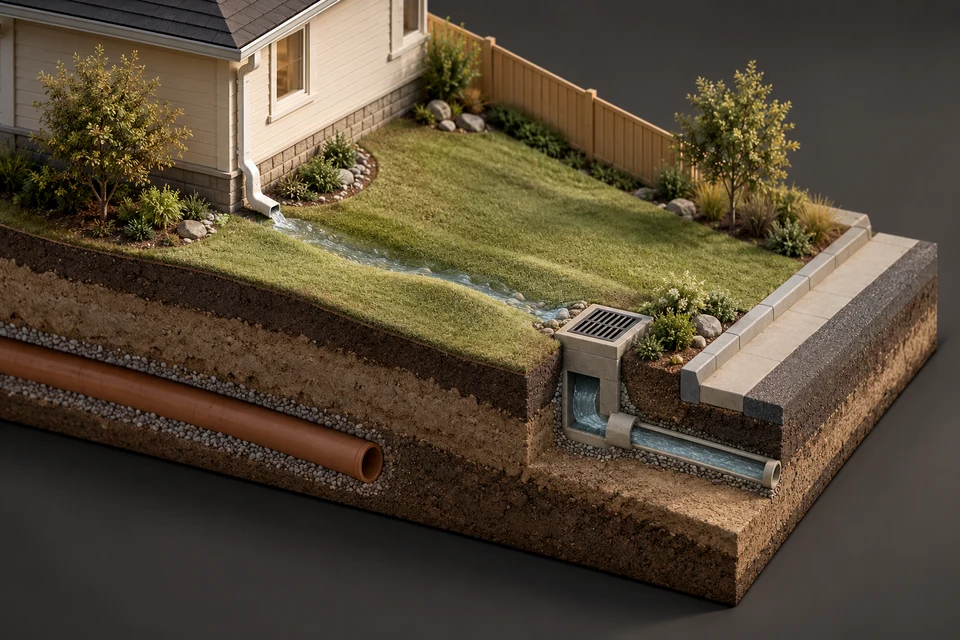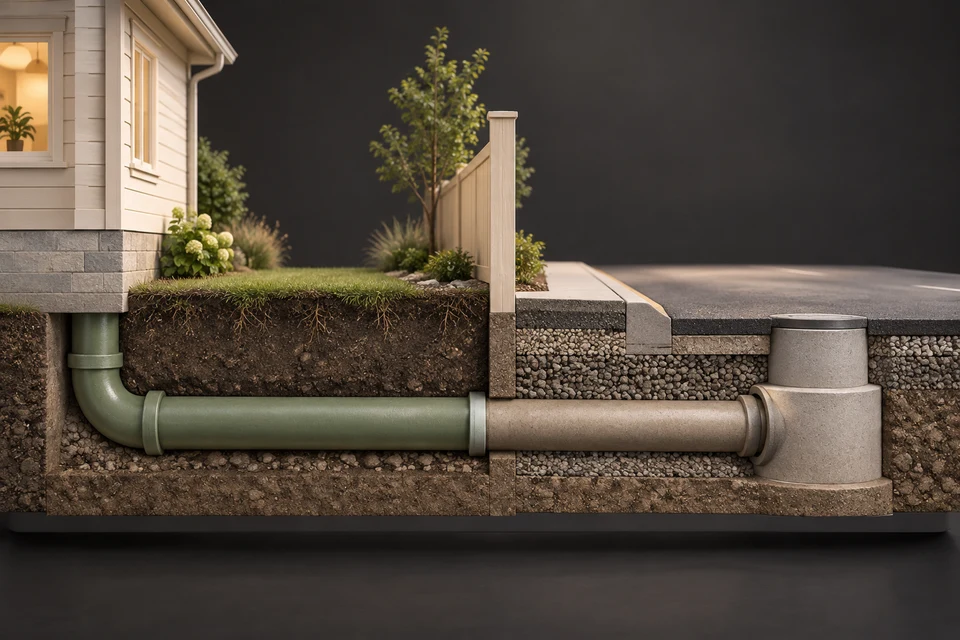
Calgary splits each sewer service line at the property line. The text the City publishes with its sanitary service line data puts the pipe between the sanitary main and the property line in the City's hands to own and maintain, and the pipe between the property line and the house in the homeowner's. For a specific backup or defect, call 311; the City assesses each case and makes the final determination.
- The City describes the sanitary service pipe as two sections: City-owned from the main to the property line, owner-owned from the property line to the house.
- The property line is usually not at the curb; part of the grass in front of many Calgary homes is City boulevard.
- After a backup, a City crew can run a snake from your cleanout to judge whether the blockage is on private or public property.
- City crews will not move furniture, lift carpet, pull toilets or open drywall to reach a cleanout; exposing it is the homeowner's job.
- Connections on the private side must be installed by City-approved, indemnified contractors and inspected by the City.
01 /What does the City of Calgary say about sewer line ownership?
The clearest statement is in the City's own description of its *Public Sanitary Service Lines* dataset. It says a sanitary service pipe, also called a sanitary service line, is the way wastewater leaves each home in Calgary, and that it can be thought of as two sections. For the first, from the sanitary main to the property line, the City writes that “this part of the pipe is owned and maintained by The City of Calgary.” For the second, from the property line to your house, it writes that “this part of the pipe is owned and maintained by the homeowner.”
Street side of the property line: the City's pipe to own and maintain. House side: yours.
The same text limits the data to pipe on public property, warns that the private pipe may be another material from another year, and directs anyone who spots a wrong or missing material to 311. The same two-part split appears on the City's page about installing water and sewer connections, which says builders or homeowners are responsible for providing the connections from the property line to the building's plumbing.
02 /Where exactly is the property line?
Usually further back than the curb. In many Calgary streets the City's right-of-way includes the boulevard strip and the sidewalk, so the lot line sits a few metres inside what looks like your front lawn. On a lane-serviced lot, the sewer may run out the back to a main in the lane instead.
- Real property report: an Alberta real property report, prepared by a land surveyor, shows the lot boundaries and is often in the paperwork from a purchase.
- City records: the public-side length in the City's service line data tells you how long the City's segment is. Citywide it averages about 8.1 m, and 55.9% of recorded lengths fall between 5 and 10 m.
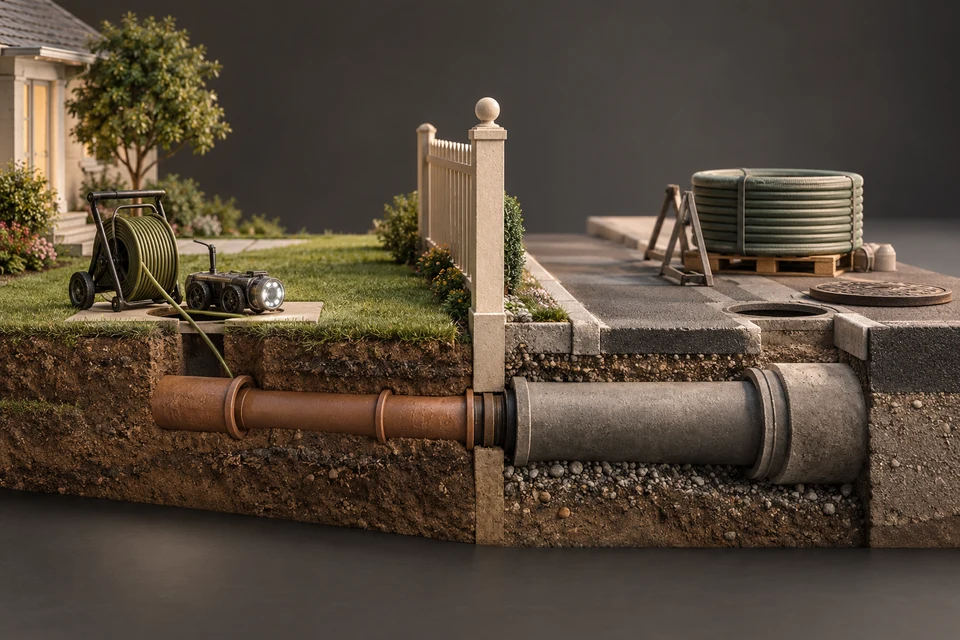
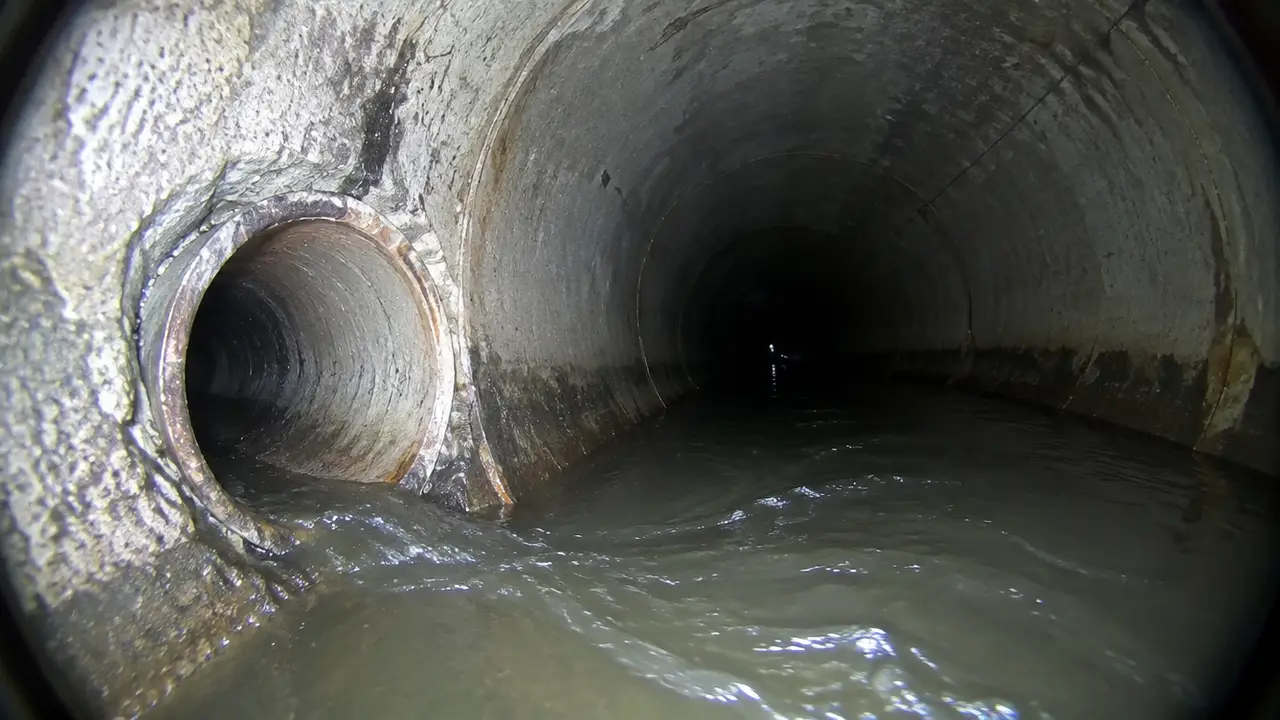
- Camera footage: a change of pipe material on a camera video often marks where City and private pipe meet, although not always exactly at the line.
One wrinkle is how new subdivisions are serviced. An earlier (2014) edition of the City's Design Guidelines for Subdivision Servicing required developers to extend residential service connections 3.5 m or 5 m into each lot, depending on the utility easement. The pipe a developer laid can therefore continue past the property line, but the City's published ownership split still falls at the property line. Check the current edition of the guidelines, and 311, for how that applies to your lot.
03 /What does the City do when you report a backup?
The City's sewage backup page sets out a short sequence: stay safe, call 311, then call your insurer. The 311 agent helps determine whether you need a plumber for an internal issue or a City inspection.
- Protect yourself
The City says not to enter the affected area without protective gear such as rubber gloves, boots and a mask.
- Call 311
Describe what is backing up and where. From outside Calgary the City's line is 403-268-CITY (2489).
- Find and clear the cleanout
The cleanout is usually in the basement or lowest level near the main water shut-off. The City asks for a clear path of about two metres (six feet) around it.
- Crew check
The crew feeds a steel snake in at the cleanout to learn whether the obstruction lies on your side of the property line or the City's.
- Private result
If the blockage is on private property, the City's guidance is to call a plumber.
04 /Who pays when the problem is near the property line?
Payment follows the ownership split, but the location of a defect is not always obvious. A root mass three metres past your foundation is plainly on your side. A break two metres from the main is plainly on the City's. A defect near the property line needs evidence.
| Evidence | Why it helps |
|---|---|
| Camera video with a running footage counter | Shows the defect and its distance from a known access point |
| The access point used and where the counter was zeroed | Lets the City convert distance along the pipe into a location |
| A locate mark or sonde reading at the defect | Places the defect on the ground relative to the property line |
| Your City-side record from the lookup | Shows the City's recorded material and length for its segment |
| Date, time and 311 reference number | Keeps later calls tied to the same case |
The City makes the final determination on its own pipe. It is also reasonable to ask the 311 agent whether an inspection has been scheduled, what was found and whether any City work is planned for your street. Keep notes; the contractor quoting your side needs to know where the City's responsibility ends.
For the whole picture of the service-line record, see how to read Calgary's service line records, and to see your address, use the Service Line Lookup.
05 /Who can work on the private side, and who inspects it?
Not every contractor. The City's page on installing water and sewer connections says that only approved, indemnified contractors may install service connections, and that it keeps a list of pre-qualified contractors under its Utility Master Indemnification Agreement. The property owner must ensure connections comply with applicable bylaws and pays for installation by their contractor.
- Standards: connections must meet the City's standard specifications for sewer construction and water services, among other requirements.
- Bylaws: the City lists the water utility, drainage, wastewater and lot grading bylaws as applicable.
- Inspection: the City inspects installations for compliance with specifications and approved plans.
- Plumbing permits: the City says a plumbing permit is required to install a backflow prevention device such as a backwater valve.
Ask any contractor quoting sewer work whether they are on the City's approved list for connection work, whether their quote includes the permit and inspection, and how they will handle the property-line boundary if the camera finds problems on both sides.
06 /Does the City ever renew its side without being asked?
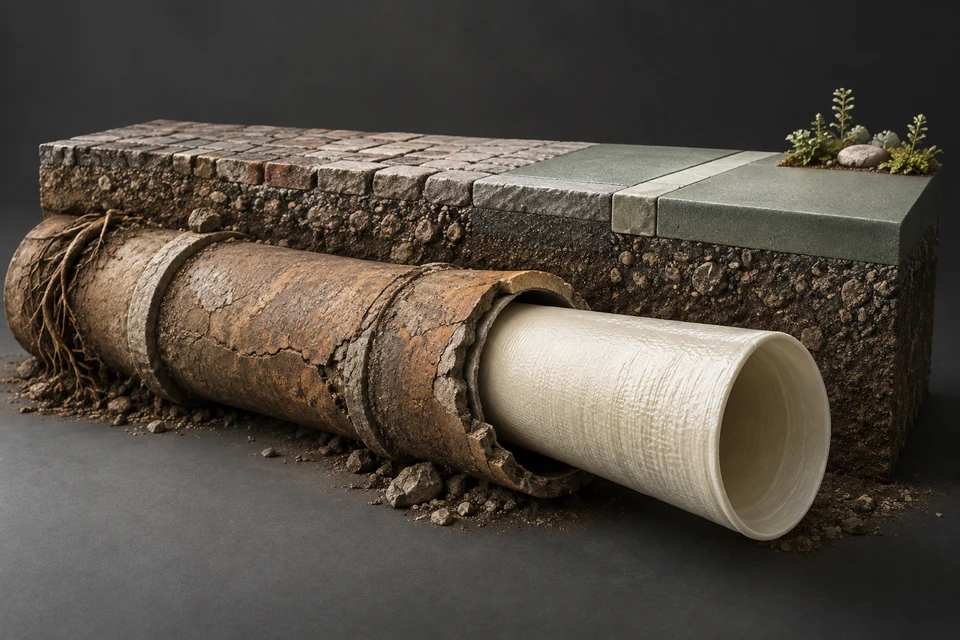
Yes. The City's service line data show thousands of City-side segments relined in recent years, and the City runs a Sanitary Lateral Lining Program, which it describes as a pilot that installs liners inside existing sanitary service pipes using trenchless technology, administered by LiquiForce, an Ontario company. The City says aging sewer infrastructure in older communities is vulnerable to root intrusion, backups and costly repairs.
If your street is part of the program, the City says the contractor will notify you in person 30 minutes before any time you need to stop using water, and that the sewer connection will be out of service for about three hours. The program page does not say whether private portions are included, so ask 311 or the crew rather than assuming your side is covered.
Relining the City's segment does nothing for a private segment in poor condition. The City's wider inspection, lining and replacement work is described in how the City of Calgary maintains its sewers. The trend is covered in Calgary sewer history and renewal, and planning ranges for owner-side work are on the Calgary sewer line costs page. When you are ready for prices on your side, request quotes.
FAQQuestions people ask
Is the sewer line under the boulevard mine or the City's?
Usually the City's: its split puts everything between the sanitary main and the property line on the municipal side. Much of the boulevard is City right-of-way, so the pipe under it is usually on the City side. Confirm your property line with a real property report or 311.
Does the City pay to clear a blocked sewer line in Calgary?
When a City crew finds the blockage on public property, it is the City's pipe to deal with. When the blockage is on private property, the City's guidance is to call a plumber, and the homeowner pays.
Who owns the sewer line in a Calgary condo or apartment?
The City's service line dataset excludes large multi-family services, and private piping on a condominium parcel is usually common property managed by the corporation. Ask the property manager and 311 for your building.
What if the City's record for my line is wrong?
The City's dataset description asks anyone who believes the recorded pipe material is wrong or missing to contact 311. Give the address and, if you have it, camera footage showing the actual material.
Does the City's lateral lining program line my side too?
The City's program page describes lining sanitary service pipes but does not say whether private portions are included. Ask 311 or the crew for your address before assuming anything.
NETWORKGo deeper across the HAUSE Sewer network
Sewer inspection points and cleanouts: how to find, use or move one
What a sewer inspection point, chamber or cleanout is, how to find yours in a Canadian house, whether you can move or add one, and scoping through a toilet.
SewerRoots.caWhose tree, whose pipe: who pays when roots block a sewer line
Who is responsible when a city or neighbour's tree sends roots into your sewer line: the general Canadian pattern, the evidence, and how to raise it.
SewerQuotes.comSewer permits, inspections and who pays: owner or city?
Sewer line permits and who pays in Canada: the usual owner vs city split, permit and inspection costs, road cuts, city tree roots and what to confirm.