As checked September 2026, a metered Calgary home pays three City utility charges. Water is $1.7409 per cubic metre plus $13.83 per 30 days. Wastewater is $1.9050 per cubic metre, billed on 88% of the water you use, plus $23.45. Stormwater is a flat $17.00. The City's typical 19 m³ household bill is $119.21 a month.
- The City's 2026 typical metered residential bill is $119.21 per month at 19 m³ of water, up from $114.89 in 2025.
- Wastewater is the largest line on a typical bill: about $55.30 of the $119.21, or roughly 46%.
- Residential wastewater volume is 88% of metered water use, because some water goes on lawns and never reaches a sewer.
- About $54.28 of every metered monthly bill is fixed service charges that do not change with how much water you use.
- The water utility is funded entirely by rates and charges; the City states that property taxes do not support it.
01 /What does a Calgary water and sewer bill charge for?
It charges for three separate City services, each with its own rate. The City's guide to reading the bill groups them as water treatment and supply, wastewater collection and treatment, and stormwater management. The first two have a usage charge and a fixed charge; the third is fixed only. Billing, meter reading and customer care are handled for the City by a contracted provider, but the rates themselves are set by the City.
| Bill line | How it is charged | What the City says it funds |
|---|---|---|
| Water treatment and supply | Per cubic metre from your meter, plus a fixed service charge | Treating and delivering drinking water; the fixed part covers meter reading, billing, meter repairs and fire protection |
| Wastewater collection and treatment | Per cubic metre on a share of your water use, plus a fixed service charge | Collecting what leaves toilets, sinks and tubs, treating it and returning it to the river; the fixed part covers infrastructure and billing |
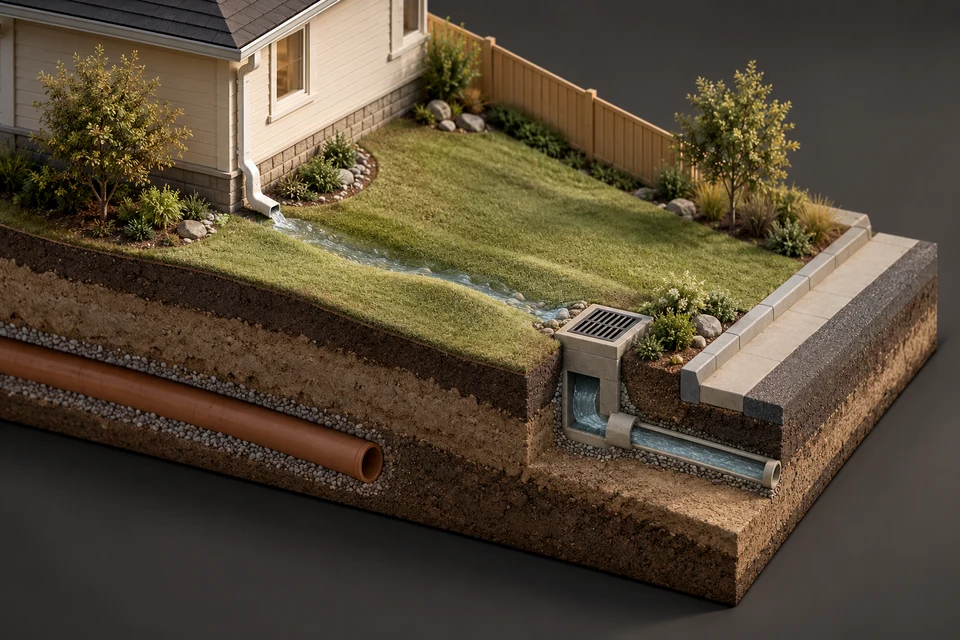
| Stormwater management | Fixed charge only | Street drainage, flood protection and river health |
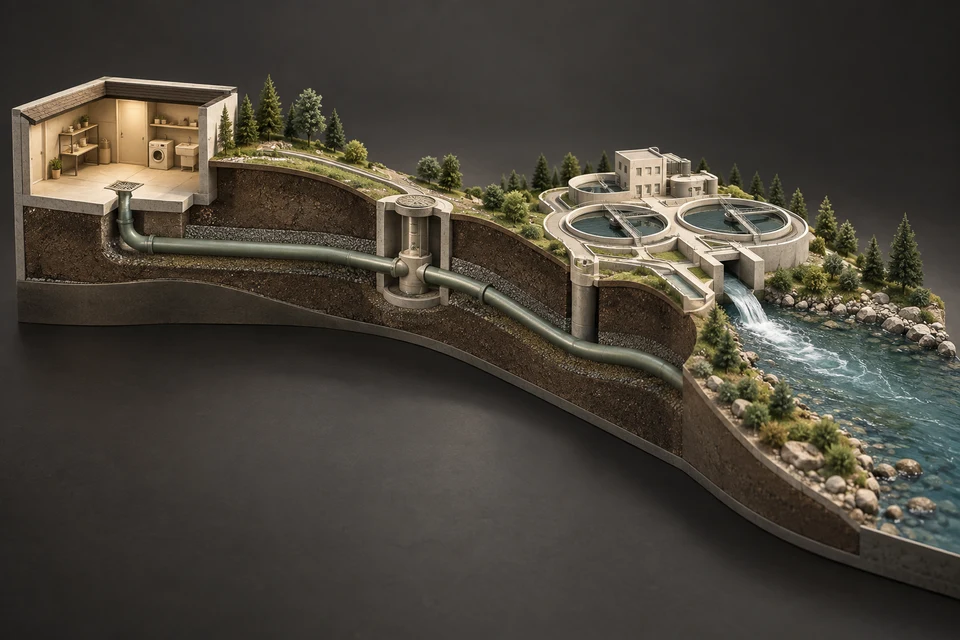
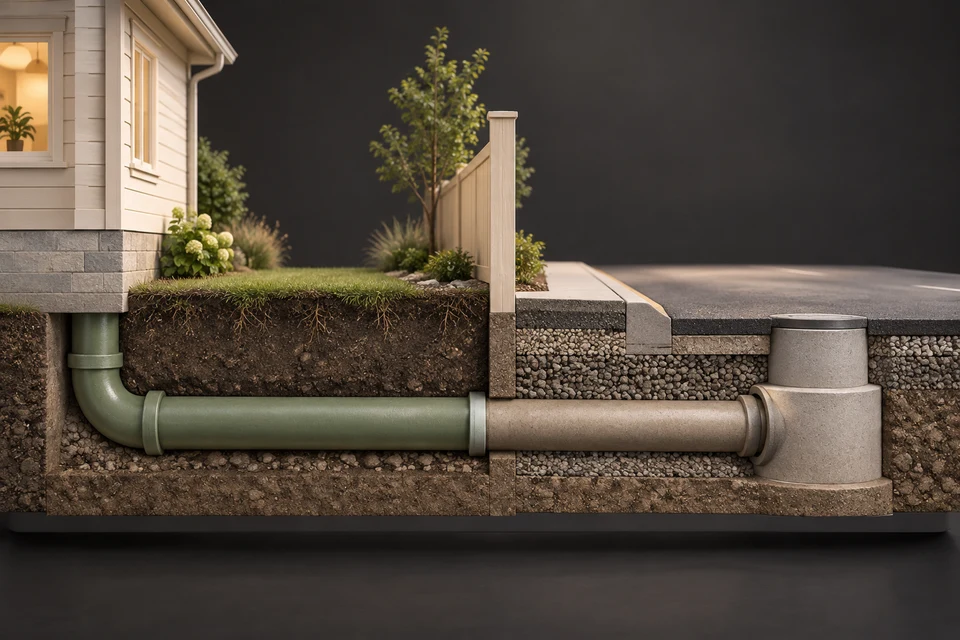
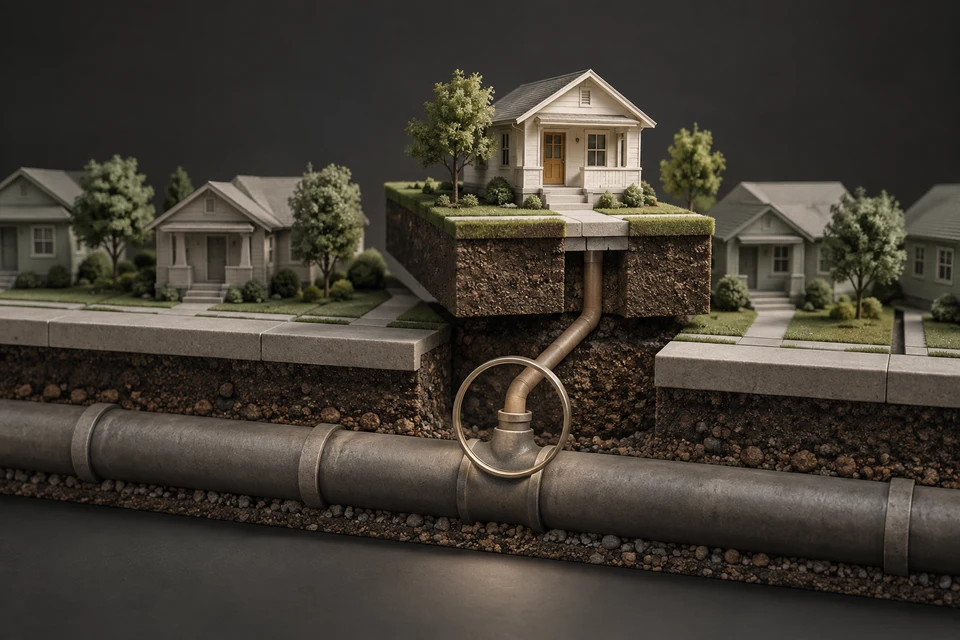
One point surprises many owners. None of these charges pays for the sewer pipe between your house and your property line. The City's service line dataset describes that segment as the homeowner's to own and maintain, while the City looks after the pipe from the property line out to the main. The wastewater charge funds everything downstream of that boundary: mains, manholes, lift stations, trunk sewers and the three treatment plants.
02 /What are Calgary's 2026 residential water and sewer rates?
The City's residential rates page lists the following metered rates, and the City changes them each January. Figures are quoted exactly as the City publishes them, as checked September 2026.
| Charge | 2025 | 2026 |
|---|---|---|
| Water usage, per m³ | $1.5972 | $1.7409 |
| Water service charge, per 30 days | $13.68 | $13.83 |
| Wastewater usage, per m³ (applied to 88% of water use) | $1.7959 | $1.9050 |
| Wastewater service charge, per 30 days | $24.54 | $23.45 |
| Stormwater charge, per 30 days | $16.30 | $17.00 |
| City's typical monthly bill at 19 m³ | $114.89 | $119.21 |
Two movements pull in opposite directions in 2026. The per-cubic-metre wastewater rate rose by about 11 cents, but the fixed wastewater service charge fell by $1.09. For a household using little water, the drop in the fixed charge offsets much of the usage increase; for a heavy user, the usage increase dominates. The City reports the overall change to its typical bill as 3.76%.
03 /How is the sewer charge on a Calgary bill calculated?
It is calculated from your water meter, not from a sewer meter, because houses do not have one. The City's bill guide says residential wastewater usage is 88% of metered water use, business usage is 90% and multi-family usage is 95%. The reduction allows for water that goes on gardens, into car radiators or out through a humidifier and never reaches the sanitary system.
Here is the arithmetic for three households at 2026 rates. The middle column matches the City's own typical bill.
| Line | Light user, 7 m³ | Typical, 19 m³ | Heavy user, 30 m³ |
|---|---|---|---|
| Water usage | $12.19 | $33.08 | $52.23 |
| Water service charge | $13.83 | $13.83 | $13.83 |
| Wastewater usage (88% of water) | $11.73 | $31.85 | $50.29 |
| Wastewater service charge | $23.45 | $23.45 | $23.45 |
| Stormwater | $17.00 | $17.00 | $17.00 |
| Total | $78.20 | $119.21 | $156.80 |
| Wastewater share of the total | 45% | 46% | 47% |
Seven cubic metres is the City's figure for the average Calgarian's monthly use, and 19 m³ is its figure for a family of three. A cubic metre is 1,000 litres. Every extra cubic metre that runs through the meter costs about $3.42 once both usage charges are counted: $1.74 for the water and about $1.68 for the 88% that is assumed to go down the drain. That works out to roughly a third of a cent per litre.
On a typical Calgary bill, taking water away costs more than bringing it in.
04 /Why is wastewater the biggest line on the bill?
Because moving and cleaning used water is the heavier job. Drinking water arrives under pressure through relatively small pipes. Wastewater leaves by gravity, so the system needs large, deep pipes laid on a steady fall, pump stations wherever the ground rises, and treatment plants that run biological processes around the clock. In a March 2025 news release the City described its wastewater network as a 5,000-kilometre system, all of it paid for through the same bill.
- Collection: mains, manholes and trunk sewers, most of them buried well below basement level; see how deep sewer lines are in Calgary.
- Pumping: lift stations that raise flow over high ground and keep it moving to the plants.
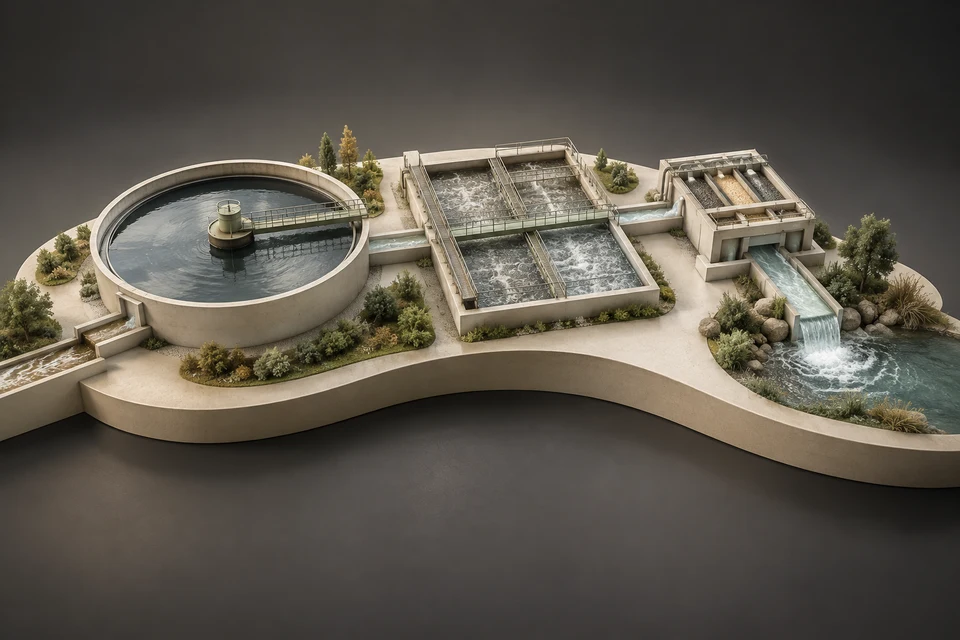
- Treatment: screening, settling, biological treatment and UV disinfection at Bonnybrook, Fish Creek and Pine Creek; see Calgary's wastewater treatment plants.
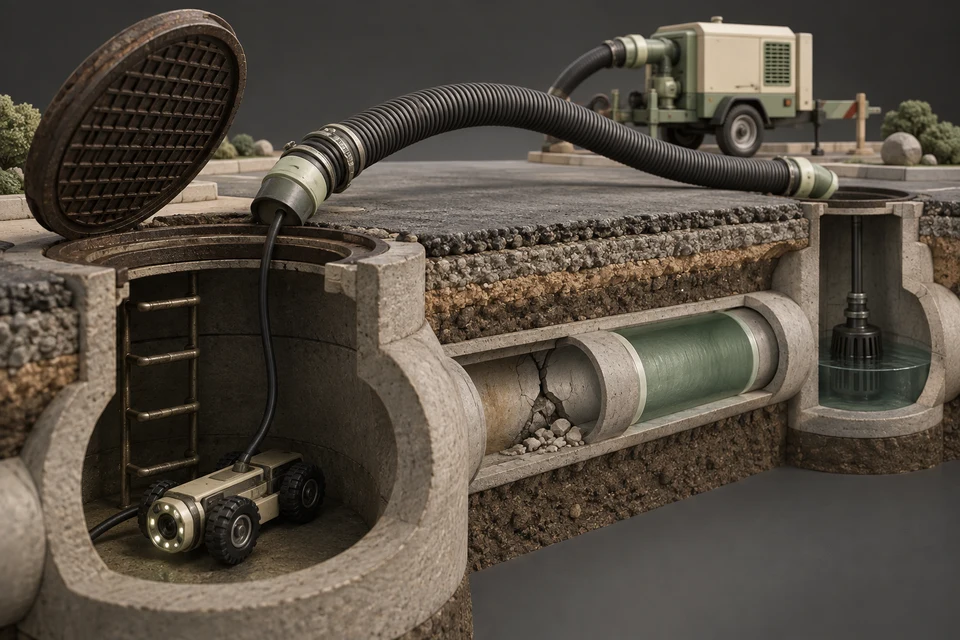
- Renewal: camera inspection, relining and replacement of ageing pipe; see how the City maintains its sewers.
- Growth: new trunk capacity for new communities and regional customers; see the Airdrie–Calgary wastewater pipeline.
The City's bill guide states that utility services are completely self-funded through water rates and service charges, with no support from property taxes. That makes the wastewater rate the direct price of keeping this chain working, and it explains why capital programs such as trunk sewer twinning and plant upgrades show up in rate decisions.
05 /Why do flat-rate homes pay more for water and sewer?
Because a flat rate charges for the size of the property rather than for water actually used. Some older Calgary homes are still billed this way. The City's rates page sets the flat water charge from the assessed lot area and building area, then bills wastewater as a fixed percentage of that water charge.
| Component | Published rate |
|---|---|
| Water, by lot area | $6.1240 per 1,000 sq ft |
| Water, by building area | $19.0978 per 1,000 sq ft |
| Minimum water charge | $46.17 per month |
| Wastewater | 144.46% of the water charge |
| Stormwater | $17.00 per 30 days in 2026 |
The City's own example is a home assessed at a 6,000 sq ft lot and 2,000 sq ft of building. That works out to about $36.74 for lot area and $38.20 for building area, $108.26 for wastewater and $17.00 for stormwater, a total of $200.20 a month. The City puts that at about 68% more than the typical metered bill. For a flat-rate owner, the wastewater line alone is almost as large as a whole metered bill for a light user.
Flat-rate properties also give the City less information. A metered account shows real consumption, which is what the 88% wastewater calculation depends on. Ask 311 about moving a flat-rate account to a meter; the process and any costs are the City's to confirm.
06 /How can you check or lower the sewer part of your bill?
Start by reading the bill against the rates, then look at the water you use indoors, since that is what the wastewater charge follows. The City notes that billing periods usually run 28 to 32 days because meters are not read on exactly the same day each month, so compare cubic metres per day rather than monthly totals.
- Find your cubic metres
Take the consumption from the bill and divide by the days in the period. Compare the same month across years so the seasons match.
- Rebuild the wastewater line
Multiply the water consumption by 0.88 and by the current wastewater usage rate, then add the fixed wastewater service charge. The result should match the bill within rounding.
- Look for silent leaks
A running toilet flapper sends water straight to the sewer and is billed twice, once as water and once as wastewater. Read the meter before bed and again in the morning with no water used; any movement is a leak.
- Ask 311 about anomalies
An estimated read, a sudden jump with no change in the household, or a flat-rate account are all questions for the City and its billing provider.
A leak on the private sewer line itself does not show up on the bill, because wastewater is billed on metered water, not on what the pipe carries. Groundwater that seeps into a cracked private line costs the whole system at the treatment plant instead. If you want to know what the City's record shows for the public part of your line, try the Service Line Lookup.
FAQQuestions people ask
What is the average water bill in Calgary?
The City's typical metered residential bill for 2026 is $119.21 a month, based on 19 m³ of water, which the City describes as usual for a family of three. A single person near the City's 7 m³ average would pay about $78, by this site's arithmetic at 2026 rates.
How much does Calgary charge for sewer?
As checked September 2026, residential wastewater is $1.9050 per cubic metre, applied to 88% of metered water use, plus a service charge of $23.45 per 30 days. On the City's 19 m³ typical bill that comes to about $55.30.
Why is my Calgary sewer charge based on my water use?
Houses have water meters but no sewer meters, so the City estimates wastewater from water. It bills residential wastewater on 88% of metered water, allowing for outdoor use that never reaches the sanitary system.
Is the stormwater charge the same for every Calgary home?
For metered residential customers it is a fixed charge, $17.00 per 30 days in 2026, and it does not depend on water use. The City says it funds street drainage, flood protection and river health.
Do Calgary property taxes pay for sewers?
No. The City's bill guide states that utility services are completely self-funded through water rates and service charges, with no support from property taxes.
Does the wastewater charge cover repairs to my sewer line?
Not for the private portion. The City's service line data describe the pipe from the house to the property line as the owner's responsibility; the utility maintains the City portion from the property line to the main.
NETWORKGo deeper across the HAUSE Sewer network
Sewer line locating and depth: how the mark on your lawn is made
How sewer line locating and depth readings work: the sonde, the hand-held locator, peak and null readings, marking, accuracy, and calling before you dig.
SewerQuotes.comEmergency and after-hours sewer service pricing
Emergency sewer service pricing in Canada (2026): after-hours call-out fees and surcharges in CAD, what to authorise at 2 a.m., and what can wait.
SewerJetting.caPressure vs flow: why gallons per minute does most of the cleaning
Jetter psi vs gpm explained: pressure breaks debris loose, flow carries it away and pulls the nozzle. Typical residential numbers and hose loss.
SOURCESSources and further reading
- City of Calgary — Water rates: residential metered and flat rate
- City of Calgary — Understanding your water utility bill and water rates
- City of Calgary Newsroom — City of Calgary responds to wastewater leak in Bow River (March 2025)
- City of Calgary open data — Public Sanitary Service Lines (xesp-3jc3)