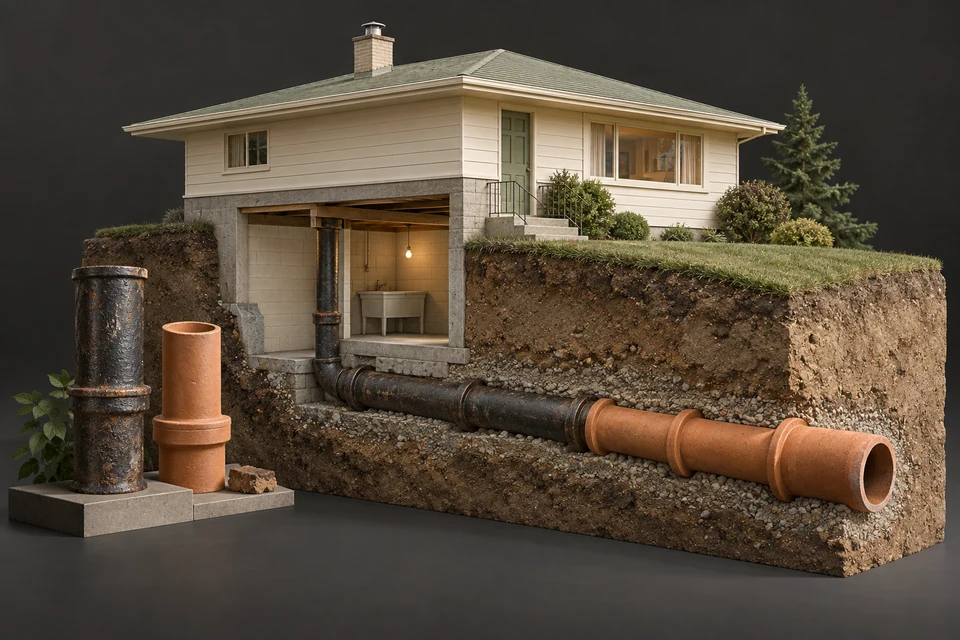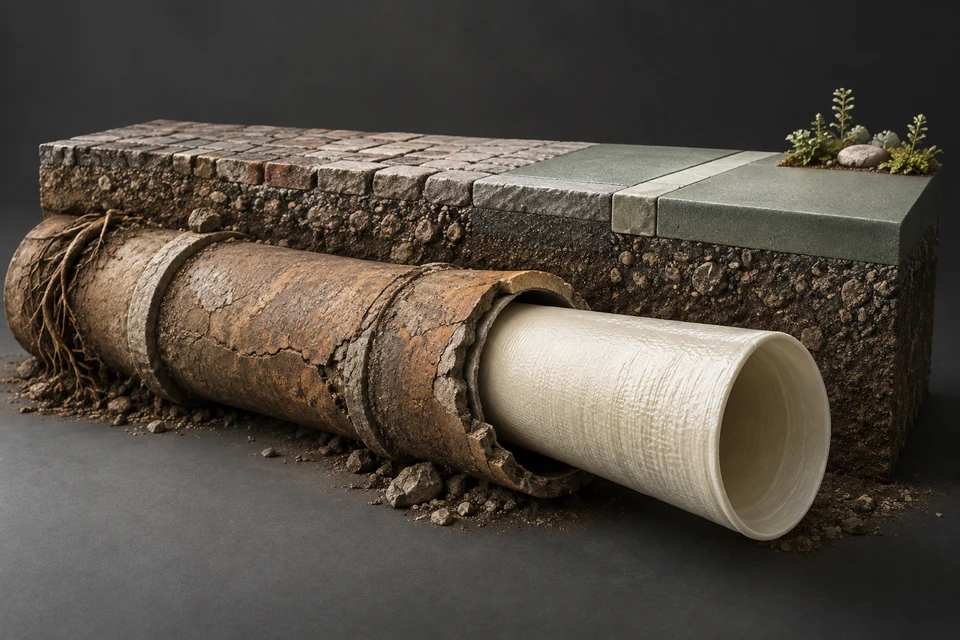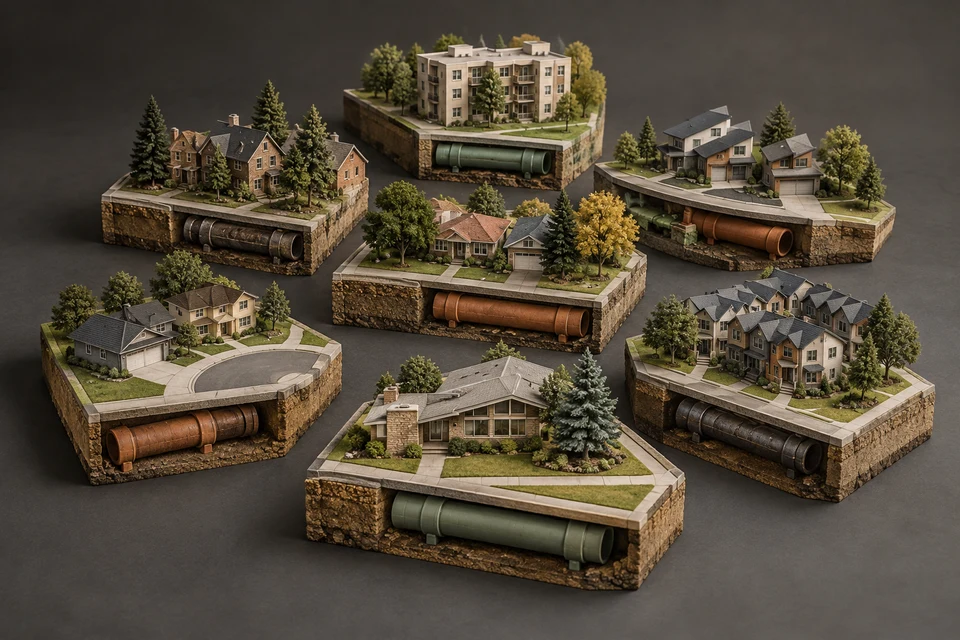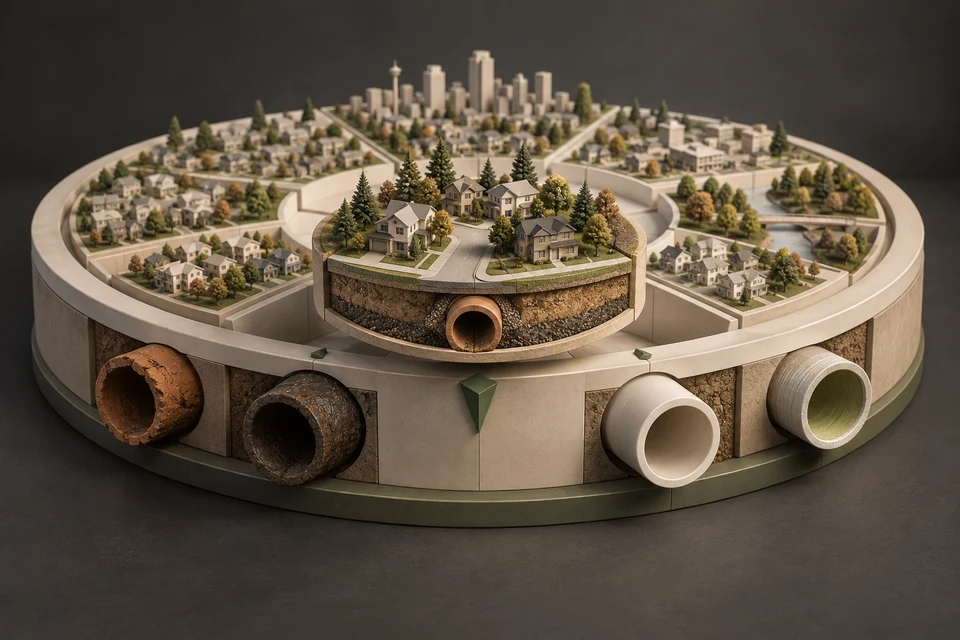
Calgary's inner-city communities hold the oldest sewer records in the city, back to 1901 in Crescent Heights. Across the 25 communities the City classes as Inner City, 41.6% of City-side lines are dated before 1960 and 38.7% carry the unexplained OTHER code. Infill has renewed much of the rest: 41.6% are PVC, and Altadore's median install year is 2007. Private lines are often older.
- Twenty-five communities sit in the City's Inner City class, holding 23,906 street-side service lines, and more than two in five of those lines (41.6%) predate 1960.
- OTHER, a code the City does not define, makes up 38.7% of inner-city lines and more than half in Scarboro, Inglewood, Ramsay, Rosedale, Upper Mount Royal, Sunnyside and Sunalta.
- Redevelopment has pushed medians forward: Altadore 2007, Mount Pleasant 2004, West Hillhurst 1998.
- Crescent Heights (16.0%), Mount Pleasant (11.2%) and Rosedale (9.3%) are among the most relined communities in Calgary.
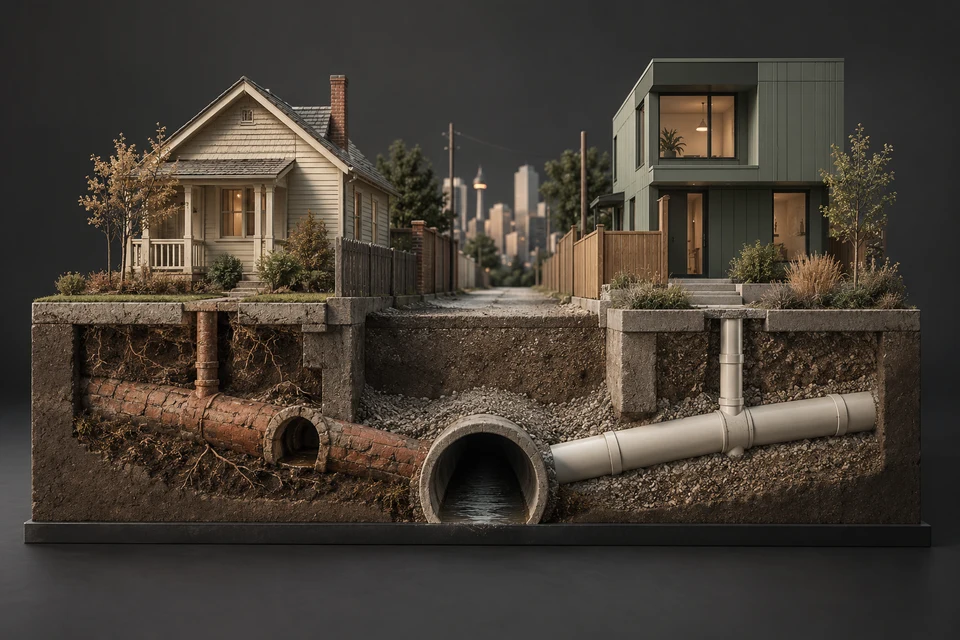
- On an inner-city lot, the private line can be decades older than the City segment, and the record gives no clue to its material.
01 /How old are Calgary's inner-city sewer records?
The oldest in the city. The earliest installed date anywhere in the City's service line data is 1901, in Crescent Heights, which has 12 lines dated to the 1900s decade. Inglewood has 44 lines from the 1900s, the earliest from 1906, and Sunnyside's records begin in 1909. Across the City's Inner City structure class, 41.6% of City-side lines carry an installed date before 1960.
| Community | Lines | Median year | % pre-1960 | % OTHER |
|---|---|---|---|---|
| Rosedale | 592 | 1950 | 56.1 | 57.1 |
| Scarboro | 335 | 1952 | 68.1 | 66.3 |
| Inglewood | 1,037 | 1954 | 57.4 | 58.1 |
| Ramsay | 882 | 1954 | 60.4 | 57.5 |
| Upper Mount Royal | 832 | 1954 | 55.9 | 53.4 |
| Hounsfield Heights/Briar Hill | 697 | 1954 | 60.7 | 48.8 |
| Renfrew | 1,870 | 1955 | 56.2 | 45.5 |
| Elbow Park | 1,224 | 1957 | 51.5 | 49.0 |
| Bankview | 768 | 1957 | 54.2 | 47.4 |
02 /What does the OTHER code mean for inner-city homes?
It means the City's record does not tell you the material. OTHER covers 18,270 lines citywide, with a median installed year of 1951, and most of the City's pre-1950 records carry it. In the inner city it is the single most common code after PVC.
- Scarboro: 66.3% OTHER, median 1952.
- Inglewood: 58.1% OTHER, with 603 of 1,037 lines.
- Ramsay: 57.5% OTHER.
- Rosedale: 57.1% OTHER and the oldest median in the city, 1950.
- Upper Mount Royal, Sunnyside, Sunalta and Bridgeland/Riverside: each above 50% OTHER.
- Crescent Heights: 47.6% OTHER, alongside 16.0% relined.
OTHER lines also tend to lack detail in other fields. Of the 18,268 records citywide with no diameter recorded, 15,553 are coded OTHER, and OTHER lines have the shortest average public-side length, about 4.5 m. A camera inspection is the only practical way to learn what an inner-city line is made of, on either side of the property line.
03 /How do inner-city communities differ from one another?
They share old records but not the same mix. Some are dominated by OTHER, some by cast iron, and some have been largely rebuilt. The table compares the smaller and mid-sized inner-city and Centre City communities that the earlier tables leave out.
| Community | Lines | Median year | % OTHER | % cast iron | % PVC | % relined |
|---|---|---|---|---|---|---|
| Cliff Bungalow | 252 | 1953 | 64.7 | 15.9 | 13.5 | 2.4 |
| Sunnyside | 658 | 1959 | 53.2 | 12.8 | 26.1 | 4.3 |
| Sunalta | 373 | 1960 | 52.8 | 22.8 | 15.5 | 4.3 |
| Bridgeland/Riverside | 1,102 | 1960 | 50.1 | 12.3 | 31.7 | 2.1 |
| Mission | 186 | 1959 | 48.9 | 30.1 | 12.9 | 0.0 |
| Beltline (Centre City) | 473 | 1962 | 47.1 | 27.5 | 13.5 | 0.4 |
| Lower Mount Royal | 181 | 1962 | 28.2 | 43.1 | 20.4 | 2.2 |
| Tuxedo Park | 1,729 | 1978 | 36.6 | 16.5 | 40.9 | 1.7 |
| Garrison Woods | 656 | 2000 | 2.6 | 0.0 | 97.4 | 0.0 |
Lower Mount Royal stands out as the inner-city community where cast iron, not OTHER, leads the record. Garrison Woods is the opposite of its neighbours: classed as Inner City but 97.4% PVC with a median of 2000, consistent with a community built largely in one recent phase. Mission and the Beltline carry high cast iron shares too, but the dataset excludes large multi-family and commercial services, so those two dense areas are represented only by their smaller buildings.
04 /What does an inner-city decade histogram look like?
It looks like waves, not a single spike. A suburban community built in one decade shows one tall bar; an inner-city community shows every era of Calgary's growth, followed by a second wave of redevelopment. Crescent Heights, home to the oldest record in the dataset, is the clearest example.
| Decade | Lines | Decade | Lines |
|---|---|---|---|
| 1900s | 12 | 1960s | 71 |
| 1910s | 61 | 1970s | 69 |
| 1920s | 33 | 1980s | 49 |
| 1930s | 208 | 1990s | 58 |
| 1940s | 203 | 2000s | 100 |
| 1950s | 131 | 2010s | 305 |
Another 94 lines are dated to the 2020s so far. The 2010s wave, the largest bar, mixes redevelopment and relining: 223 of Crescent Heights' City-side lines are coded CIPP, and CIPP records carry their relining date. The Community Sewer Atlas draws this histogram for any community you select.
05 /What is under inner-city streets?
Some of the oldest public pipe in Calgary. On its page about sanitary main and sewer pipe breaks, the City lists the types of pipe used in Calgary sanitary repairs by era, beginning with brick tunnels before 1915, then cast iron from 1910 to 1968 and concrete from 1911 to 1981. Inner-city mains therefore span every generation of materials the City has used.
Service lines in these communities connect to those mains. Where the City has renewed a main or a service segment, the record changes; where it has not, the City-side record may still carry an OTHER code from the first half of the twentieth century. The history of these codes and renewals across the whole city is in Calgary sewer history and renewal.
06 /How has infill changed the inner-city record?
Dramatically. When an old house is replaced, its service connection is usually replaced as well, and the new City segment enters the record as PVC with a new date. Communities with heavy redevelopment now have medians decades younger than their houses.
| Community | Lines | Median year | % PVC | Lines dated 2010 or later |
|---|---|---|---|---|
| Altadore | 2,239 | 2007 | 68.7 | 979 |
| Mount Pleasant | 2,273 | 2004 | 45.6 | 901 |
| West Hillhurst | 2,294 | 1998 | 54.7 | 664 |
| Hillhurst | 1,451 | 1990 | 48.1 | 364 |
| South Calgary | 1,071 | 1989 | 50.3 | 274 |
Mount Pleasant is a clear case: 431 City-side lines dated to the 1940s, then 544 in the 2010s and 357 so far in the 2020s. The City's own description notes that its data change with parcel redevelopment, and these communities show it happening lot by lot.
For owners of houses that have not been redeveloped, this creates a mixed street: a new PVC connection next door, an OTHER record at your address, and possibly a 1920s private line under your yard. Connections on a redeveloped lot must be installed by City-approved contractors and inspected by the City, according to its page on water and sewer connections.
07 /Why is the inner city so heavily relined?
The data show where relining has happened, not the reasons. The Inner City class has 3.9% of City-side lines coded CIPP, the highest of any residential class, and three inner-city communities rank among the most relined in Calgary: Crescent Heights (223 lines, 16.0%), Mount Pleasant (255 lines, 11.2%) and Rosedale (55 lines, 9.3%).
The City has said it is retrofitting existing wastewater pipes that are vulnerable to backups with new liners, and it describes a Sanitary Lateral Lining Program for older communities vulnerable to root intrusion, backups and costly repairs. A CIPP record at your address means the City segment has been lined; the private segment is a separate question.
08 /What should inner-city owners and buyers do?
- Pull the City record
Use the Service Line Lookup. An OTHER code means the record cannot tell you the material; a PVC code may reflect a redevelopment or repair.
- Camera the whole run
Ask for a recorded inspection from the building drain to the main, with every material change and its distance called out.
- Expect transitions
Inner-city lines often change material more than once, especially where a previous owner replaced part of the line.
- Check for historic records
The City of Calgary Archives holds records from the Village of Crescent Heights and the former towns of Bowness, Montgomery and Forest Lawn from before annexation; building permits can be ordered through the City.
Planning ranges for inner-city work, which are estimates and not quotes, are on the Calgary sewer line costs page. To compare your community with others, open the Community Sewer Atlas, or request quotes for an inspection.
FAQQuestions people ask
Which Calgary communities have the oldest sewer lines?
On the City side, Rosedale (median 1950), Scarboro (1952) and Inglewood, Ramsay, Upper Mount Royal and Hounsfield Heights/Briar Hill (all 1954) have the oldest medians. Crescent Heights has the earliest record, dated 1901.
What does OTHER mean in Calgary's sewer data?
The City does not define it. It is the code on most pre-1950 service line records, with a median installed year of 1951, so it tells you the line is old but not what it is made of.
Does infill replace the sewer line?
Usually the service connection for the new building is replaced, which is why heavily redeveloped communities like Altadore and Mount Pleasant have recent median install years on the City side.
Why is my inner-city City side relined?
The City has relined thousands of City-side segments, especially in older communities, and describes lining pipes vulnerable to backups. Your private segment is not covered by the City record and may still be original.
Are inner-city sewers brick?
The City lists brick tunnels as a pre-1915 type of pipe in Calgary sanitary repairs, referring to mains. House service lines are small pipes; their early material is usually recorded only as OTHER.
NETWORKGo deeper across the HAUSE Sewer network
Roots in clay and concrete sewer pipe: why older neighbourhoods suffer most
Why roots invade clay and concrete sewer pipe in older Canadian neighbourhoods: joint spacing, mortar and jute seals, mature trees, and how to plan repairs.
DrainAugering.caWhy your drain snake is not working, and how to get it past the bend
Drain snake not working? Why a cable will not go down the drain, stalls at a 90-degree bend, spins without clearing or gets stuck, and how to fix each one.
SewerQuotes.comSewer line cost per foot (and per metre): how the rate really works
Sewer line cost per foot in Canada (2026): open-cut, lining and bursting rates per foot and metre in CAD, why short runs cost more, and how to check a quote.