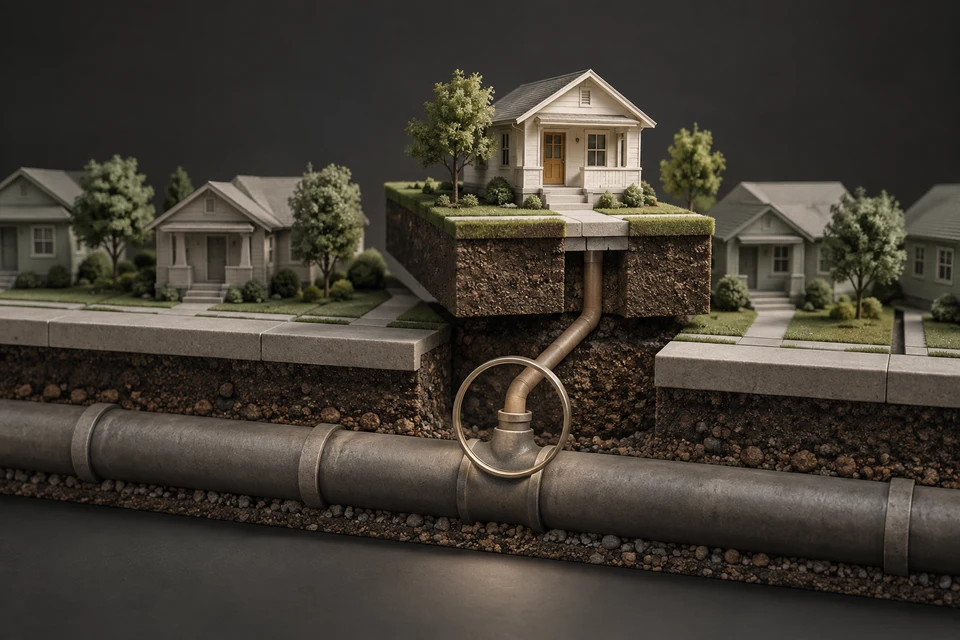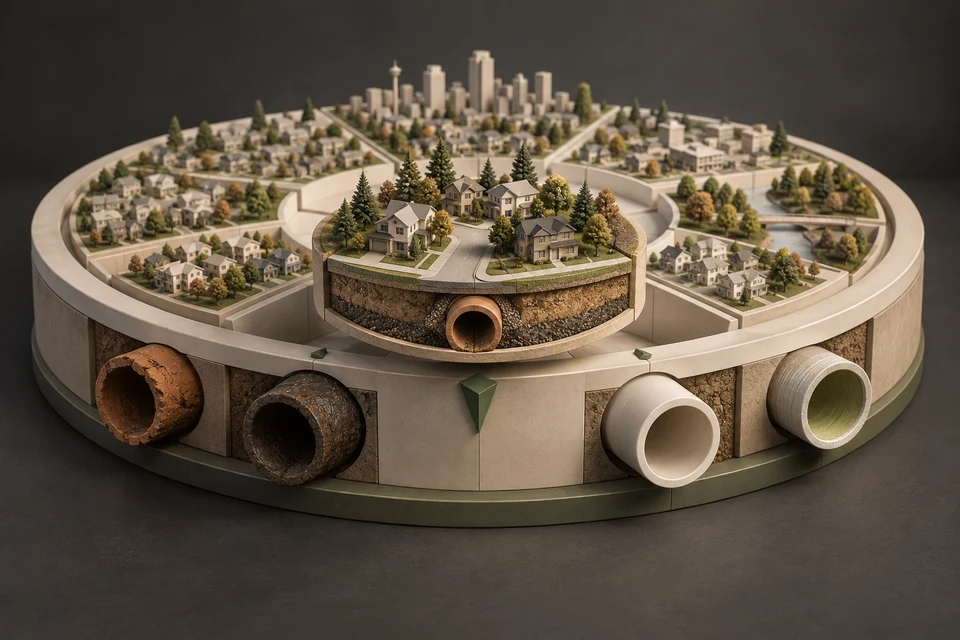
Each record in the City of Calgary's Public Sanitary Service Lines data describes the City-owned segment of one sewer connection: the address served, building type, material code, diameter in millimetres, public-side length in metres and installed date. PVC, CI and CIPP are standard codes; TIL, TP, PLA and OTHER are not defined by the City. The private segment on your lot is not recorded.
- Each row stops at the property line; whatever runs from there to the house is unrecorded and may differ.
- PVC accounts for two-thirds of rows (66.5%), the TIL tile code, generally read as clay tile, for a fifth (20.2%), and cast iron for 3.3%.
- TIL, TP, PLA and OTHER are not defined in the City's metadata; TP appears almost entirely on 1954 to 1960 installs.
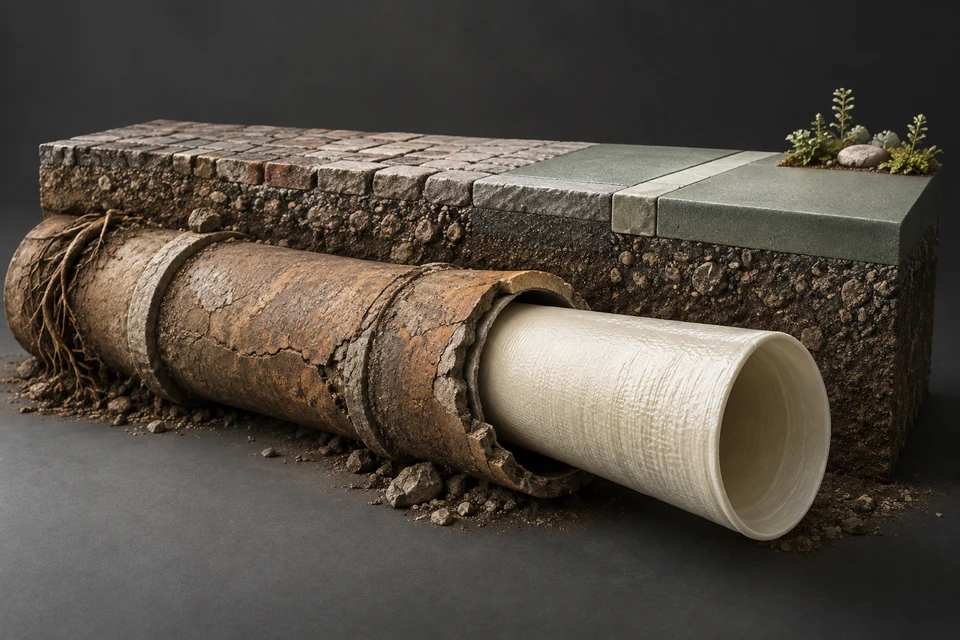
- A CIPP record's date is usually the year the pipe was relined, not the year it was first laid.
- 94.4% of records show a 100 mm (4 in) pipe, and the public-side length averages about 8.1 m.
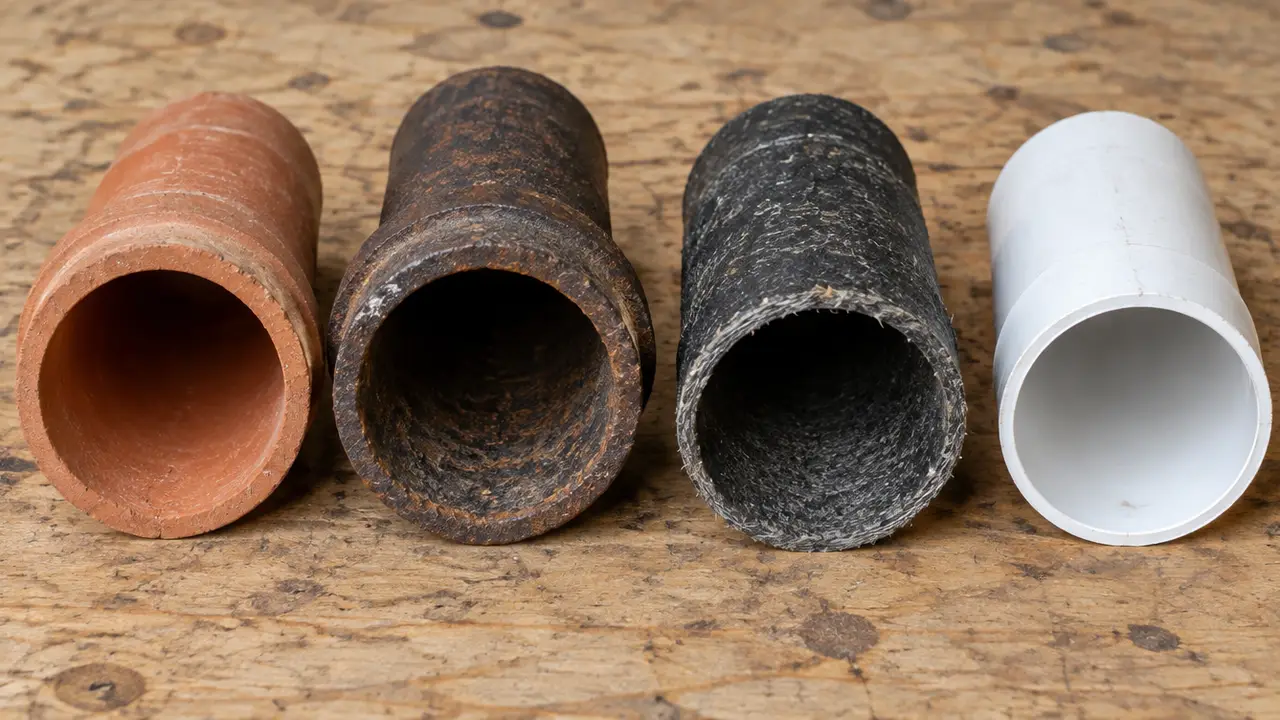
01 /What is in a Calgary service line record?
A record is one row in the City's *Public Sanitary Service Lines* dataset, supplied by the City's Water Services business unit and refreshed monthly. The City's column descriptions are brief; the table below adds what this site found when it analysed all 367,397 rows (snapshot of 2026-09-24, rows last updated by the City on 2026-09-01).
| Column | City's description | What the data actually contain |
|---|---|---|
| ADDRESS | Address served | The house number only, for example 60 |
| STREET_NM | Name of the street | Street name, abbreviated type and quadrant in capitals, for example CRESTBROOK VW SW |
| STATUS_IND | Status of asset | Every published row is ACTIVE |
| BLDG_TYPE | Type of building | Single Family (86.1%), Duplex (10.9%), Commercial (1.9%), Triplex (1.1%), a handful of others |
| MATERIAL_TYPE | Service material | 13 codes plus blanks; see the next section |
| PIPE_DIAMETER | Diameter of service (mm) | 100 mm on 94.4% of rows; blank on about 5% |
| PIPE_LENGTH | Public-side length of service connection (m) | Averages about 8.1 m; blank on some rows |
| INSTALLED_DATE | Date service was installed | 1901 to 2026 on almost every row; about 20 rows carry impossible future dates and 396 are blank |
| MULTILINESTRING | Service line geometry | The mapped route of the City segment |
02 /What do the material codes mean?
Nine codes are standard abbreviations. Four are the City's own shorthand and are not defined in its metadata, so this site does not assert their meaning beyond what the pattern of dates shows.
| Code | Lines | Share | Meaning | Median installed year |
|---|---|---|---|---|
| PVC | 244,431 | 66.5% | Polyvinyl chloride sewer pipe | 2003 |
| TIL | 74,111 | 20.2% | Not defined; generally read as clay tile (vitrified clay) | 1972 |
| OTHER | 18,270 | 5.0% | Not defined | 1951 |
| CI | 12,227 | 3.3% | Cast iron | 1965 |
| TP | 7,600 | 2.1% | Not defined; almost all installed 1954 to 1960 | 1957 |
| Blank (shown as UNKNOWN in the atlas) | 5,803 | 1.6% | No material recorded | 1996 |
| CIPP | 4,113 | 1.1% | Cured-in-place pipe liner | Relining dates, mostly 2017 to 2025 |
| PLA | 448 | 0.1% | Not defined; clustered in 1976 and 1977 | 1977 |
| HDPE | 131 | <0.1% | High-density polyethylene | Recent |
| PEX | 109 | <0.1% | Cross-linked polyethylene | Recent |
| CON | 77 | <0.1% | Concrete | Mostly 1960s to 1980s |
| PE | 72 | <0.1% | Polyethylene | Recent |
| DI | 5 | <0.1% | Ductile iron | Mostly 1970s |
Two codes deserve extra care. OTHER is concentrated in the oldest records: its median year is 1951 and a quarter of OTHER lines are dated 1944 or earlier, which is why the City's pre-1950 records are mostly OTHER. TP is the tightest cluster in the dataset: half of all TP lines are dated between 1956 and 1958. Whatever TP stands for, it is a 1950s code. Communities where TP dominates are profiled in Calgary's 1950s communities.
03 /What does the installed date really tell you?
It tells you the date on the City's record, which is usually, but not always, when that segment went in. Three patterns show where the date needs interpreting.
- Relining resets the date. 3,871 of the 4,113 CIPP records (94%) are dated 2017 to 2025. Those dates are when an older pipe was relined, so the original install year is not shown. A small number of CIPP records, 76, carry dates before 2007, which suggests the date was not always updated when a line was relined.
- Replacement resets the date. When a lot is redeveloped or a City segment is dug up and replaced, the new pipe carries a new date. That is why established communities such as Altadore (median 2007) and Mount Pleasant (median 2004) have recent medians.
- Record-keeping has eras too. The switch in codes between 1953 and 1954 is abrupt, as the table below shows. It may reflect how records were kept as much as what was laid in the ground.
| Year | OTHER | CI | TP | TIL | PVC |
|---|---|---|---|---|---|
| 1953 | 1,668 | 35 | 2 | 1 | 4 |
| 1954 | 276 | 1,108 | 325 | 0 | 4 |
| 1956 | 245 | 427 | 2,224 | 9 | 9 |
| 1958 | 498 | 542 | 614 | 2,991 | 1 |
| 1974 | 260 | 169 | 0 | 5,296 | 5 |
| 1976 | 12 | 369 | 1 | 4,602 | 422 |
| 1979 | 8 | 571 | 4 | 4,258 | 4,777 |
| 1980 | 10 | 285 | 0 | 884 | 5,737 |
| 1982 | 1 | 170 | 0 | 4 | 1,655 |
Read down the columns and the history of Calgary's service connections appears: OTHER until 1953, cast iron and TP from 1954, the tile code taking over in 1958 and peaking in 1974, PVC arriving in 1976 and overtaking tile in 1979. The single busiest year on the record is 1979, with 9,869 City-side lines.
04 /What do the diameter and length fields show?
Diameter is nearly uniform. Of all records, 346,717 (94.4%) show 100 mm, the standard 4-inch house sewer; among records with a diameter recorded, the share is 99.3%. Only 832 show 150 mm and 191 show 200 mm. Most blank diameters, 15,553 of 18,268, are on OTHER-coded lines, another sign those are the oldest and least documented records.
| Length | Share of records | Typical situation |
|---|---|---|
| 5 m or less | 15.0% | Main close to the property line, often in a lane |
| Over 5 m to 10 m | 55.9% | The common case |
| Over 10 m to 20 m | 28.2% | Wider boulevards or mains on the far side of the road |
| Over 20 m | 0.9% | Unusual layouts, long crossings |
Average public-side length varies by code: about 6.1 m for TIL, 8.7 m for PVC, 10.2 m for cast iron and 4.5 m for OTHER. The length is only the City's share. Your private run, from the property line to the foundation, is often as long again or longer, and it is recorded nowhere public.
05 /What does building type reveal?
Building type changes the age profile. Among single-family services, 1.6% are cast iron; among duplex services, 12.0%; among commercial services, 32.1%. Triplex services are almost all recent: 98.1% PVC. The dataset leaves out large commercial and multi-family services entirely, so apartment towers and big condominium sites are missing by design, not by error.
The building type is the City's classification of the service, and it may lag a change of use. A house converted to a duplex, for example, may keep its original record until the connection is changed.
06 /How should you use a record?
- Look it up
Use the Service Line Lookup to pull the record for your address.
- Place it in context
Check your community in the Community Sewer Atlas. A record that matches its neighbours is probably original; an outlier may have been replaced.
- Treat it as the City side only
Assume nothing about your side. An older City-side code is a strong reason to camera-inspect the private side; a PVC or CIPP code is not a reason to skip it.
- Match it to a camera video
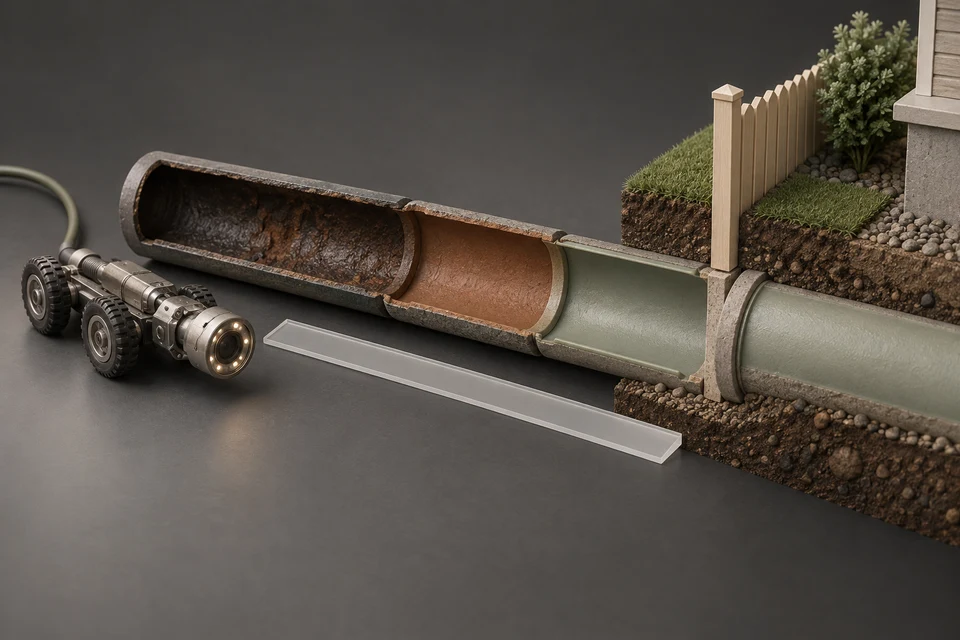
On a video, a material change near the recorded public-side length from the main often marks the property line. Calgary sewer scopes and the City record explains how.
- Correct it if wrong
Report errors or omissions through 311, as the City's description invites.
If your record shows TIL, CI, TP or OTHER and you want your side assessed, you can request quotes for a camera inspection.
FAQQuestions people ask
What does TIL mean in Calgary's sewer data?
TIL is the City's tile code. It is not defined in the City's metadata but is generally read as clay tile (vitrified clay). It covers 20.2% of City-side lines, mostly installed from 1958 to 1981.
What does TP mean in Calgary's sewer data?
The City does not define TP in its metadata, and this site does not guess. It appears almost entirely on lines installed from 1954 to 1960, with half of them dated 1956 to 1958.
Why is the installed date on my record so recent?
The City segment may have been replaced during redevelopment or repair, or relined, in which case a CIPP record usually shows the relining year. Your private pipe may still be original.
Does the record show how deep my sewer is?
No. The dataset has no depth field. Depth on your property is estimated during a camera inspection using a sonde and a surface locator.
Why is my apartment building not in the data?
The City's description says large commercial and multi-family service lines are not included. Houses, duplexes, triplexes and smaller commercial services are.
NETWORKGo deeper across the HAUSE Sewer network
Sewer pipe materials by construction era, and what each looks like on camera
Sewer pipe materials by era in Canadian homes: clay, cast iron, Orangeburg, concrete, ABS and PVC, how each one fails and what it looks like on camera.
DrainAugering.caAuger Cable Sizer: pick the cable, head and machine before you start
Auger Cable Sizer: choose the line, the distance to the clog and the clog type to get drum or sectional cable, length, head, machine class and a pro flag.
SewerJetting.caJetting before trenchless lining: why the prep cleaning decides the result
Why jetting before trenchless lining matters: root removal, descaling cast iron, cleaning to a bare wall, camera checks and what rushed CIPP prep causes.