Calgary regulates its sewers mainly through the Wastewater Bylaw 14M2012, which controls what may enter the sanitary system and requires grease interceptors for food businesses, and the Stormwater Bylaw, which bans pollutants from storm drains. Lot grading and community standards rules cover drainage around homes. Residents report backups, blocked drains, spills and record errors to 311.
- The Wastewater Bylaw 14M2012 sets limits and prohibited or restricted substances for discharges to the sanitary system and is enforced mainly on businesses.
- Every Calgary business that prepares or produces food must have a properly sized grease interceptor under the Wastewater Bylaw.
- The Stormwater Bylaw makes it an offence to let prohibited material into the storm system, from motor oil to grass clippings.
- 311 is the entry point for backups, blocked storm drains, spills, bylaw complaints and corrections to the City's sewer records.
- The City does not accept anonymous bylaw complaints through 311; you must identify yourself.
01 /Which Calgary bylaws apply to sewers?
Several bylaws share the job. The City's page on installing water and sewer connections lists the water utility, drainage, wastewater and lot grading bylaws as the ones a connection must comply with, and its bylaw pages add the community standards rules for downspouts. Each has a different focus.
| Bylaw | Main subject | Who it mostly affects | Typical sewer relevance |
|---|---|---|---|
| Wastewater Bylaw 14M2012 | What may be discharged to the wastewater system | Businesses, industry, food service | Grease interceptors, prohibited and restricted substances, high-strength wastewater |
| Stormwater Bylaw 37M2005 (formerly the Drainage Bylaw) | What may enter the storm system and how property drains | Everyone | No oil, paint, soil, soap or yard waste in storm drains |
| Lot Grading Bylaw 32M2004 | Grading so water drains away from buildings | New builds and renovations | Keeps surface water away from foundations and weeping tile |
| Community Standards Bylaw | Property standards, including downspouts | Residents | Downspout placement |
| Water Utility Bylaw | The water service and utility relationship | Customers of the utility | Service connections and utility rules |
The numbers shown, 14M2012 for wastewater, 37M2005 for stormwater and 32M2004 for lot grading, are the ones the City's own bylaw pages use, as checked September 2026; older City documents call 37M2005 the Drainage Bylaw. For the full text of any bylaw, use the City's bylaw pages or ask 311; bylaws are amended, and the City's own connections page cautions that its web summary has no legal status as an official interpretation.
02 /What does the Wastewater Bylaw 14M2012 require?
It sets the rules for what goes into the sanitary sewer beyond ordinary household use. The City's wastewater bylaw pages say wastewater from commercial customers is monitored for prohibited and restricted materials, that all wastewater must meet the limits in the bylaw's schedules, and that some industrial discharges need a wastewater permit.
- Grease interceptors: the City states that all businesses preparing or producing food in Calgary are required to have a properly sized grease interceptor under Wastewater Bylaw 14M2012, and must keep maintenance records.
- Prohibited and restricted substances: businesses must contact 311 to report a release of prohibited or restricted substances as defined in the bylaw.
- High-strength wastewater: the City runs a Wastewater Surcharge Program that adds a charge to the utility bills of businesses whose wastewater is stronger than the bylaw limits for certain treatable parameters.
- Pools and hot tubs: the City's bylaw summary points to the Wastewater Bylaw for pool and hot tub drainage requirements, which matter to homeowners too.
For households, the practical rules are simpler and appear on the City's Protect Your Pipes page: grease into the green cart, wipes and floss into the garbage, and nothing but pee, poo and toilet paper into the toilet. The system-wide reason is in how Calgary's sewer system works.
03 /What does the Stormwater Bylaw prohibit?
Anything other than clean runoff. The City's summary says it is an offence to allow any prohibited material into the stormwater system, and lists soil, waste, animal waste, cooking oils and grease, gasoline, motor oil, paint, cement, yard waste, pesticides and detergents among them. On car washing, the City's two bylaw summaries currently differ: its storm drain page says vehicles must be washed at a car wash, while its stormwater bylaw page says washing on the street with water alone, and no soap, is allowed. Either way, soapy water must not reach a storm drain. The downspout, swale and permit rules under the same bylaw are set out in Calgary's drainage bylaw and permits.
The reason is physical, not bureaucratic: storm drains discharge to rivers and creeks without treatment. A litre of used motor oil poured into a catch basin reaches the Bow or Elbow with nothing in between. See sanitary vs storm sewers in Calgary for how the two systems differ.
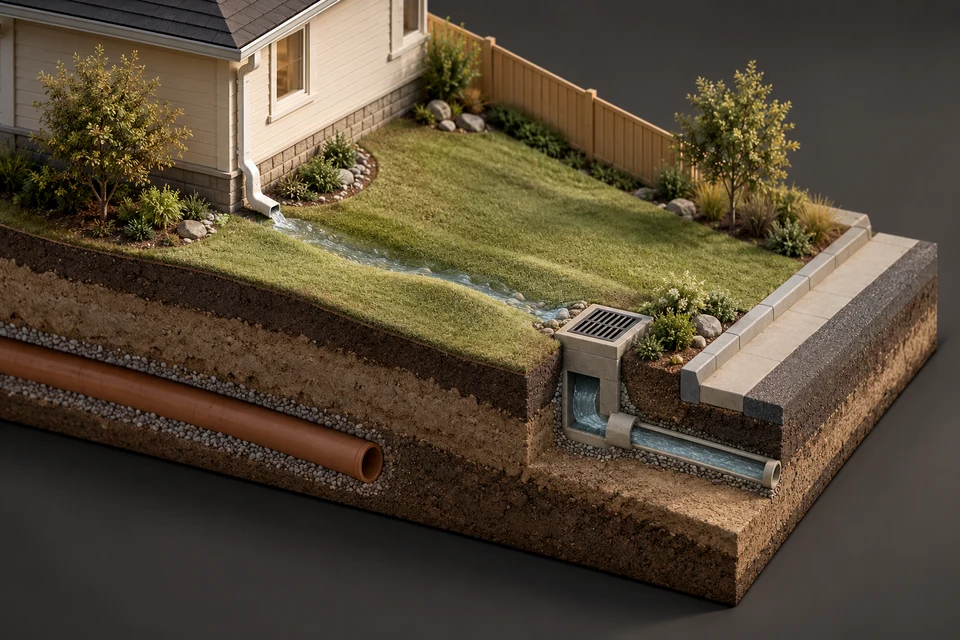
Drainage on your own lot is covered too. The City's summary says downspouts and eavestroughs must not end within 2 metres of a surface drainage facility, unless in a side yard, or of a street, which includes alleys and lanes. Sump pump discharge should not be directed onto neighbouring properties, lanes, sidewalks, boulevards or streets, or into a foundation drain or weeping tile, according to the City's basement flooding guidance.
04 /What can you report to 311 about sewers?
Almost anything that involves City pipes, public drains or someone else's discharge. 311 is the City's single entry point: dial 311 in Calgary, 403-268-CITY (2489) from outside the city, or use the 311 app or online request forms.
| Situation | Why 311 | What to have ready |
|---|---|---|
| Sewage backing up in your basement | The City can check whether the blockage is on private or public property | Location of your cleanout, cleared about 2 m around |
| Blocked or flooded storm drain | Storm drains are City infrastructure | Exact location and photos |
| Water entering buildings or vehicles during rain | The City asks for immediate reports | Address, photos, time |
| Spill or dumping into a storm drain | Stormwater Bylaw enforcement | What, where, when, and a description of who |
| Error in your City sewer record | The City invites corrections to its service line data | Address and evidence such as camera footage |
| Sewer odour from a manhole, catch basin or lift station | These are City assets; the City traces odour sources partly from 311 reports | Exact time, location and how long it lasted; see sewer smells in Calgary |
| Defect found at or past the property line | Possible City-side responsibility | Camera video, distances, locate marks |
| Business releasing prohibited substances | Wastewater Bylaw 14M2012 | Location and what was released |
05 /How do you write a 311 report that gets acted on?
Be specific about place, time and evidence. Crews triage by severity, and the City notes that photos help it prioritize. A clear first report saves a second call.
- Say what and where
Give the civic address or the nearest intersection, and say whether the problem is inside a building, on the street, in a lane or in a park.
- Say when and how bad
Note when it started, whether it is getting worse and whether sewage or only water is involved.
- Attach evidence
Photos for surface problems; for a suspected City-side pipe defect, the camera video with footage counter readings and the access point used.
- Keep the reference number
Write down the service request number and the date. Refer to it on every follow-up call.
- Share the outcome with contractors
If the City finds the problem on your side, give your contractor the City's finding so quotes start from the right boundary.
- Escalate environmental releases
If sewage is reaching a creek, a river or a storm outfall, also call Alberta's 24-hour Energy and Environmental Response Line; the steps are in sewage leaks and the Bow River.
Ownership questions are covered in depth in who owns the sewer line in Calgary. For record corrections, first check what the City currently shows with the Service Line Lookup.
06 /Which permits apply to sewer work on your property?
Plumbing and connection work is permitted and inspected. The City states that a plumbing permit is required to install a backflow prevention device such as a backwater valve. Its page on water and sewer connections says only approved, indemnified contractors may install service connections, that the owner covers the cost, and that the City inspects connections for compliance with its specifications and approved plans.
Work in the City's boulevard or road involves the City side of the property line, and permissions for that work come from the City. Because permit types, fees and processes change, confirm current requirements with 311 or the City's building and development pages before work begins, and make sure the contractor's quote says who applies. Pumping groundwater or rain out of an excavation into a street or storm drain needs its own City drainage permit or notification, also covered in Calgary's drainage bylaw and permits. Design standards behind those inspections are summarized in Calgary sewer design standards.
If you need a contractor who handles permitted sewer work, you can request quotes and ask each one to confirm permits and inspections in writing.
FAQQuestions people ask
What is Calgary's Wastewater Bylaw number?
The City's wastewater pages refer to it as Wastewater Bylaw 14M2012. It regulates what may be discharged into the wastewater system and is enforced mainly on commercial and industrial customers.
Do Calgary restaurants need a grease interceptor?
Yes. The City states that all businesses preparing or producing food in Calgary must have a properly sized grease interceptor under Wastewater Bylaw 14M2012 and keep maintenance records.
Can I wash my car in my driveway in Calgary?
Not with soap. One City bylaw page says vehicles must be washed at a car wash; its stormwater bylaw page says washing on the street with water only is allowed under Bylaw 37M2005. Soapy water entering storm drains reaches rivers untreated, so ask 311 if you need a firm answer.
How do I report a sewer problem in Calgary?
Call 311, or 403-268-CITY (2489) from outside Calgary, or use the 311 app or online form. Have the address, photos and any camera footage ready, and keep the reference number.
Do I need a permit for a backwater valve in Calgary?
The City says a plumbing permit is required to install a backflow prevention device. Hire a qualified plumber and confirm the permit and inspection are in the quote.
NETWORKGo deeper across the HAUSE Sewer network
What causes sewer backup, and how to tell which cause is yours
What causes sewer backup: roots, grease, wipes, sags, broken pipe, frozen lines and rain-overloaded city sewers, plus how to tell which one caused yours.
SewerJetting.caCommercial and municipal sewer jetting: combination trucks, interceptors and schedules
Commercial sewer jetting explained: jet-vac combination trucks, high-flow mains cleaning, restaurant grease lines, interceptors and confined space rules.
PipeCleaning.caChemical drain cleaners: why they damage pipes and harm people
Chemical drain cleaners explained: how caustic, acid and bleach openers work, how they damage pipes, their burn and gas hazards, and what to do instead.