These are the questions Calgarians most often ask about their sewer system, answered from the City of Calgary's published data and guidance: who owns which part of a service line, what codes like TIL and CIPP mean, where wastewater goes, how deep sewers are, whether maps exist, which bylaws apply and when to call 311. Each answer links to a deeper guide.
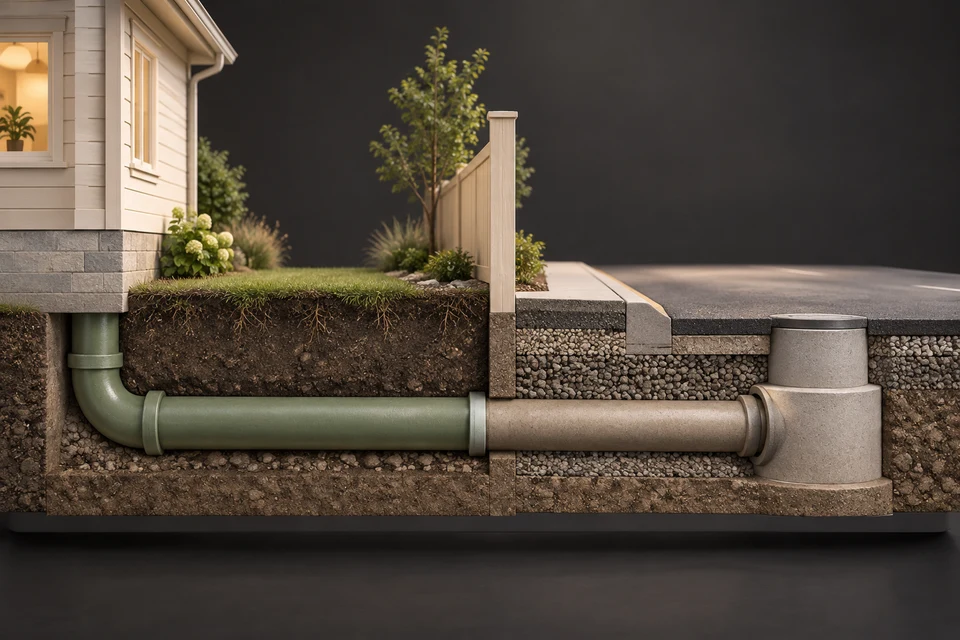
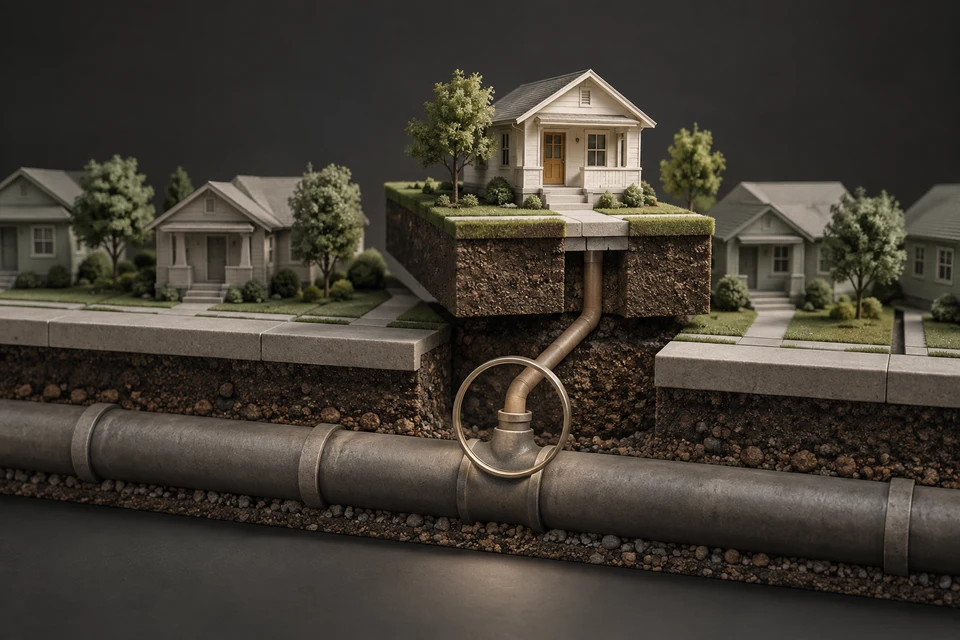
- Street side of the property line: the City's pipe. House side: the owner's.
- The City's service line data cover only the City-owned segment, and four of its material codes are unexplained.
- Calgary's sanitary sewage is treated at three plants and released to the Bow River; storm drains go to rivers untreated.
- 311 is the starting point for backups, blocked storm drains, record errors and suspected City-side defects.
01 /About these answers
Every answer below is built from a primary source: the City of Calgary's open data, its web pages on wastewater, stormwater, bylaws and connections, its design guidelines, and Alberta's one-call locate service. Numbers drawn from the City's records reflect this site's snapshot of 2026-09-24 and apply to street-side pipe alone; what lies on the owner's side is not recorded and may differ.
Rules and programs change. For a decision about your own property, confirm the current position with 311. For the terms used here, see the glossary; to see the City's record for your address, use the Service Line Lookup.
02 /Topics covered
- Ownership and responsibility: where the City's pipe ends and yours begins, and who pays. Deeper: who owns the sewer line in Calgary.
- The City's records: material codes, dates, lengths and limits. Deeper: how to read Calgary's service line records.
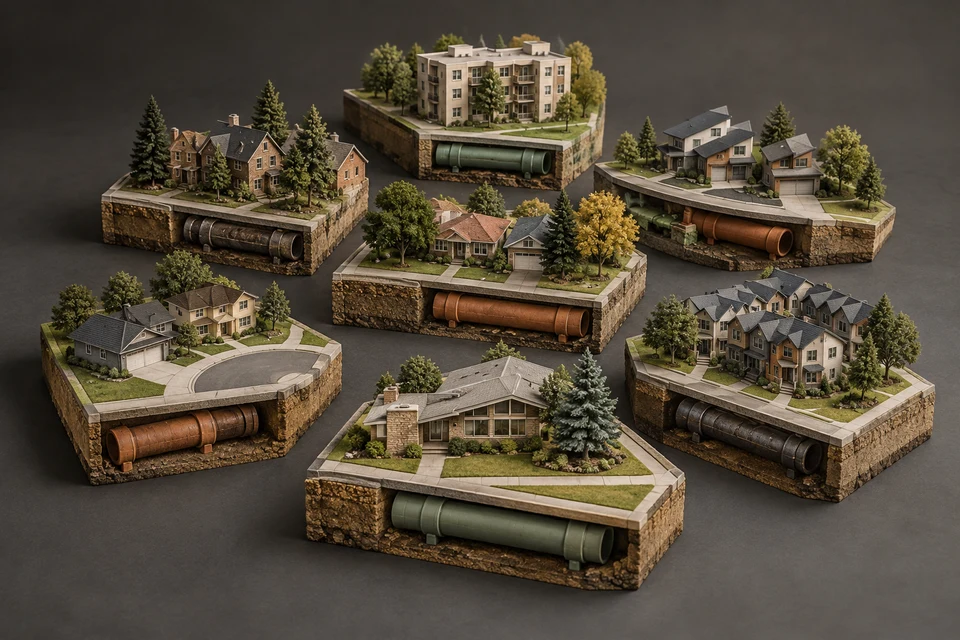
- Communities and eras: which parts of Calgary were built with which pipe. Deeper: Calgary communities.
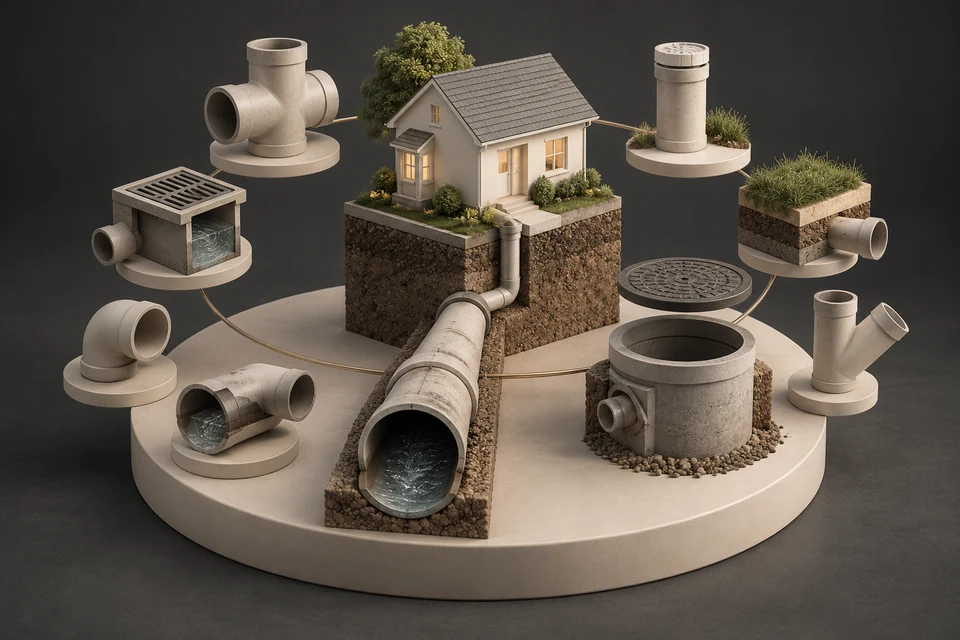
- The system: treatment plants, storm versus sanitary, depth and design. Deeper: how Calgary's sewer system works.
- Rules and reporting: bylaws, permits and 311. Deeper: Calgary sewer bylaws and 311.
- Bills, drainage and odour: the utility bill, drainage permits and smells. Deeper: Calgary water and sewer rates, Calgary's drainage bylaw and permits and sewer smells in Calgary.
- The City's work and the wider system: maintenance, regional service and the river. Deeper: how the City maintains its sewers, the Airdrie–Calgary wastewater pipeline and sewage leaks and the Bow River.
FAQAll questions
Who owns the sewer line in Calgary?
The City draws the line at the property line, in the text that accompanies its service line data. Toward the street, back to the sanitary main, the pipe is the City's to own and maintain; toward the house, it is the homeowner's. Individual cases go to 311, and the City decides them.
Where is the property line on my lot?
Usually behind the curb, often near the back of the sidewalk, because the boulevard is City right-of-way. A real property report shows the lot boundaries, and the City's public-side length for your service line tells you how long its segment is.
What do the City's material codes mean?
PVC, CI (cast iron), CIPP (cured-in-place liner), HDPE, PEX, PE, DI (ductile iron) and CON (concrete) are standard abbreviations. TIL, TP, PLA and OTHER are not defined in the City's metadata; TIL is generally read as clay tile.
How common is clay tile in Calgary?
Tile is the second most common code on the City's record, at 20.2% of street-side segments; TIL is generally read as clay tile. It dominates communities serviced from 1958 to about 1981, such as Maple Ridge, Rundle and Lake Bonavista.
What does it mean if my City record says CIPP?
The City segment of your service line has been relined in place. The date is usually the relining year. It does not mean your private segment has been renewed.
Does the City record show my private sewer line?
No. The City's description says the data relate only to the portion on public property, and that the private portion can be a different material installed at a different time. Only a camera inspection shows your side.
How do I correct the City's record for my address?
The City's dataset description asks anyone who believes the pipe material shown is wrong or missing to contact 311. Give the address and any evidence, such as camera footage.
Which Calgary communities have the oldest sewer records?
Inner-city communities. Rosedale has the oldest median City-side install year (1950), and Crescent Heights has the earliest record, 1901. Across the City's Inner City class, 41.6% of lines are dated before 1960.
Where does Calgary's sewage go?
Through City mains and pump stations to the Bonnybrook, Fish Creek or Pine Creek treatment plant. After treatment, including UV disinfection, the City releases the water into the Bow River.
How much wastewater do Calgary's plants treat?
The City's effluent data show an average of about 515,000 cubic metres of treated water released per day in 2025, roughly 79% of it from Bonnybrook. Flows rise sharply on wet summer days.
Are Calgary's storm drains connected to the sewer?
Not to the sanitary sewer. The City says storm drains, more than 60,000 of them, carry water to rivers and streams without treatment. That is why nothing but rain should enter them.
Why does my basement back up during storms?
Rain and groundwater leak into sanitary pipes through cracks, open joints and improper connections, and a surcharged main pushes water back up service lines. A serviced backwater valve helps protect below-grade fixtures.
How deep are sewer mains in Calgary?
The City's 2018 design guidelines require at least 2.5 m of cover over sanitary sewers in the public right-of-way, and the City describes excavating 8 to 24 feet to reach mains during repairs.
Is there a free map of Calgary's sewers?
The City's service line data are free and mapped, but they show only the City segment of each residential connection. Maps of mains and manholes are sold through City Online under a licence.
Will a utility locate find my sewer line?
No. Utility Safety Partners locates utility-owned lines for free with at least three full working days' notice, but its guidance says customer-owned water and sewer lines are not located. A private locator or a camera with a sonde finds yours.
What is Calgary's Wastewater Bylaw?
The City's wastewater pages refer to Wastewater Bylaw 14M2012. It sets limits and prohibited or restricted substances for discharges to the wastewater system and requires food businesses to have properly sized grease interceptors.
What can't go down a Calgary storm drain?
The City's bylaw summary lists soil, waste, animal waste, cooking oils and grease, gasoline, motor oil, paint, cement, yard waste, pesticides and detergents. Soapy car-washing water must not reach a storm drain either; the City's pages differ on whether rinsing on the street with water alone is allowed.
Do I need a permit for a backwater valve in Calgary?
The City says a plumbing permit is required to install a backflow prevention device. It also notes that Alberta's plumbing code requires below-grade fixtures to be protected from sewer backup.
What will a City crew do if my sewer backs up?
After a 311 call, a crew can run a steel snake through your cleanout to judge whether the blockage is on private or public property. The City says crews will not move furniture, pull carpet, remove toilets or open drywall.
Is the City relining sewer lines in my area?
The City's data show 3,871 City-side segments relined from 2017 to 2025, concentrated in older communities, and the City describes a Sanitary Lateral Lining Program pilot. Check your address with the lookup or ask 311.
Does Calgary monitor wastewater for COVID and flu?
Yes. Alberta's wastewater surveillance program, managed by Alberta Health and Alberta Precision Laboratories, tests for COVID-19, influenza, RSV and other pathogens, and Calgary was added to the national dashboard's joint program in 2024.
Who can install or replace my sewer connection?
The City says only approved, indemnified contractors may install service connections, that the owner pays for the work, and that the City inspects connections against its specifications.
What share of my water use is billed as sewer in Calgary?
The City bills residential wastewater on 88% of metered water use, business accounts on 90% and multi-family accounts on 95%. The reduction allows for water used outdoors that never reaches a sewer.
What made up a typical Calgary utility bill in 2026?
On the City's 19 m³ example of $119.21 a month, water came to about $46.91, wastewater about $55.30 and stormwater $17.00, by this site's arithmetic from the City's published 2026 rates, as checked September 2026.
What was the March 2025 sewage leak near Bonnybrook?
One of three pipes carrying untreated wastewater under the Bow River to the Bonnybrook plant leaked on the east bank near the Ogden Road bridge. The City isolated it on 28 March 2025 and diverted flow to the other two pipes.
Is the Stormwater Bylaw the same as Calgary's Drainage Bylaw?
Yes. Both names refer to Bylaw 37M2005; the City's current bylaw pages call it the Stormwater Bylaw. Lot grading is covered separately by Lot Grading Bylaw 32M2004.
Where should I report a sewage odour outdoors in Calgary?
To 311. The City asks for the exact time you noticed it, the location and how long it lasted, and uses those reports with wind data to trace odour sources.
Does Calgary treat wastewater for other municipalities?
Yes. The City lists six regional wastewater customers, including Airdrie, Chestermere and Strathmore. Each carries its wastewater to the Calgary city limits, and rates are set to recover the full cost of the service.
When does the City of Calgary replace sanitary mains?
The City says its sanitary main replacement work runs from April to October, with each replacement expected to take two to four weeks and at least a day's notice of any service disruption.
Is CalgarySewers.ca part of the City of Calgary?
No. It is an independent information site that analyses the City's open data and links to official sources. For official decisions and service requests, contact the City through 311.