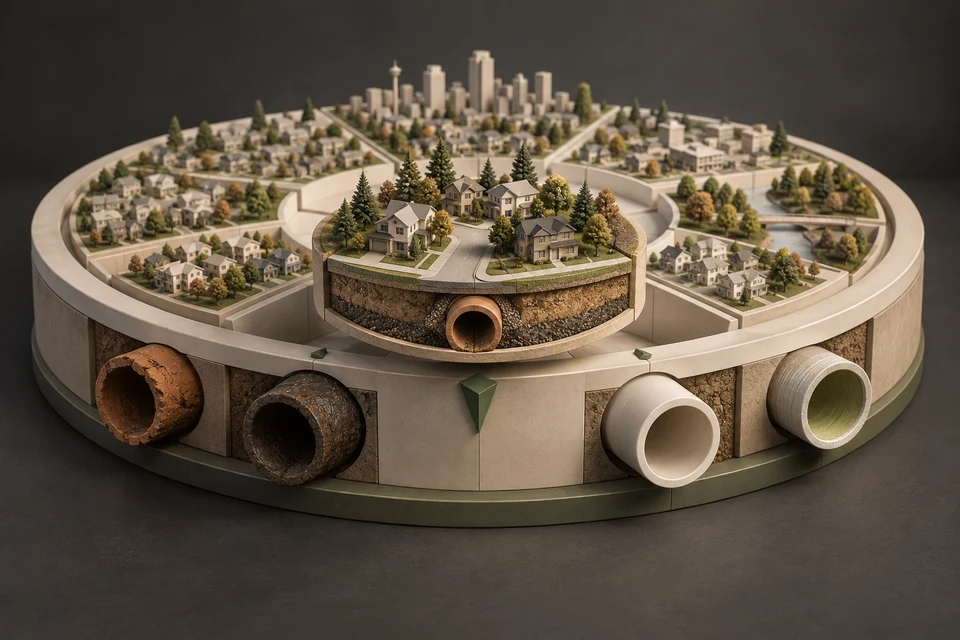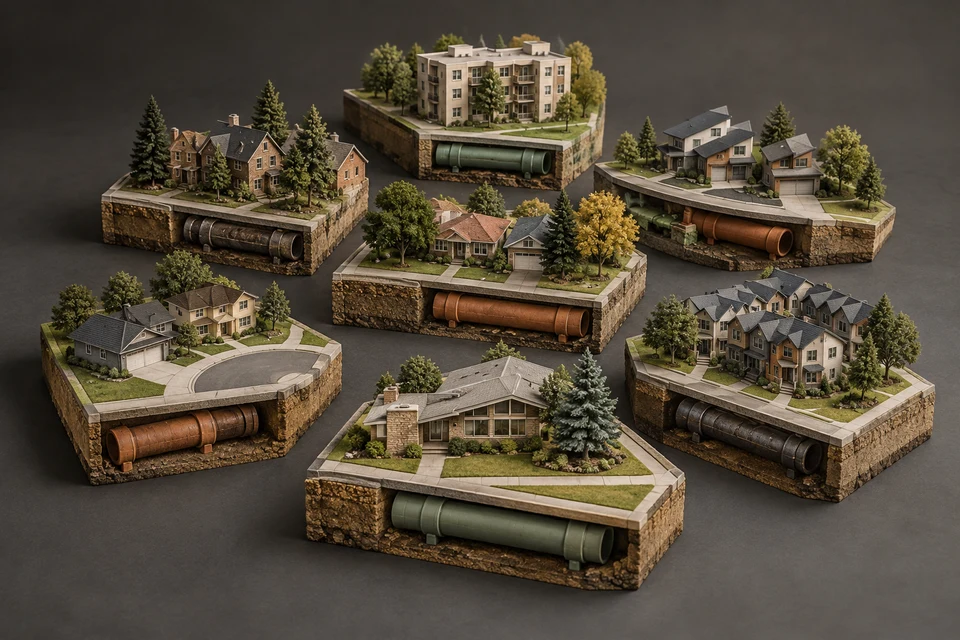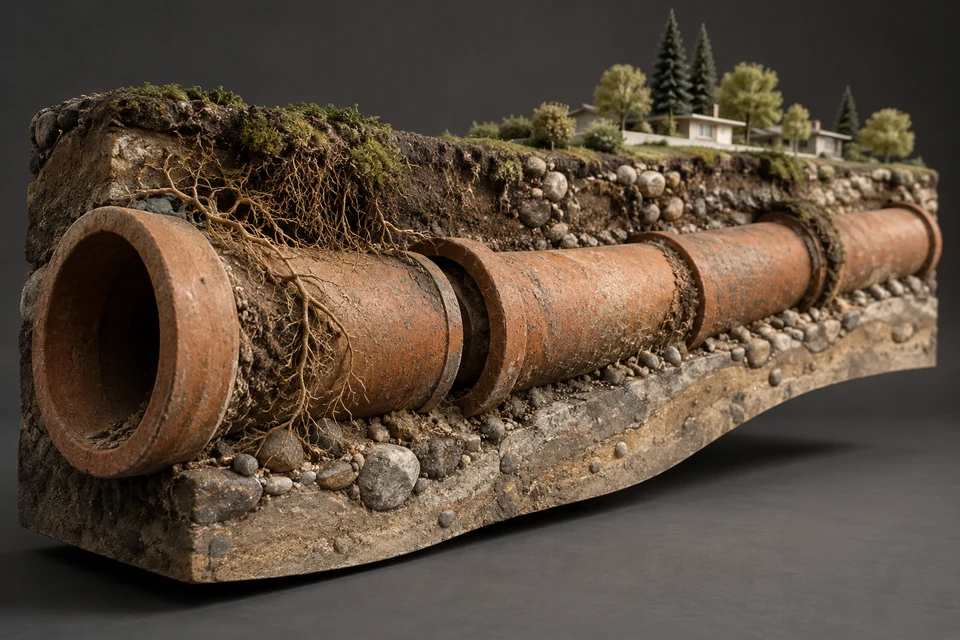
In the City of Calgary's service line records, communities classed as 1960s/1970s are dominated by the TIL (tile) code, generally clay tile: 77.5% of their 71,348 City-side lines. Maple Ridge, Rundle, Marlborough Park, Willow Park and Parkland are all above 95%. The tile code runs from 1958 to about 1981 and peaked in 1974. Private lines on those lots were often built in the same era.
- Across the 44 communities in the City's 1960s/1970s structure class, 77.5% of City-side lines carry the TIL code, 17.4% are PVC and 1.7% have been relined.
- The TIL code appears in volume from 1958, peaks at 5,296 lines in 1974 and nearly disappears after 1981.
- More than two dozen communities with 300 or more lines have TIL shares above 82%, spread across every quadrant.
- Communities built across the late-1970s switch to PVC, such as Castleridge and Woodbine, are split roughly half and half.
- The data describe only the City-owned segment; the private pipe on each lot may be clay, replaced or lined, and only a camera shows which.
01 /Which Calgary communities are in the clay tile belt?
The clay tile belt is this site's name for the ring of 1960s and 1970s communities where the City's record for the public segment of almost every service line carries the TIL code. TIL is not defined in the City's metadata, but it is generally read as clay tile, or vitrified clay pipe. The table lists the communities with the highest TIL shares among those with at least 300 City-side lines.
| Community | Lines | % TIL | Median install year |
|---|---|---|---|
| Maple Ridge | 808 | 99.1 | 1966 |
| Rundle | 2,312 | 97.1 | 1975 |
| Marlborough Park | 2,138 | 96.9 | 1973 |
| Willow Park | 1,596 | 96.0 | 1965 |
| Parkland | 1,357 | 95.2 | 1974 |
| Bonavista Downs | 370 | 95.1 | 1972 |
| Fairview | 1,270 | 94.5 | 1959 |
| Penbrooke Meadows | 2,234 | 94.1 | 1972 |
| Acadia | 2,445 | 93.7 | 1961 |
| Lake Bonavista | 3,272 | 93.3 | 1971 |
| Marlborough | 2,484 | 92.6 | 1971 |
| Ranchlands | 2,044 | 92.6 | 1977 |
| Brentwood | 2,010 | 92.5 | 1962 |
| Palliser | 481 | 90.4 | 1968 |
| Queensland | 1,392 | 90.4 | 1974 |
| Braeside | 1,459 | 90.3 | 1975 |
| Dalhousie | 2,223 | 89.3 | 1971 |
| Southwood | 1,742 | 88.4 | 1965 |
| Lakeview | 1,777 | 88.1 | 1963 |
| Varsity | 2,769 | 85.0 | 1967 |
Other large members include Huntington Hills (82.1% of 3,838 lines), Silver Springs (81.3% of 2,819), Dover (78.6% of 3,056), Canyon Meadows (78.2% of 2,170) and Haysboro (78.4% of 1,860, one of the earliest). Maple Ridge is the most uniformly tile community in the dataset: 801 of its 808 City-side lines carry the TIL code, and 802 of the 808 are dated to the 1960s.
02 /When was clay tile used in Calgary?
On the City's record, the tile code has a sharp start and a sharp end. Before 1958, fewer than 20 lines a year carry it. In 1958 the count jumps to 2,991, and it stays in the thousands every year until 1979. In 1980 it falls to 884, in 1981 to 165, and after that it all but vanishes. Half of all TIL lines are dated between 1965 and 1975, and the median is 1972.
| Year | TIL | PVC | Reading |
|---|---|---|---|
| 1957 | 16 | 17 | Before the tile era; TP and cast iron dominate |
| 1958 | 2,991 | 1 | Tile arrives in volume |
| 1968 | 3,018 | 1 | Suburban expansion on tile |
| 1974 | 5,296 | 5 | Peak tile year |
| 1977 | 4,064 | 2,455 | PVC ramps up |
| 1979 | 4,258 | 4,777 | PVC overtakes tile; busiest year on record |
| 1980 | 884 | 5,737 | Tile fades |
| 1981 | 165 | 5,976 | Effectively the end of tile |
Seen by structure class, the belt is overwhelmingly the City's 1960s/1970s group: 44 communities, 71,348 lines, 77.5% TIL. By sector, the East has the highest tile share at 42.0%, followed by the South (33.3%), the Northeast (32.2%) and the Northwest (28.7%). The Community Sewer Atlas lets you filter by either.
03 /Why does clay tile matter for a homeowner?
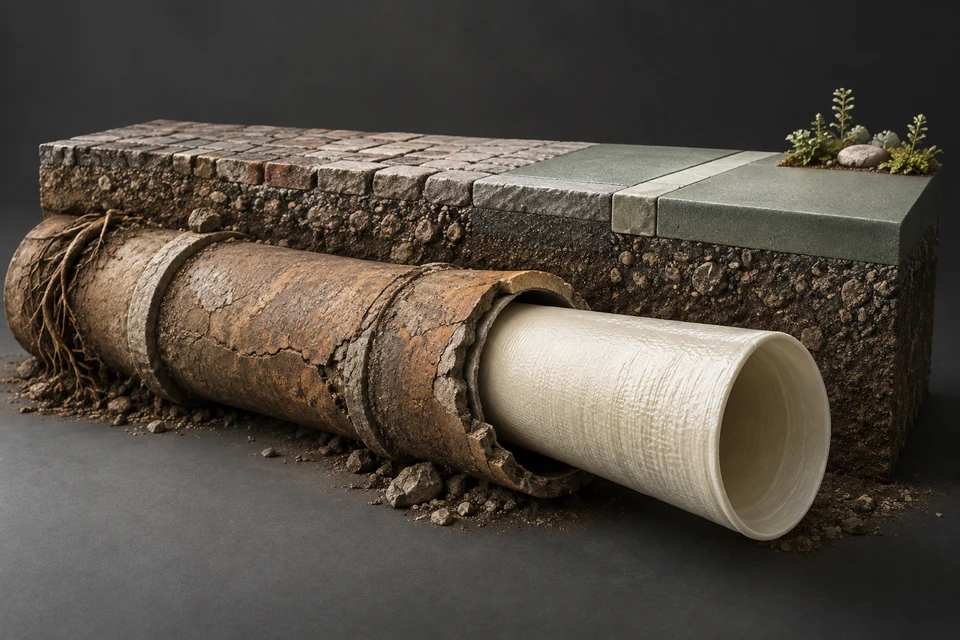
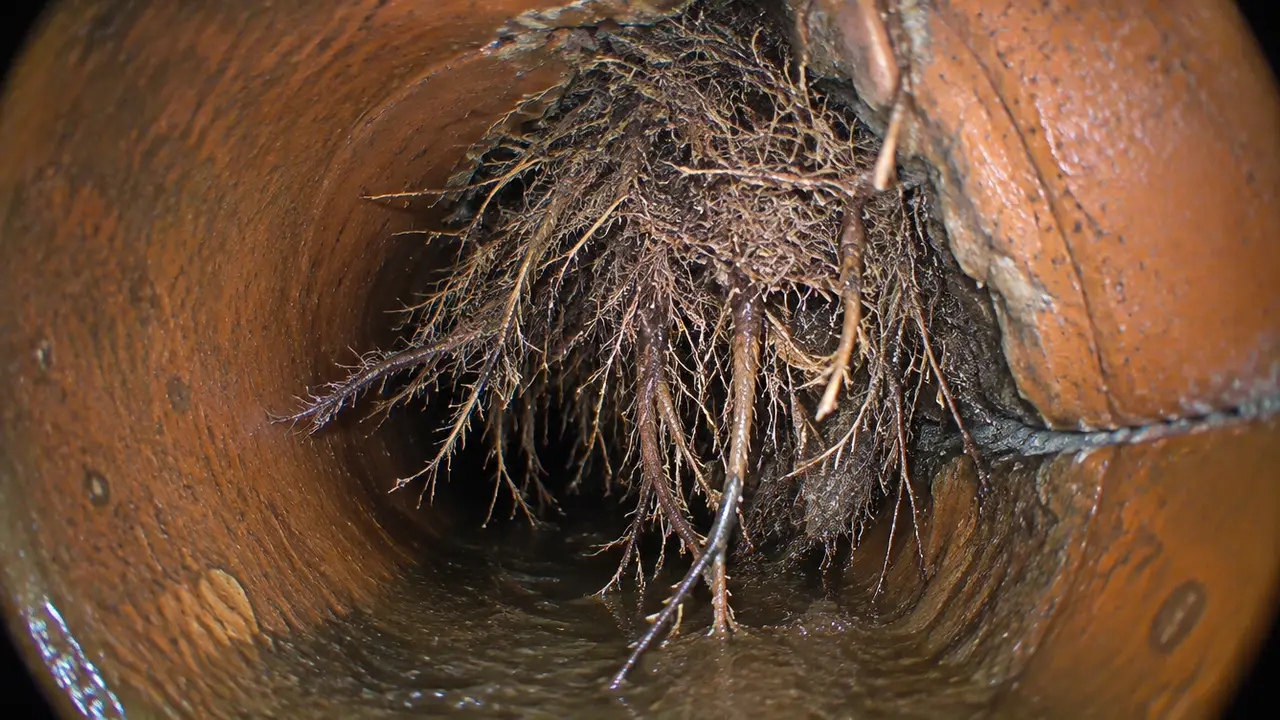
Because clay's weak points are its joints, and joints are where roots and ground movement do their work. Vitrified clay itself is hard and resists chemical attack, but it is laid in short sections joined end to end. Over decades, soil movement can open or offset those joints, and fine roots can enter through a very small gap and grow into a mass that catches paper and grease.
Trees planted when these communities were new are now 50 or more years old, with root systems to match. Combined with clay-rich soils that shrink and swell, it is no surprise that root intrusion, cracked sections and offset joints are common camera findings on older jointed pipe. None of that is visible in the City's record, which says only what material the City side is and when it went in.
- Roots at joints: often managed by cutting, with a camera check afterward; recurring roots suggest sealing or lining.
- Offsets and cracks: a shifted joint can catch solids even without roots.
- Bellies: settled sections hold water and debris.
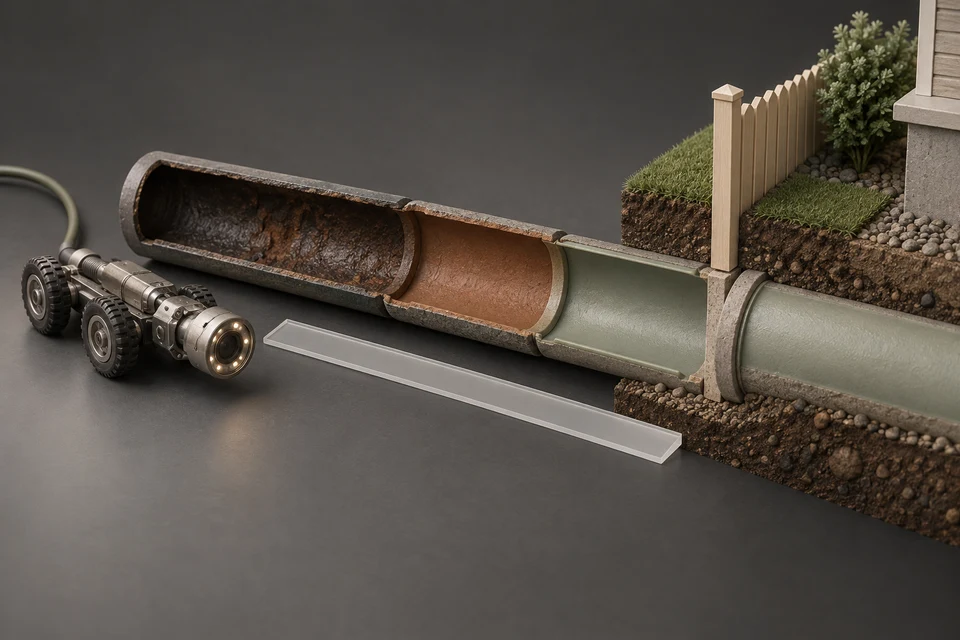
- Transition at the property line: where the City side has been relined or replaced, a clay private side can meet a newer City segment.
04 /What happens where the clay and PVC eras overlap?
Communities built across the late-1970s changeover are split. Their City-side records mix tile and PVC in roughly equal measure, often street by street, depending on when each phase was serviced.
| Community | Lines | % TIL | % PVC | Median year |
|---|---|---|---|---|
| Castleridge | 1,690 | 46.6 | 51.9 | 1979 |
| Whitehorn | 3,249 | 43.3 | 51.8 | 1977 |
| Woodlands | 1,774 | 42.3 | 55.9 | 1978 |
| Falconridge | 2,416 | 39.6 | 59.8 | 1979 |
| Woodbine | 3,042 | 38.4 | 60.4 | 1979 |
| Cedarbrae | 1,833 | 37.5 | 60.2 | 1977 |
| Edgemont | 4,730 | 25.0 | 74.3 | 1985 |
| Beddington Heights | 3,613 | 17.7 | 81.4 | 1978 |
In these communities, neighbours on the same block can have different materials on the City side. That makes an address-level check more useful than a community average: the Service Line Lookup shows which side of the changeover your City segment fell on. The newer half of the story is in Calgary's 1980s to 2020s communities.
05 /How much of the clay tile belt has been renewed?
Only a small share on the City side so far. In the 1960s/1970s structure class, 1.7% of City-side lines are coded CIPP, meaning they have been relined in place. A few communities stand out: University Heights (19.9%), Charleswood (7.4%), Huntington Hills (6.8%, 262 lines), Dover (6.6%, 203 lines) and Coach Hill (5.2%). The City has said it retrofits some wastewater pipes vulnerable to backups with liners, and runs a Sanitary Lateral Lining Program that it describes as a pilot.
A relined City segment does not renew the private one. If your City side shows CIPP and your house dates from the 1960s or 1970s, the private side may still be the original clay. Calgary sewer history and renewal looks at the relining trend in detail.
06 /What should owners in the clay tile belt do?
- Check your own record
Look up your address. A TIL City side is typical here; a PVC or CIPP City side means the City segment has changed, not yours.
- Get a camera baseline
A recorded camera inspection of your private side, with distances and a locate, shows the material, joints, roots and grade. It is the reference point for every later decision.
- Set a cycle if roots appear
Where roots are found at joints, many owners clean on a schedule and recheck by camera, then consider lining or replacement if the problem keeps returning or the pipe is cracked.
- Report City-side findings
If the camera shows a problem at or beyond the property line, send the video and distances to 311.
Buyers of 1960s and 1970s homes face the same question with a deadline; Calgary sewer scopes and the City record explains how to use both together. When you are ready for a camera inspection or repair prices, request quotes.
FAQQuestions people ask
Which Calgary communities have clay sewer pipes?
Street-side records in the 1960s and 1970s belt are overwhelmingly on the TIL (tile) code, in places like Maple Ridge, Rundle, Marlborough Park, Willow Park, Parkland, Lake Bonavista, Acadia and Varsity. Private lines are not recorded, but many date from the same era.
In what year does clay tile drop out of Calgary's sewer records?
On the City's service line record, the TIL code falls from 4,258 lines in 1979 to 884 in 1980 and 165 in 1981, as PVC took over. PVC overtook tile in 1979.
Is a clay tile service line a problem in Calgary?
Clay is durable and resists chemicals, but it is jointed in short sections. After 50 or more years, joints can open or shift, letting in roots and water. Condition varies widely, so a camera inspection is the only reliable test.
My City side is clay. Is my side clay too?
Often, if the house was built at the same time, but not always. Private lines may have been replaced or lined by a previous owner. A camera inspection shows the material and any transition at the property line.
Why is my 1970s community only half clay?
Communities serviced during the 1976 to 1981 changeover mix tile and PVC. Castleridge, Whitehorn, Woodbine and Falconridge are examples, with 38 to 47% TIL on the City side.
NETWORKGo deeper across the HAUSE Sewer network
Jetter power calculator: hydraulic horsepower, rig class and line fit
Jetter power calculator: enter psi, gpm and line size to get hydraulic horsepower, the rig class your flow implies, the usual pairing and safety flags.
SewerCleaners.caMain sewer line cleaning: what is actually involved
Main sewer line cleaning explained: how pros access the line, cable vs jetting, camera proof, how long it lasts, and what a complete job should include.
SewerRoots.caRoot Risk Calculator
Root Risk Calculator: enter tree species, distance to the sewer line, pipe material, age and root history to get a risk band, the reasons and next steps.