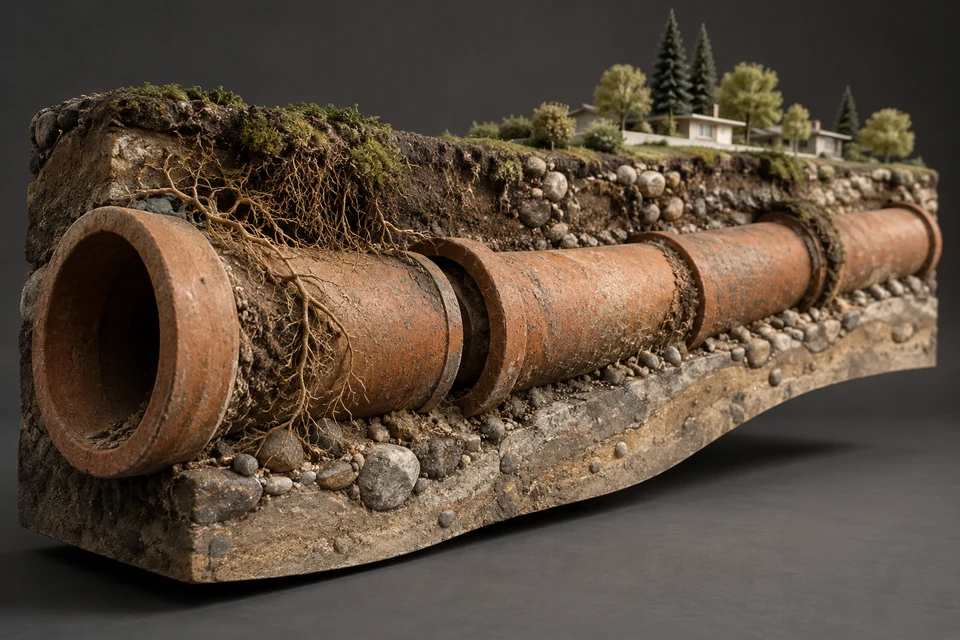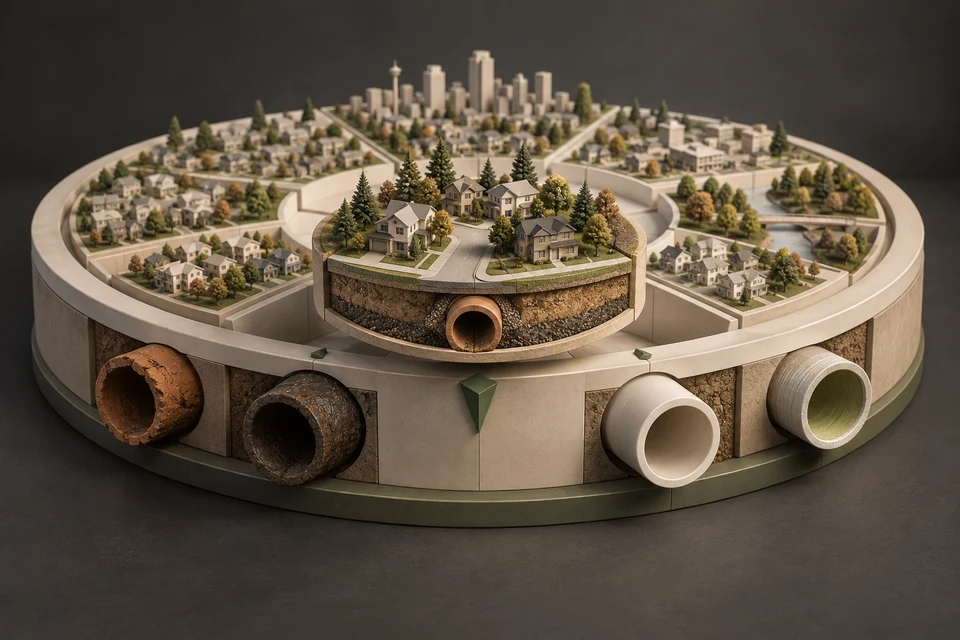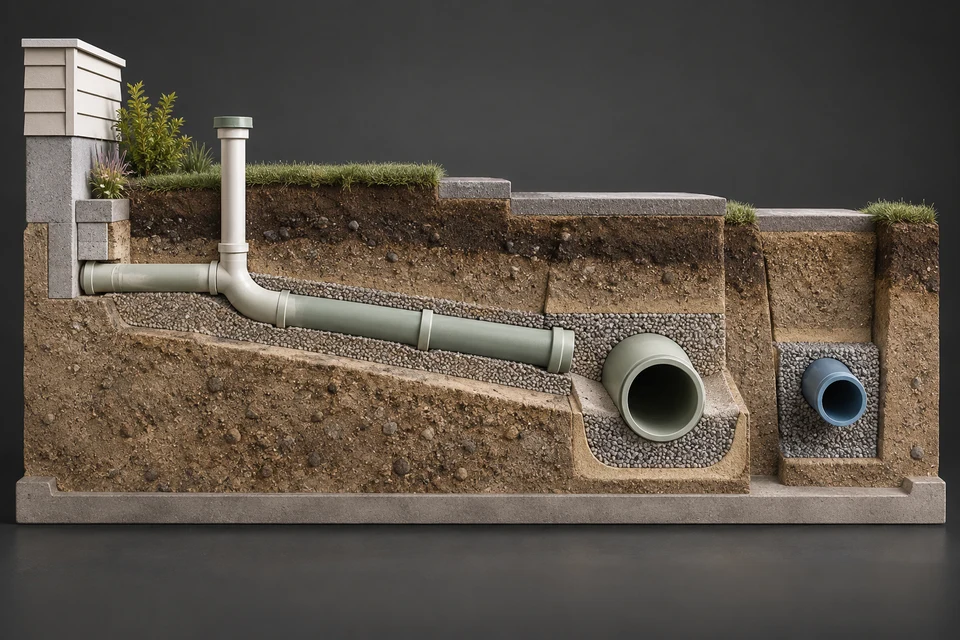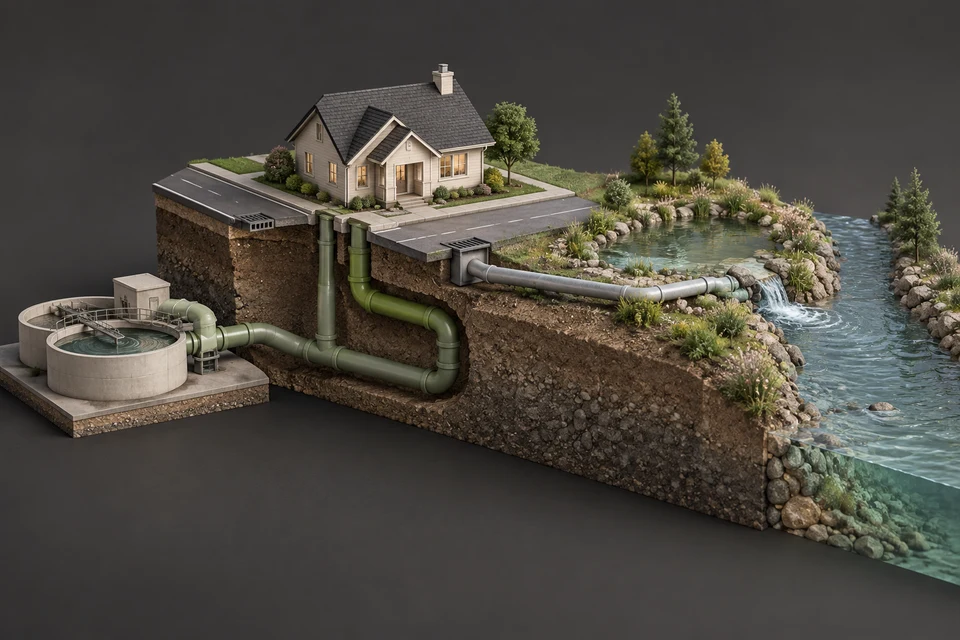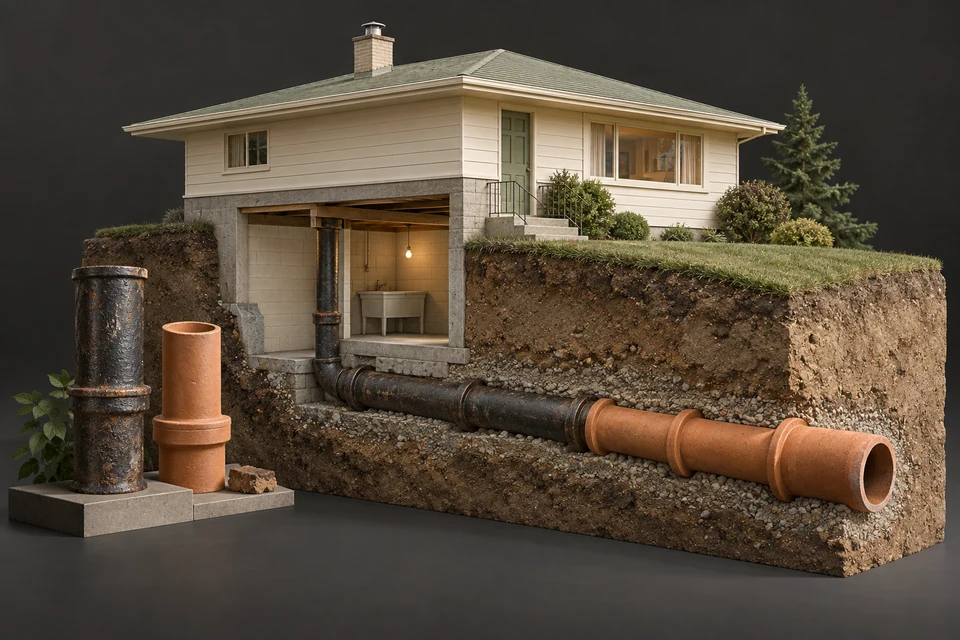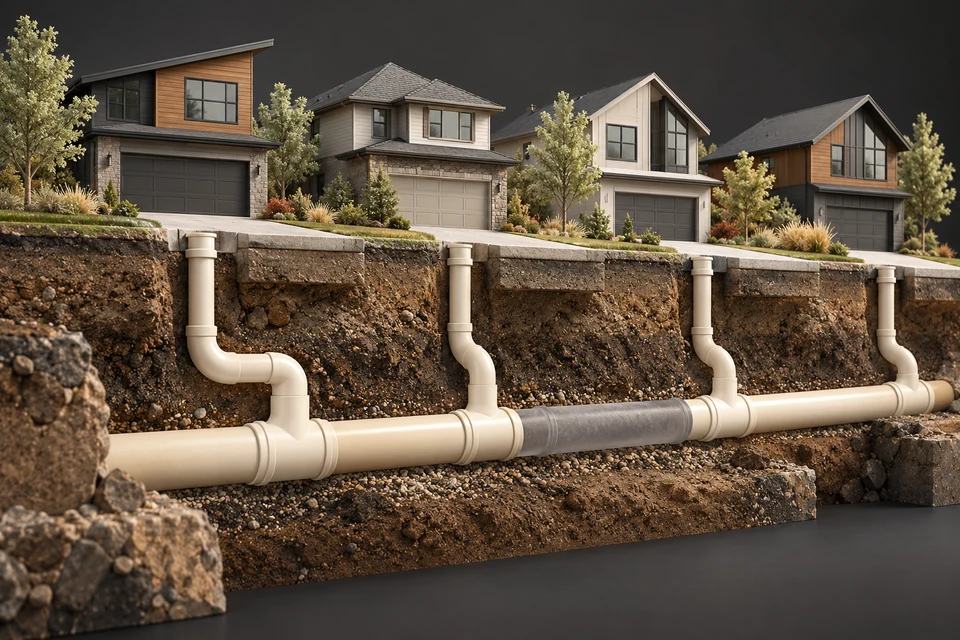
Plastic pipe defines everything Calgary has built since 1980. On the street side of the property line, PVC makes up 87.6% of lines in the City's 1980s/1990s class, 95.7% in the 2000s class and over 98% in the 2010s, 2020s and Building Out classes. The exceptions are informative: late-1970s tile lingers in some 1980s communities, and a cluster of 1990s records has no material recorded. PVC lines can still sag, separate or be damaged.
- The City's 1980s/1990s class has 70,484 City-side lines, 87.6% PVC and 9.1% on the TIL tile code, mostly in communities started in the late 1970s.
- Newer classes are almost entirely PVC: 95.7% (2000s), 98.4% (2010s), 100% (2020s) and 99.4% (Building Out).
- 5,803 lines citywide have no material recorded, with a median year of 1996; Country Hills (30.6%) and Tuscany (11.5%) have the largest shares.
- The City's structure class does not always match install dates: Abbeydale is labelled 2000s but its median City-side year is 1978.
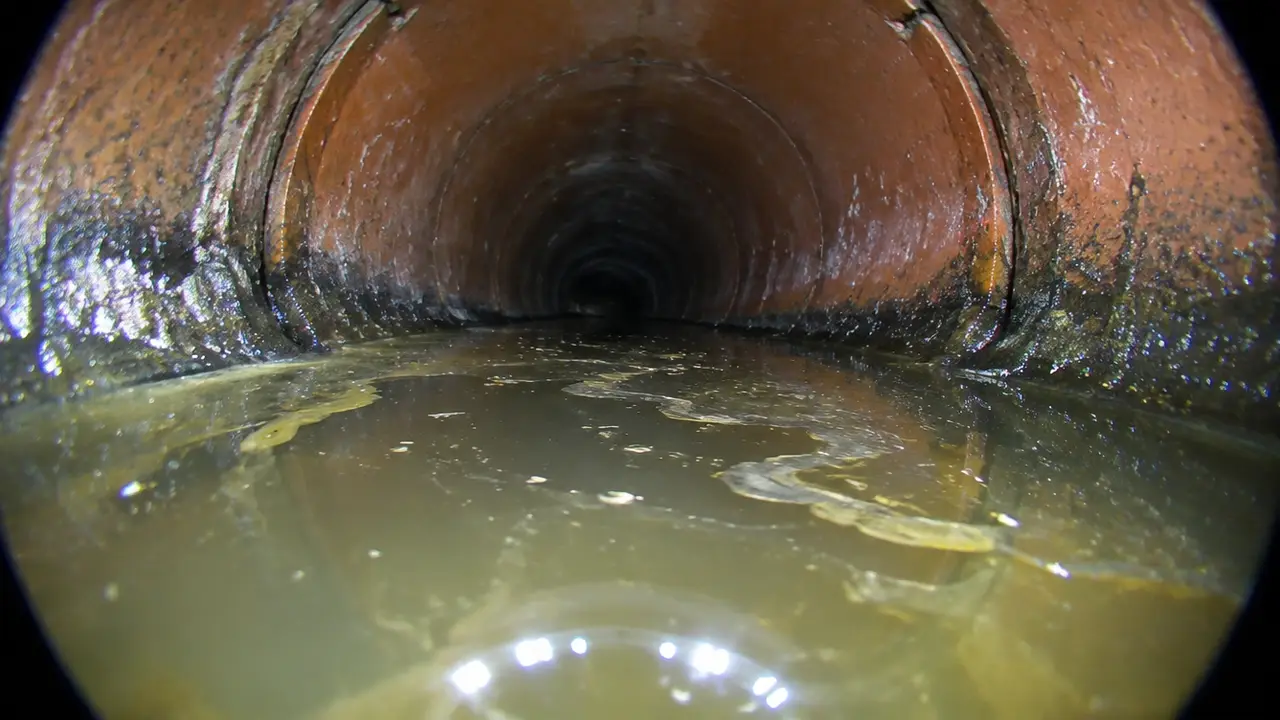
- PVC is not problem-free: settlement bellies, joint separation, construction debris and later excavation damage all show up on camera.
01 /How much of post-1980 Calgary is PVC on the City side?
Nearly all of it. PVC first appears in volume on the City's record in 1976, overtakes the TIL tile code in 1979 and, by the mid-1980s, accounts for almost every new City-side service line; cast iron still appears on 170 to 285 lines a year from 1980 to 1982. The City's own list of pipe types used in sanitary repairs gives PVC's era as 1976 to the present and HDPE's as 1980 to the present.
| Structure class | Communities | Lines | % PVC | % TIL | % no material recorded |
|---|---|---|---|---|---|
| 1980s/1990s | 31 | 70,484 | 87.6 | 9.1 | 2.8 |
| 2000s | 27 | 73,482 | 95.7 | 2.1 | 2.2 |
| 2010s | 7 | 26,485 | 98.4 | 0.0 | 1.4 |
| 2020s | 3 | 7,706 | 100.0 | 0.0 | 0.0 |
| Building Out | 25 | 45,397 | 99.4 | 0.0 | 0.3 |
Together these classes hold 223,554 City-side lines, more than 60% of the city's total. The busiest single years on the record after the 1979 peak are 2002 (9,327 lines) and 1997 (9,288). The largest communities by line count are all from this era: Cranston (6,302 lines, median 2007), Panorama Hills (5,978), Saddle Ridge (5,894), Evergreen (5,599), Tuscany (5,545) and Mahogany (5,434).
02 /Why do some 1980s communities still show clay tile?
Because they were started before the switch was complete. Several communities in the City's 1980s/1990s class were serviced in phases that began in the late 1970s, when the tile code was still in wide use.
| Community | Lines | % TIL | Median year |
|---|---|---|---|
| Coach Hill | 743 | 72.1 | 1977 |
| Castleridge | 1,690 | 46.6 | 1979 |
| Woodlands | 1,774 | 42.3 | 1978 |
| Falconridge | 2,416 | 39.6 | 1979 |
| Woodbine | 3,042 | 38.4 | 1979 |
| Edgemont | 4,730 | 25.0 | 1985 |
| Strathcona Park | 2,091 | 11.8 | 1980 |
| Erin Woods | 1,998 | 11.6 | 1989 |
| Hawkwood | 3,073 | 11.6 | 1987 |
Edgemont shows the phasing clearly: 983 City-side lines in the 1970s, 2,285 in the 1980s and 1,370 in the 1990s, with 1,181 of them on the tile code. In a community like this, two houses a few streets apart can have completely different City-side materials. The Service Line Lookup settles it for one address, and Calgary's clay tile belt covers the older half of the story.
03 /What is the late-1990s blank-material cluster?
A group of records with no material entered. Citywide, 5,803 City-side lines have a blank material field, shown as UNKNOWN in this site's atlas. Their median installed year is 1996, and 4,097 of them are dated to the 1990s. They are concentrated in a handful of communities.
| Community | Lines | % no material recorded | Median year |
|---|---|---|---|
| Country Hills | 993 | 30.6 | 1997 |
| Tuscany | 5,545 | 11.5 | 2002 |
| Oakridge | 1,723 | 11.3 | 1973 |
| Erin Woods | 1,998 | 9.0 | 1989 |
| Harvest Hills | 2,336 | 8.9 | 1995 |
| Bridlewood | 3,163 | 8.3 | 2000 |
| Hidden Valley | 3,495 | 7.2 | 1995 |
Given the dates, most of these lines are very likely PVC like their neighbours, but the record does not say so, and this site does not fill the gap by assumption. If your address returns no material, a camera inspection answers the question, and the City invites corrections to the record through 311.
04 /Do the City's community labels match the pipe dates?
Not always. The structure class comes from the City's community boundary data and appears to be a planning classification rather than a construction date. Comparing it with the median City-side install year turns up clear mismatches.
| Community | City structure class | Median install year | Dominant City-side code |
|---|---|---|---|
| Abbeydale | 2000s | 1978 | TIL (86.3%) |
| Chaparral | 2010s | 2002 | PVC |
| McKenzie Towne | 2010s | 2003 | PVC |
| Panorama Hills | 2010s | 2005 | PVC |
| Copperfield | 2020s | 2006 | PVC |
| Nolan Hill | 2020s | 2013 | PVC |
| Walden | 2020s | 2015 | PVC |
| Greenwood/Greenbriar | 1960s/1970s | 2023 | PVC |
For sewer questions, trust the install dates over the label. The Community Sewer Atlas shows both on every community card so you can see where they diverge.
05 /What do the newest communities look like in the record?
Uniform. Every one of the communities with a median install year of 2022 or later is 100% PVC on the City side, apart from two stray records in Greenwood/Greenbriar, and most began appearing in the data only after 2018. Across the city, 37,161 City-side lines are dated to the 2020s so far.
| Community | Lines | Median year | Earliest record | City structure class |
|---|---|---|---|---|
| Huxley | 155 | 2025 | 2025 | 2000s |
| Alpine Park | 1,886 | 2024 | 2020 | Building Out |
| Ricardo Ranch | 982 | 2024 | 2023 | Building Out |
| Lewisburg | 577 | 2024 | 2023 | Building Out |
| Keystone Hills | 324 | 2024 | 2024 | Building Out |
| Rangeview | 2,012 | 2023 | 2020 | 2000s |
| Glacier Ridge | 1,976 | 2023 | 2021 | 2000s |
| Haskayne | 1,686 | 2023 | 2020 | Building Out |
| Pine Creek | 1,886 | 2022 | 2018 | Building Out |
| Wolf Willow | 1,388 | 2022 | 2018 | Building Out |
Two cautions apply to new communities. First, the City-side stub is often installed when the subdivision is serviced, before the house is built; an earlier (2014) edition of the City's subdivision servicing guidelines had developers extend residential service connections 3.5 m or 5 m into each lot. The date on the record can therefore precede the home. Second, communities still under construction keep growing in the data every month, so their line counts in this snapshot, taken 2026-09-24, will rise.
A few newer plastics also appear in small numbers: 131 HDPE, 109 PEX and 72 PE records citywide, mostly dated from the 2000s onward. They are standard material abbreviations, unlike TIL, TP, PLA and OTHER, which the City does not define.
06 /What still goes wrong with newer PVC sewer lines?
PVC does not corrode and its gasketed joints resist roots far better than clay, but a newer line can still fail for reasons that have nothing to do with material.
- Settlement bellies: backfill that was not compacted well can settle, leaving a low spot that holds water and solids.
- Joint separation or deflection: ground movement or poor bedding can pull a joint apart or bend the line.
- Construction debris: concrete, gravel or rags left in a line during building can cause clogs years later.
- Later damage: fence posts, landscaping, utility work and additions can crack or crush a pipe that was fine at handover.
- Grease and wipes: material does not matter to blockages that start in the kitchen and bathroom.
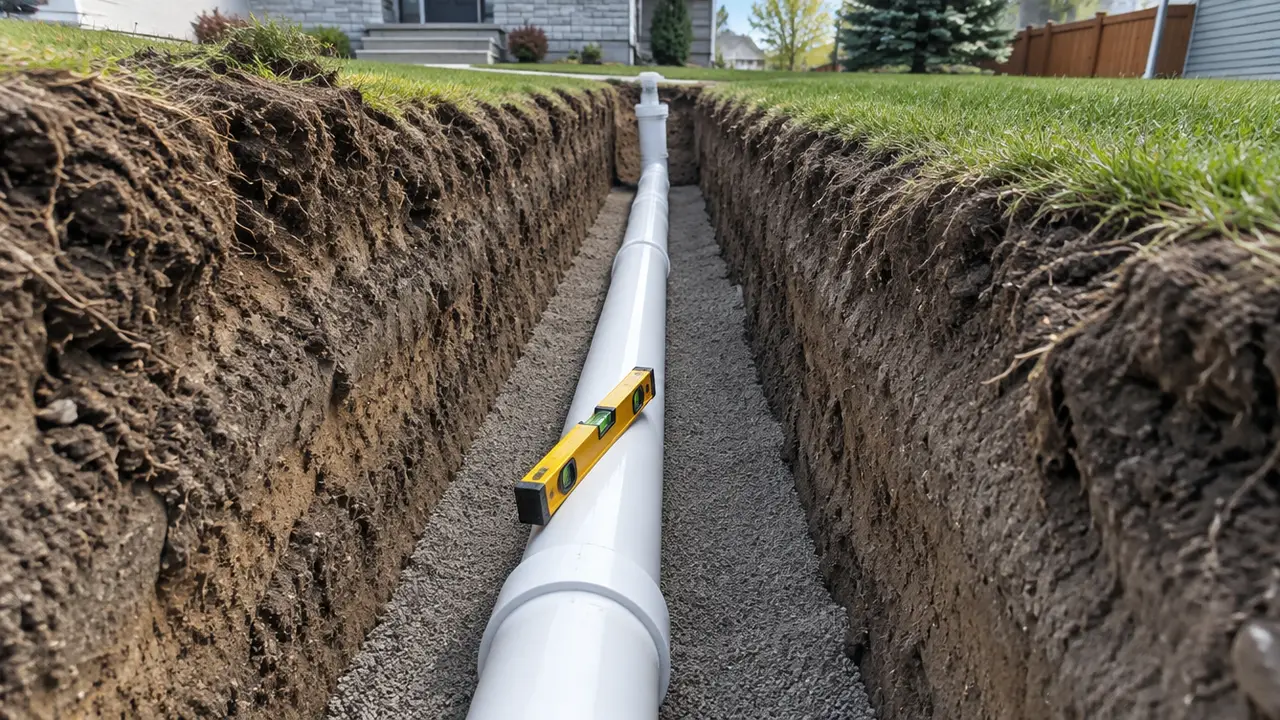
The City's design guidelines require a 2% minimum slope for 100 mm sanitary pipe in the public right-of-way; on private land, grade is the responsibility of the designer and installer. A camera with a level reading shows whether a line holds water. The numbers are in Calgary sewer design standards.
07 /What about backwater valves in newer homes?
Many newer homes have them, and they need care. The City's home maintenance guidance notes that Alberta's plumbing code requires any fixture below grade to be protected from sewer backup from the street, and that a full-port backwater valve requires servicing every year to stay in working order.
Older homes can add one; the City says a plumbing permit is required to install a backflow prevention device. How storms push water backward through a sanitary system is explained in sanitary vs storm sewers in Calgary. If your newer home has recurring slow drains or you want a baseline video, you can request quotes for an inspection.
FAQQuestions people ask
When did Calgary switch to PVC sewer lines?
On the City's service line record, PVC appears in volume in 1976, overtakes the TIL tile code in 1979 and dominates from 1980. The City's own list of repair pipe types gives PVC's era as 1976 to present.
Do newer Calgary homes need sewer inspections?
Less often than older homes, but newer PVC lines can still have bellies, separated joints, construction debris or damage from later digging. A camera is worth it after repeated slow drains or before buying.
Why does my 1990s Calgary address show no pipe material?
About 5,800 City-side records have a blank material field, mostly dated in the late 1990s. They are likely PVC like neighbouring lines, but the record does not say. The City accepts corrections through 311.
Why is Abbeydale listed as a 2000s community?
That is the City's structure classification in its boundary data. Abbeydale's City-side service lines have a median install year of 1978 and 86.3% carry the TIL tile code.
Do Calgary homes need backwater valves?
The City notes that Alberta's plumbing code requires below-grade fixtures to be protected from sewer backup, and that installing a backflow prevention device requires a plumbing permit. Ask a plumber about your house.
NETWORKGo deeper across the HAUSE Sewer network
Sewer pipe materials by construction era, and what each looks like on camera
Sewer pipe materials by era in Canadian homes: clay, cast iron, Orangeburg, concrete, ABS and PVC, how each one fails and what it looks like on camera.
PipeCleaning.caPipe cleaning methods compared, method by method
Pipe cleaning methods compared: snaking, hydro jetting, descaling, chain knockers, enzymes and chemicals — what each removes, and which pipes each can harm.
SewerRoots.caHow fast roots grow back, and how often to cut them
How fast roots grow back in a sewer line after cutting, what sets the interval, how often to schedule root cutting, and when a cycle costs more than a fix.