This glossary defines the terms used on CalgarySewers.ca: the material codes and fields in the City of Calgary's Public Sanitary Service Lines data, ownership and civic terms such as property line and 311, parts of the sanitary and storm systems, and the treatment plants and bylaws that govern them. Where the City does not define a code, the entry says so.
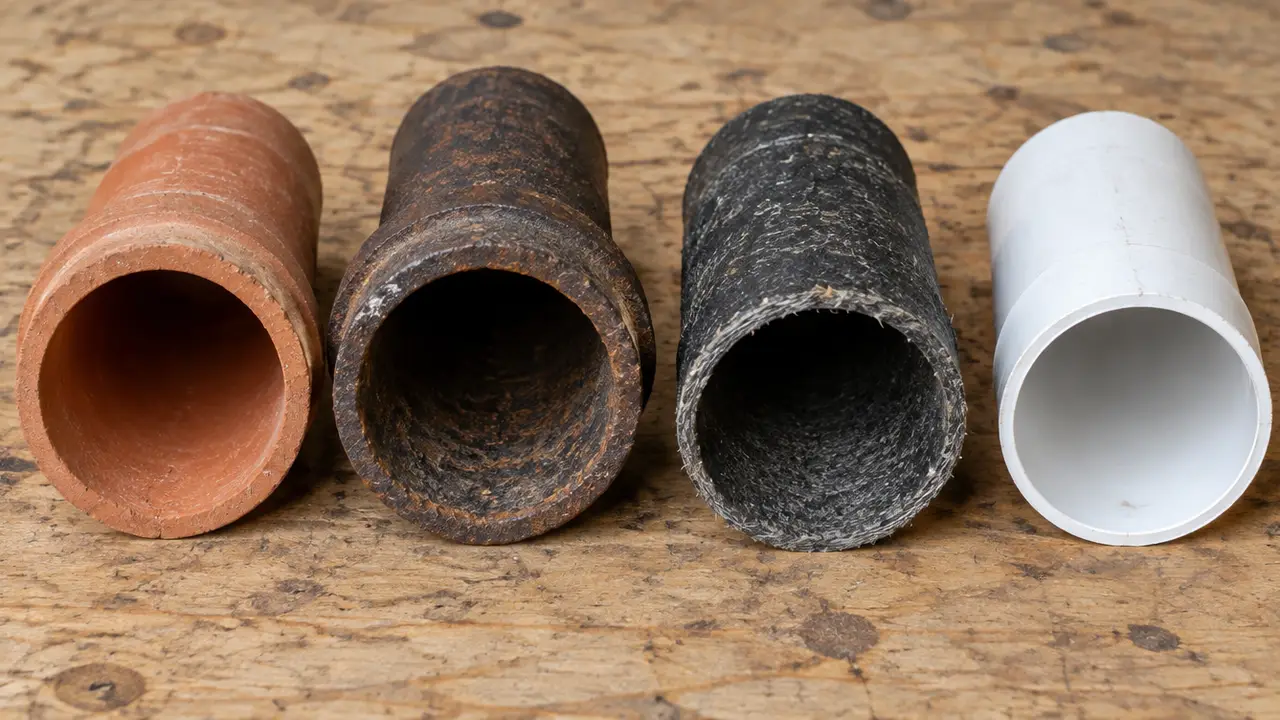
- TIL, TP, PLA and OTHER are the City's own codes and are not defined in its metadata; TIL is generally read as clay tile.
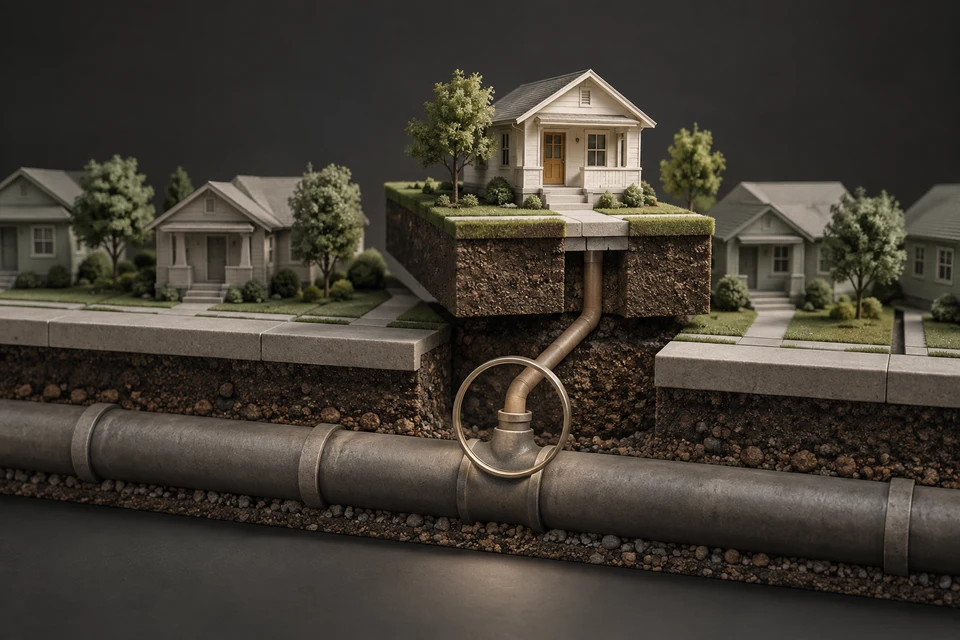
- The City's service line data describe only the segment from the sanitary main to the property line.
- CIPP entries are normally dated to when the lining was done, so the original pipe's age is hidden.
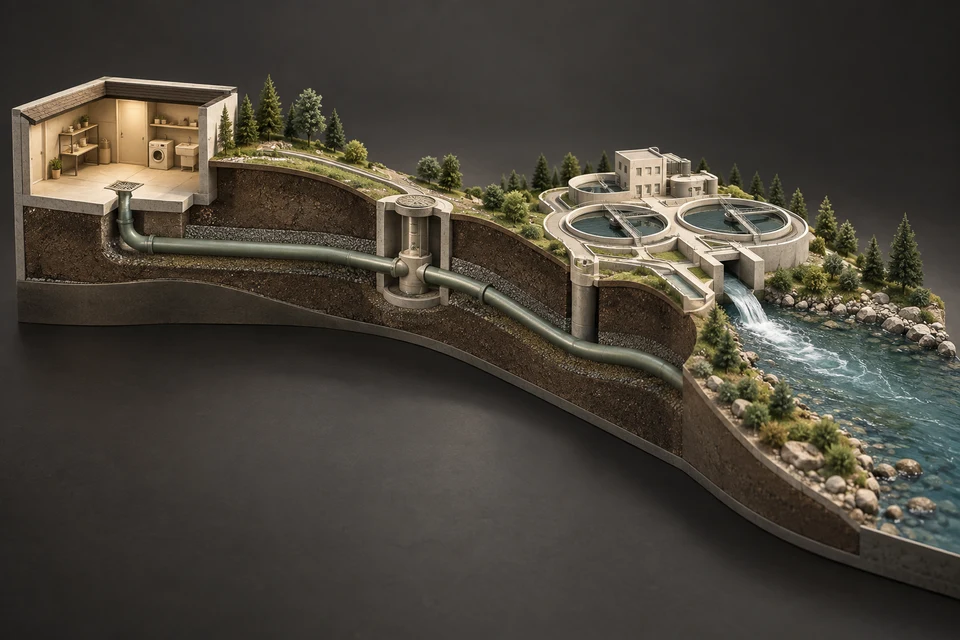
- Storm drains and sanitary sewers are separate systems with different destinations.
01 /Reading these definitions
Entries run from A to Z, with numerals first. Material codes appear exactly as they do in the City's dataset, so you can match them to a result from the Service Line Lookup or a column in the Community Sewer Atlas. Data figures quoted in definitions come from this site's analysis of the City's open data on 2026-09-24 and cover the City-owned portion of each service line only; the private portion can be a different material and age.
For a narrative walk through the same fields, read how to read Calgary's service line records. For the rules and who to call, see Calgary sewer bylaws and 311.
A–ZTerms
- 311
- The City of Calgary's non-emergency service line, also reached at 403-268-CITY (2489) from outside the city, through the 311 app or online. It is the entry point for sewage backups, blocked storm drains, spills, bylaw complaints and corrections to the City's sewer records.
- ACTIVE (STATUS_IND)
- The status field in the City's service line dataset. Every record in the 2026 snapshot is ACTIVE, so the open data describe the current network only.
- Backwater valve
- A one-way fitting on the building drain: its gate swings open for outgoing flow and seals shut if the main surcharges and water tries to come back. The City says installing one requires a plumbing permit and that a full-port valve needs annual servicing.
- Bedding
- The granular layer placed under and around a sewer pipe in a trench so it is evenly supported. The City's construction specifications govern bedding for public sewers.
- Biofilter
- An odour-control bed of moist organic media that foul air is pushed through so microbes can break down odorous compounds. The City says a well-maintained biofilter can cut odours, hydrogen sulphide and ammonia by more than 80 per cent, and plans biofilters at Fish Creek.
- Biosolids
- Treated, digested sludge from the wastewater plants. In Calgary they are applied to farmland through the Calgro program in spring and summer or dewatered and composted in fall and winter.
- Bonnybrook Wastewater Treatment Plant
- The largest of Calgary's three wastewater treatment plants by flow. The City's effluent data show it releasing about 405,000 cubic metres of treated water a day on average in 2025.
- Building drain
- The main horizontal pipe beneath a house, typically under the basement slab, that gathers every stack and hands the flow to the service line at the foundation wall. It is the owner's pipe.
- Building type (BLDG_TYPE)
- The City's classification of the building a service line serves: Single Family (86.1% of records), Duplex (10.9%), Commercial (1.9%) or Triplex (1.1%). Large commercial and multi-family services are excluded.
- Bypass pumping
- Temporary pumps and pipe that carry sewage around a section of City sewer taken out of service for construction. The City's 2018 guidelines require an engineer-signed plan submitted at least six weeks before work.
- Calgro
- The City of Calgary's program for applying biosolids to agricultural land. The City says it has run for more than 30 years and supplies nutrients for crops such as cereal grains, sod and oilseeds.
- Cast iron (CI)
- A heavy iron pipe, coded CI in the City's data. It covers 3.3% of City-side service lines, mostly installed from 1954 to 1980, and fails mainly from the inside through corrosion and scale.
- Catch basin
- Another name for a storm drain: the grated inlet at a curb or in a lane that collects runoff. The City counts more than 60,000 and says their water reaches rivers and streams without treatment.
- CIPP (cured-in-place pipe)
- A method of renewing pipe without digging: a resin-soaked tube is placed in the old line and hardened into a new wall. In the City's data, 4,113 City-side lines are coded CIPP, most dated 2017 to 2025; the date is usually the relining date.
- City Online
- The City of Calgary's online store, through which it sells licensed Sanitary Utility Section Maps showing mains, manholes and test manholes.
- Cleanout
- A capped access fitting on a drain or service line used to clear blockages and insert cameras. The City asks residents to clear about two metres around it before a crew visit after a backup.
- Cleansing velocity
- The minimum flow speed that keeps solids moving in a pipe. The City's 2018 site servicing guidelines require service pipes to be designed for at least 0.6 m/s.
- Community District Boundaries
- The City's open dataset (surr-xmvs) of community boundaries, including each community's sector and structure class. This site used it to assign service lines to communities.
- Community structure class
- A classification in the City's boundary data, with values such as Inner City, 1950s, 1960s/1970s, 1980s/1990s, 2000s, Building Out, Employment and Centre City. It does not always match install dates.
- Cover
- The depth of soil from the top of a pipe to the finished ground surface. The City's 2018 guidelines require at least 2.5 m over sanitary sewers and 1.2 m over storm sewers in the public right-of-way.
- Crown
- The top inside or outside surface of a pipe. Cover is measured from the crown to finished grade.
- Design Guidelines for Development Site Servicing Plans (DSSP)
- The City's 2018 guidelines for servicing designs on development sites where connections are added or changed, covering pipe sizing, cover, slope, separation and materials.
- Digester
- A warm, oxygen-free tank where bacteria break down sludge over about 25 days. Calgary's plants use the resulting methane for heat and electricity.
- Drainage permit
- City approval, as a permit or notification, needed before releasing water directly or indirectly to the storm system, including streets and swales. Construction dewatering is the most common case.
- E. coli (MPN/100 mL)
- A bacterium used as an indicator of fecal contamination in river water. The City's watershed data report it as the most probable number of organisms per 100 millilitres of sample.
- Effluent
- Treated wastewater leaving a treatment plant. The City publishes daily effluent flow and laboratory results for its three plants from 2007 onward.
- Energy and Environmental Response Line
- The Government of Alberta's 24-hour line for reporting releases to the environment and complaints about spills or water quality: 1-800-222-6514 in Alberta.
- Fish Creek Wastewater Treatment Plant
- The smallest of Calgary's three plants by 2025 flow. The City says it can currently run at only about 30% of its capacity and is being upgraded, with completion scheduled for the end of 2031.
- Footage counter
- The distance readout on a sewer camera, measuring how far the camera has travelled along the pipe from where it was zeroed. It is used to place defects and the property line on a video.
- Forcemain
- A sewer pipe that carries wastewater under pump pressure rather than by gravity, usually from a lift station. Wastewater held in one can arrive low in oxygen and release odour where it discharges.
- Grease interceptor
- A tank that separates fats, oils and grease from kitchen wastewater. Calgary's Wastewater Bylaw 14M2012 requires one for every business that prepares or produces food.
- HDPE
- High-density polyethylene pipe. The City lists HDPE among pipe types used in sanitary repairs from 1980 onward; 131 City-side service lines carry the code.
- Headworks
- The first stage of a treatment plant, where screens remove rags, wipes and debris and grit tanks settle out heavy particles.
- Hydrogen sulphide (H2S)
- The gas behind the rotten-egg smell of sewage, produced when wastewater sits without oxygen. It is hazardous in confined spaces such as manholes, where high concentrations can dull the sense of smell.
- Inflow and infiltration
- Rain and groundwater entering sanitary pipes: inflow through direct openings such as loose lids or wrong connections, infiltration through cracks and open joints. It is why Calgary's plant flows peak on wet summer days.
- Installed date (INSTALLED_DATE)
- The date on the City's record for a service line. It usually marks installation, but relining or replacement gives a segment a new date, and pre-1950 records are mostly coded OTHER.
- Invert
- The bottom inside surface of a pipe, where flow runs. Slope and depth for drainage are measured at the invert.
- Lateral
- Common name for a building's sewer service line, from the house to the main. In Calgary it has a private segment and a City segment.
- Lift station
- A pump station that raises wastewater to a higher point so it can continue by gravity. The City says wastewater moves through its system by gravity and pump stations.
- Locate
- Marking the position of buried lines before digging. Utility Safety Partners arranges free locates of utility-owned lines; customer-owned sewer and water lines need a private locate.
- Lot Grading Bylaw 32M2004
- The City bylaw requiring new buildings to have lots graded so surface water drains away from them, with an As Constructed Grade Certificate due within 12 months.
- Main (sanitary main)
- The public sewer pipe under a street or lane that collects flow from service lines. It is City infrastructure.
- Master service agreement
- The long-term contract between Calgary and each regional customer for water, wastewater or stormwater service; the City says these typically run 20 years and are updated every four years.
- NTU (nephelometric turbidity unit)
- A measure of how cloudy water is. The City says water above 100 NTU may not be discharged to the storm drainage system.
- OTHER (material code)
- A City material code that is not defined in its metadata. It covers 5.0% of City-side lines, with a median installed year of 1951, and tells you the record does not name the material.
- Outfall
- The point where a storm sewer discharges to a river or creek. The City counts more than 800.
- Overland Drainage Right-of-Way (ODRW)
- The City's term for surface drainage facilities such as swales and catch basins on private property. They must be kept clear, and only a fence with at least 15 cm of clearance may cross one.
- Pine Creek Wastewater Treatment Plant
- One of Calgary's three plants, in the south of the city. Its effluent records begin in July 2008, and it averaged about 82,000 cubic metres of treated water a day in 2025.
- PLA (material code)
- A City material code not defined in its metadata. Its 448 lines cluster in 1976 and 1977, mainly in Forest Heights and Whitehorn; this site does not guess its meaning.
- Property line
- The boundary between a lot and the City right-of-way. Under the City's published split, the service line is City-owned from the main to the property line and owner-owned from the property line to the house.
- Public-side length (PIPE_LENGTH)
- The length in metres of the City-owned segment of a service line. It averages about 8.1 m citywide.
- PVC
- Polyvinyl chloride pipe. It covers 66.5% of City-side service lines, appeared in volume in 1976 and has dominated since 1980.
- Regional customer
- A neighbouring municipality or site that buys water or wastewater service from Calgary. Six of the City's eight regional customers, including Airdrie and Chestermere, send wastewater to Calgary.
- Right-of-way
- Land owned by the City for roads, sidewalks, boulevards and utilities. Much of the grass in front of many Calgary homes is right-of-way, not private lot.
- Sanitary Lateral Lining Program
- A City program, described as a pilot and administered by LiquiForce, that installs liners inside existing sanitary service pipes without digging up streets.
- Sanitary sewer
- The pipe system carrying wastewater from toilets, sinks, tubs, laundry and floor drains to treatment. Calgary's goes to the Bonnybrook, Fish Creek or Pine Creek plant.
- Sanitary Utility Section Maps
- The City's licensed maps of sanitary mains, manholes, test manholes and commercial services, sold by section through City Online.
- Service line
- The pipe that carries wastewater from one building to the main, also called a sanitary service pipe or lateral. The City's open data list 367,397 active City-side segments.
- Sewer scope
- A camera inspection of a drain and service line, recorded on video with a footage counter. It is the only way to see the condition and material of the private segment.
- Shepard Lagoons
- Settling lagoons where Calgary's biosolids rest for about six weeks in spring and summer before land application.
- Sonde
- A small radio transmitter in or behind a sewer camera head. A receiver on the surface locates it to mark the pipe's route and estimate depth.
- Storm sewer
- The separate pipe system collecting rain and snowmelt through storm drains and carrying it, untreated, to rivers, creeks and ponds.
- Stormwater Bylaw
- Bylaw 37M2005, called the Drainage Bylaw in older City documents: the City bylaw that makes it an offence to let prohibited material into the stormwater system, from motor oil and paint to soil and yard waste.
- Surcharge
- A condition in which a sewer main runs full and pressurized, pushing water back up connected service lines toward the lowest openings, such as basement floor drains.
- TIL (material code)
- The City's tile code, not defined in its metadata but generally read as clay tile (vitrified clay). It covers 20.2% of City-side lines, installed mostly from 1958 to 1981.
- TP (material code)
- A City material code not defined in its metadata. Its 7,600 lines are almost all dated 1954 to 1960 and dominate communities such as Wildwood and Kingsland.
- Trap (water seal)
- The U-shaped bend under a drain that holds water to block sewer gas. A floor drain trap that dries out is the most common cause of a sewer smell in a basement.
- Trunk sewer
- A large sewer that collects flow from many mains and carries it toward a treatment plant, often following river valleys.
- Utility Safety Partners
- Alberta's one-call organization for locate requests. It asks for at least three full working days' notice, at 1-800-242-3447 or online, and does not locate customer-owned sewer lines.
- UV disinfection
- The final treatment step, in which ultraviolet light alters the DNA of remaining microbes so they cannot reproduce before water returns to the Bow River.
- Wastewater Bylaw 14M2012
- The City of Calgary bylaw regulating what may be discharged into the wastewater system, including limits, prohibited and restricted substances and grease interceptor requirements for food businesses.
- Wastewater service charge
- The fixed monthly part of the wastewater line on a Calgary utility bill, charged per 30 days whatever the water use. The City says it pays for the infrastructure that collects wastewater and for billing; current amounts are on its rates page.
- Wastewater usage factor
- The share of metered water use billed as wastewater: 88% for residential, 90% for business and 95% for multi-family accounts, according to the City's bill guide.
- Wet pond and dry pond
- Stormwater facilities. Wet ponds hold water permanently and let sediment settle; dry ponds fill only during heavy rain and can take up to 24 hours to drain. The City counts more than 200 wet and 100 dry ponds.
FAQQuestions people ask
What does TIL mean in Calgary sewer records?
It is the City's tile code. The City does not define it in its metadata, but it is generally read as clay tile, or vitrified clay pipe.
What does CIPP mean on a Calgary sewer record?
Cured-in-place pipe: the City segment has been relined with a new pipe formed inside the old one. The date is usually the relining date.
What is a lateral in Calgary?
The sewer service line from a building to the main. Calgary splits it at the lot line, with the City responsible on the street side and the owner on the house side.
What is the difference between a storm sewer and a sanitary sewer?
A sanitary sewer carries wastewater to treatment; a storm sewer carries runoff from storm drains to rivers and creeks without treatment.