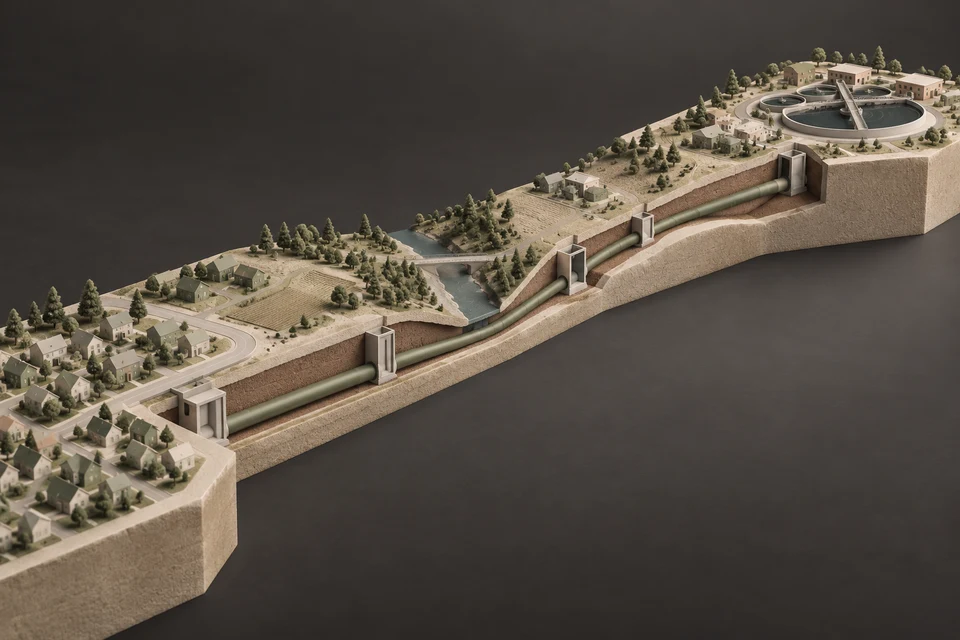
Airdrie does not treat its own sewage; it is one of Calgary's regional customers for water and wastewater. A new seven-kilometre wastewater pipeline, led by the City of Airdrie, will connect to Calgary's system. Alberta's major projects listing puts its cost at $114 million, including $50 million from the province, with construction starting in 2026 and completion expected in 2027.
- Calgary provides wastewater service to Airdrie, Chestermere, Strathmore, Tsuut'ina Nation, Foothills County (Spruce Meadows) and one power plant, under long-term master service agreements.
- Calgary's responsibility stops at the city limits: each regional customer builds and runs its own pipes outside Calgary and hands its wastewater over at the boundary.
- The Airdrie wastewater pipeline is about 7 km long, estimated at $114 million, and listed by the province as under construction for 2026–2027.
- Regional servicing is run on a 100% cost recovery basis, so rates charged to neighbours are designed to cover the full cost of serving them.
- North Calgary flows, and regional flows from the north, travel to the Bonnybrook plant through the Nose Creek sanitary trunk system.
01 /Why does Airdrie's wastewater go to Calgary?
Because Airdrie buys wastewater treatment from Calgary instead of running its own plant. The City of Calgary's regional water servicing page lists Airdrie as a customer for both water and wastewater, and says Calgary has provided these services to a few regional neighbours for more than 60 years. Pooling treatment at large plants is generally cheaper per litre than building many small ones, and it concentrates the regulatory and operating expertise in one utility.
| Regional customer | Water | Wastewater |
|---|---|---|
| City of Airdrie | Yes | Yes |
| City of Chestermere | Yes | Yes |
| Foothills County (Spruce Meadows) | Yes | Yes |
| Tsuut'ina Nation | Yes | Yes |
| Power plant in Rocky View County | Yes | Yes |
| Town of Strathmore | No | Yes |
| Town of Cochrane | Yes | No |
| Rocky View County (Elbow Valley and Bearspaw School) | Yes | No |
Six of the eight customers send wastewater to Calgary. The City's page describes master service agreements between Calgary and each customer, typically in place for 20 years and updated every four years so the volumes and rates stay current. News coverage in 2026 reported that Airdrie's current bilateral agreement runs from 2015 to 2035; confirm terms with either city if they matter to you.
02 /What is the new Airdrie–Calgary wastewater pipeline?
It is a larger connection to carry Airdrie's growing wastewater flow into Calgary's system. The Government of Alberta's major projects listing describes it as a new seven-kilometre wastewater pipeline connecting to Calgary's existing treatment system, supported by a $50 million provincial investment.
| Item | As published |
|---|---|
| Proponent | City of Airdrie |
| Length | About 7 km |
| Total estimated cost | $114 million |
| Provincial contribution | $50 million |
| Stage | Under construction |
| Start | 2026 |
| Expected completion | 2027 |
| Stated benefit | Enables development of up to 45,000 new housing units by avoiding the need for Airdrie to build its own treatment facility |
The City of Airdrie's own announcement of the provincial grant describes design under way, construction starting in 2026 and completion in 2027, and frames the line as a coordinated effort with the City of Calgary to share infrastructure. Local news coverage in 2026 reported that the new line replaces a smaller pressurized pipe and that a Calgary council committee endorsed extra borrowing authority toward Calgary's portion in May 2026; the cost split between the two cities has been reported in different ways, so rely on each council's published records for exact shares.
03 /How does regional sewage travel through Calgary to a plant?
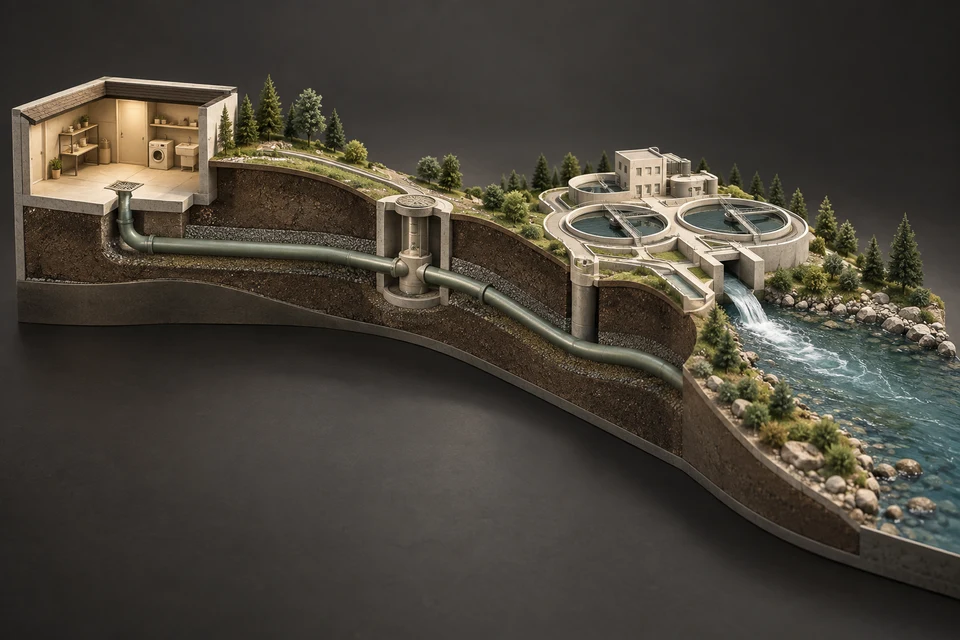
It crosses the city limits in the neighbour's pipe and continues in Calgary's. The City's regional servicing page draws that line exactly: Calgary receives regional customers' wastewater for treatment at the city limits, and each customer is responsible for all transmission outside Calgary as well as its own local collection and retail service. From the handover point onward, the flow joins Calgary's trunk sewers.
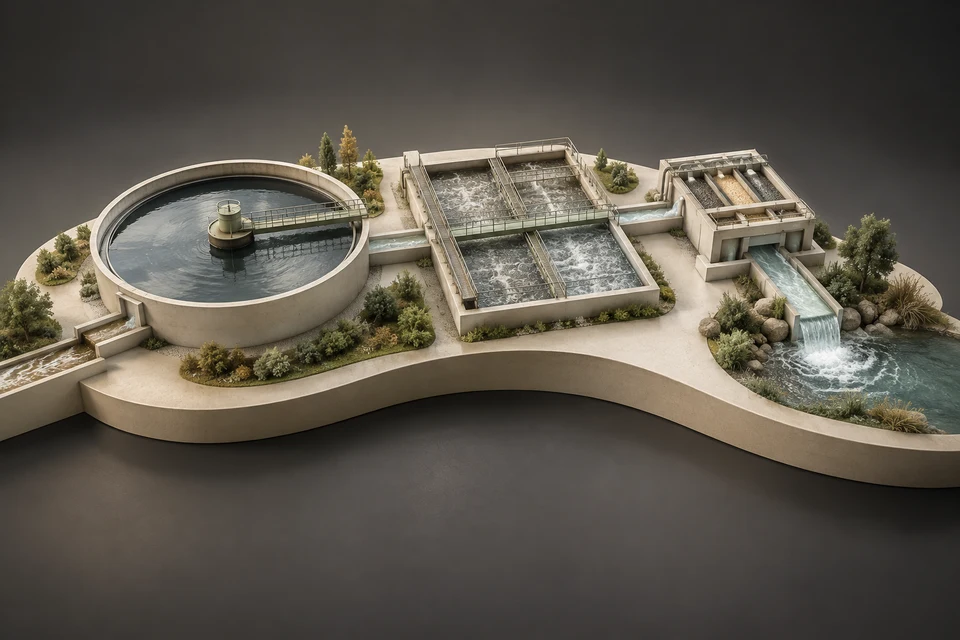
In the north, the backbone is the Nose Creek sanitary trunk system. Alberta's major projects listing describes the City of Calgary's Nose Creek Sanitary Sewer Trunk work as a project to expand sewer capacity in the north by moving flows from north Calgary communities to the Bonnybrook Wastewater Treatment Plant, and lists one phase as completed between 2015 and 2017. Bonnybrook, the largest of Calgary's three plants, treats roughly four-fifths of the city's wastewater, as shown in Calgary's wastewater treatment plants.
| Feature | Gravity trunk sewer | Pressure main (forcemain) |
|---|---|---|
| How flow moves | Downhill on a continuous grade | Pumped under pressure, uphill if needed |
| Pipe size | Large, sized to run partly full | Smaller, runs full |
| Energy | None once built | Pumps run continuously |
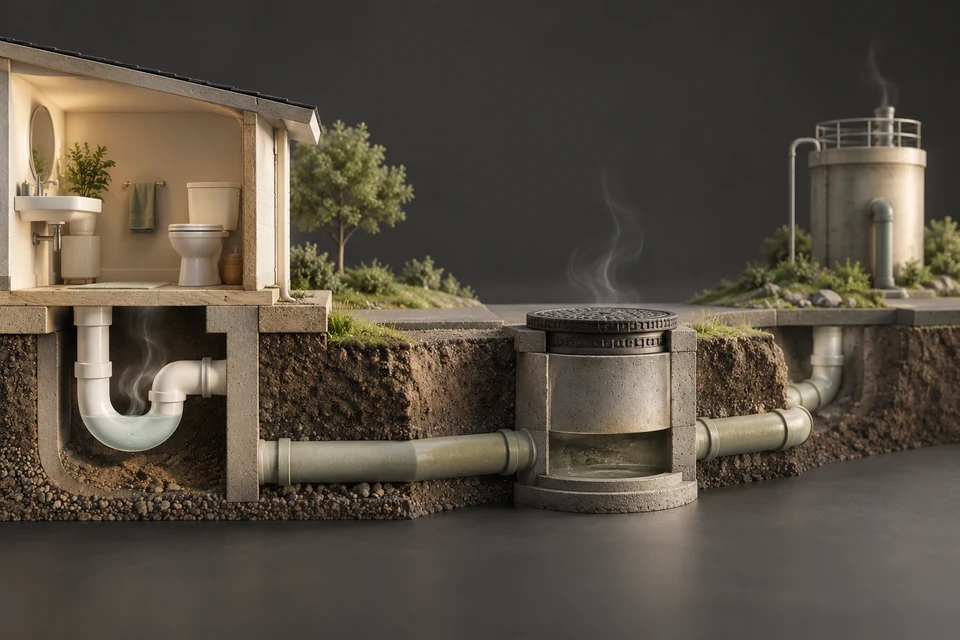
| Odour risk | Lower where flow stays fast | Higher at the discharge point, where low-oxygen wastewater is released |
| Main vulnerability | Sags, root intrusion, groundwater infiltration at joints | Pump failure, pressure bursts |
Which type a regional line uses depends on the ground between the two cities. The published descriptions of the Airdrie project do not set out its internal design or the route of its flows inside Calgary, so this page does not guess at them.
04 /Who pays for Calgary to treat a neighbour's wastewater?
The neighbour does, through regional rates. The City's regional servicing page says regional operations run on a 100 per cent cost recovery basis, with rates designed to recover the full cost of providing the regional service. Calgary residents' own rates are set separately, as explained in Calgary water and sewer rates.
- Operating cost: treatment, pumping and trunk sewer upkeep scale with volume, so the agreements are updated regularly to keep volumes and rates current.
- Capital cost: new capacity, such as trunk twinning or a larger connection, is financed up front and recovered over time, which is why council budget decisions and provincial grants appear in the news around projects like Airdrie's.
- Growth inside Calgary: a trunk built for regional flow can also open capacity for new Calgary communities along its route, so a single project often serves both.
The same trunk capacity serves Calgary's own growth. The treatment plants' inflows swing with rain and groundwater as well as population, a pattern the City's effluent data make visible; see Calgary wastewater data and monitoring.
05 /What does the City's record show for north Calgary communities?
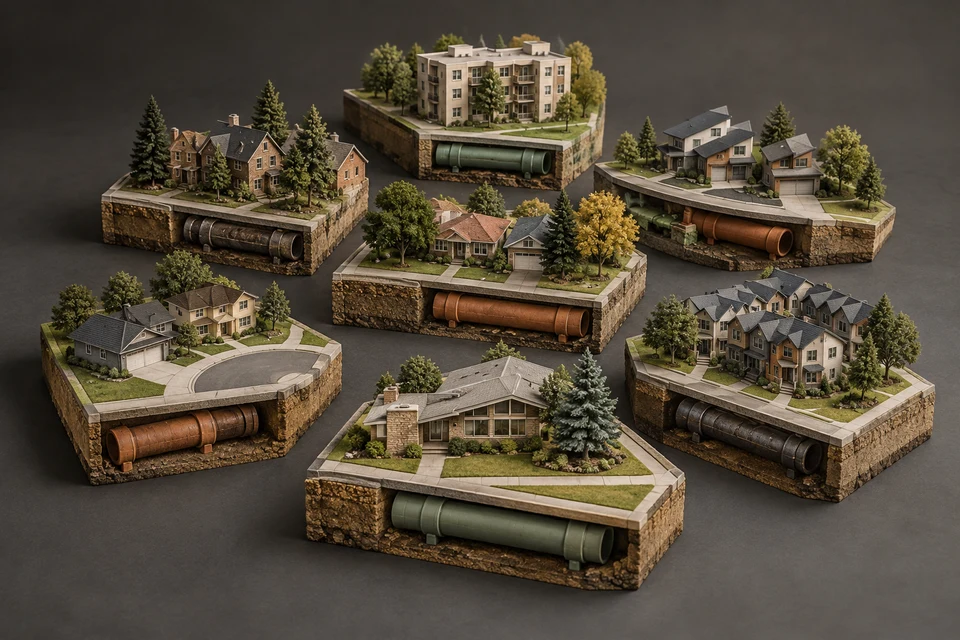
Almost entirely modern PVC on the City side, in contrast to the older communities south of them. The table below lists north Calgary communities from the City's Public Sanitary Service Lines records, from the oldest median install year to the newest. It says nothing about the trunk sewers that carry regional flow; it describes only the house connections in communities along the north corridor.
| Community | Service lines | Median install year | % clay tile (TIL) | % PVC | % relined (CIPP) |
|---|---|---|---|---|---|
| Thorncliffe | 2,511 | 1962 | 44.7 | 4.9 | 5.9 |
| Huntington Hills | 3,838 | 1969 | 82.1 | 9.2 | 6.8 |
| Beddington Heights | 3,613 | 1978 | 17.7 | 81.4 | 0 |
| Harvest Hills | 2,336 | 1995 | 0 | 91.1 | 0 |
| Coventry Hills | 5,266 | 2000 | 0 | 97.4 | 0 |
| Panorama Hills | 5,978 | 2005 | 0 | 96.8 | 0 |
| Evanston | 4,963 | 2011 | 0 | 100 | 0 |
| Livingston | 3,783 | 2021 | 0 | 100 | 0 |
| Carrington | 2,559 | 2021 | 0 | 100 | 0 |
| Glacier Ridge | 1,976 | 2023 | 0 | 100 | 0 |
| Keystone Hills | 324 | 2024 | 0 | 100 | 0 |
The pattern is the city's growth written into pipe: 1960s clay tile in the older north communities, a switch to PVC by the late 1970s and 1980s, and all-PVC records in the communities built since. The records cover only the City-owned portion from the main to the property line; the private pipe can differ, and large commercial and multi-family services are not included. TIL is the City's tile code, generally read as clay tile. Compare any community in the Community Sewer Atlas or browse the communities by sewer era.
06 /What should residents watch for as the pipeline is built?
Mostly project updates rather than any change at home. A regional pipeline does not alter who owns your service line or how your utility bill is calculated. The useful things to follow are public.
- Construction notices
The City of Airdrie leads the project. Work near the city limits, including any within Calgary, should come with notices from the responsible city.
- Provincial listing
The Alberta Major Projects listing records stage and completion dates and is updated as projects move forward.
- Council records
Borrowing, cost shares and agreement renewals go through Calgary and Airdrie council meetings, which publish agendas and minutes.
- Odour or spill concerns
If new infrastructure brings odour or an overflow near your home, report it to 311 with times and locations; see sewer smells in Calgary.
For the bigger picture of how wastewater moves from a house to the river, start with how Calgary's sewer system works.
FAQQuestions people ask
Does Airdrie send its sewage to Calgary?
Yes. The City of Calgary lists Airdrie as a regional customer for both water and wastewater. Airdrie carries its wastewater to the Calgary city limits, and Calgary treats it.
How long is the Airdrie–Calgary wastewater pipeline?
About seven kilometres, according to the Government of Alberta's major projects listing, which puts its estimated cost at $114 million.
When will the Airdrie wastewater pipeline be finished?
The provincial listing and the City of Airdrie both give 2026 for the start of construction and 2027 for completion. Large projects can slip, so check the listing for the current schedule.
Which communities does Calgary treat wastewater for?
According to the City, Airdrie, Chestermere, Strathmore, Tsuut'ina Nation, Foothills County (Spruce Meadows) and a power plant in Rocky View County. Cochrane and parts of Rocky View County receive water only.
Do Calgary residents pay for Airdrie's wastewater?
The City says regional servicing runs on a 100 per cent cost recovery basis, with rates designed to recover the full cost of serving regional customers.
Which treatment plant handles north Calgary's sewage?
Flows from north Calgary travel through the Nose Creek sanitary trunk system to the Bonnybrook Wastewater Treatment Plant, according to the provincial description of the City's Nose Creek trunk project.
NETWORKGo deeper across the HAUSE Sewer network
What causes sewer backup, and how to tell which cause is yours
What causes sewer backup: roots, grease, wipes, sags, broken pipe, frozen lines and rain-overloaded city sewers, plus how to tell which one caused yours.
SewerRoots.caSewer lining for tree roots: will a CIPP liner stop them for good?
Sewer lining for tree roots: how a CIPP liner seals root-damaged joints, which lines qualify, preparation, weak points at the ends, and planning costs.
PipeCleaning.caDuctile iron pipe, cement linings and how pipelines are cleaned
What ductile iron pipe is, how it is made, why it is cement lined and where it is used, plus how water mains and pipelines are cleaned with pigs and flushing.
SOURCESSources and further reading
- City of Calgary — Regional water servicing
- Government of Alberta — Major Projects: Airdrie Wastewater Pipeline Expansion
- Government of Alberta — Major Projects: Nose Creek Sanitary Sewer Trunk
- City of Airdrie — City of Airdrie receives $50 million for wastewater line
- City of Calgary open data — Public Sanitary Service Lines (xesp-3jc3)