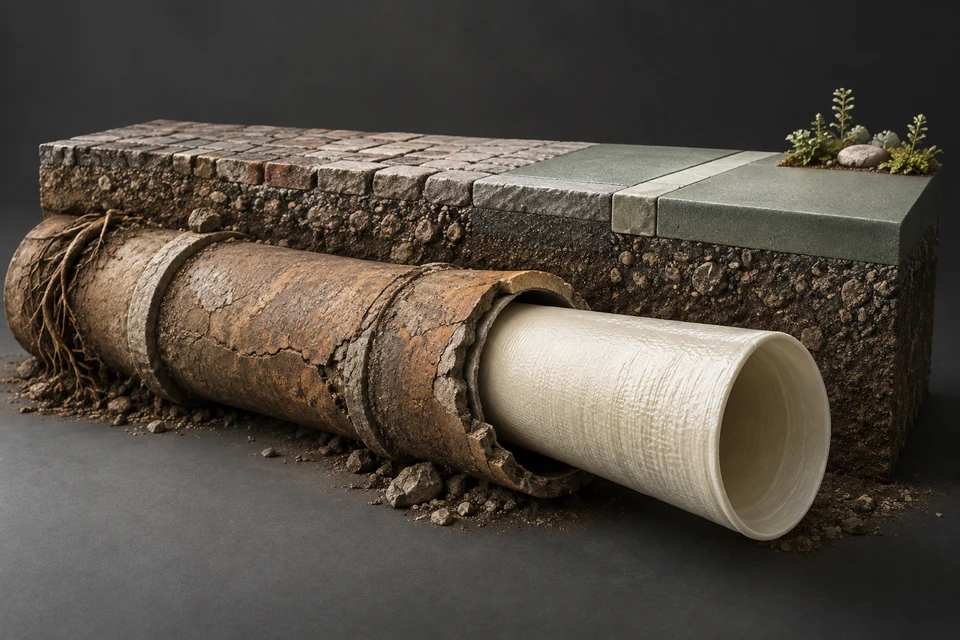
In March 2025, one of three pipes carrying untreated wastewater under the Bow River to the Bonnybrook plant leaked on the east bank near the Ogden Road bridge. Falling plant inflows from 19 March and high E. coli readings led crews to it on 28 March; they closed its valve and diverted flow to the other two pipes. Drinking water, drawn upstream, was not affected.
- The March 2025 leak was found through falling flows at the Bonnybrook plant, then river E. coli sampling and a bank inspection, nine days after the first signal.
- Three pipes cross under the Bow to Bonnybrook; closing the leaking one and diverting to the other two kept the sewer system running.
- Calgary draws drinking water upstream of the city, so a release near Bonnybrook does not reach its intakes.
- City river data show E. coli rising as the Bow passes through Calgary: a 2021–2025 median near 1 per 100 mL below Bearspaw Dam against about 50 at Policeman's Flats.
- Anyone can report a suspected release to 311 and to Alberta's 24-hour Energy and Environmental Response Line at 1-800-222-6514.
01 /What happened in the March 2025 sewage leak into the Bow River?
A wastewater pipe crossing under the river failed near the Bonnybrook Wastewater Treatment Plant, and untreated sewage escaped into the Bow for several days before it was found. The City's news release of 29 March 2025 sets out how the leak was traced. The dates below follow that release.
| When | What the City reported |
|---|---|
| 19 March | Monitoring at Bonnybrook showed wastewater arriving at the plant at lower than normal levels |
| The following days | Levels kept dropping; crews checked the plant, seasonal patterns, regional customers, lift stations and 311 reports without finding a cause |
| 27 March | Water samples taken and the river bank near the plant inspected; no visible leak |
| 28 March, morning | Results showed elevated E. coli in the river near Bonnybrook; a second inspection at about 11 a.m. found a visible leak on the east bank by the Ogden Road bridge |
| 28 March, by 2:30 p.m. | The failing pipe was identified, its valve closed and flow rerouted to the two other pipes |
| 29 March | The City announced the leak; flows into Bonnybrook had returned close to normal |
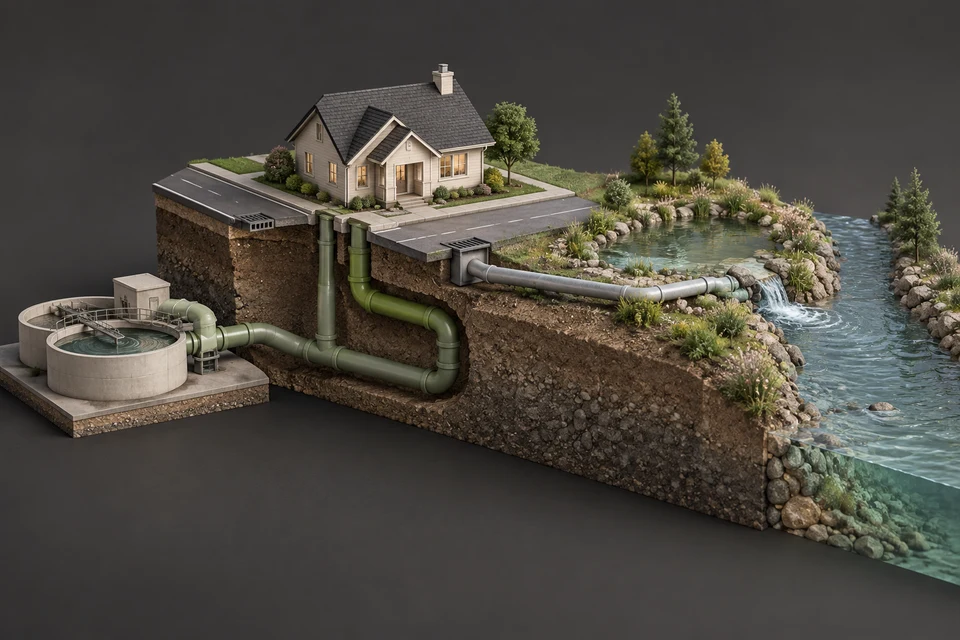
The release also describes the layout that made the fix possible. Three pipes at that crossing carry untreated wastewater under the river to the plant, and they are designed to back each other up. Once one was isolated, the other two carried the full flow and household service continued as normal.
02 /How much sewage reached the river?
Nobody measured it directly, because a leaking pipe under a river has no meter on the leak. What the City had was the gap between normal and actual inflow at Bonnybrook. News coverage at the time reported City officials saying the total could not be calculated with precision, and citing a shortfall of more than 100 million litres over roughly a week. Treat that as an order-of-magnitude figure rather than a measurement.
For scale, the City's effluent data put Bonnybrook's average treated outflow in 2025 at about 405,000 cubic metres a day, or roughly 405 million litres. A shortfall in the region of 100 million litres spread over several days is a small fraction of the plant's daily flow, which is one reason the drop took days to separate from ordinary variation. It was still raw sewage entering a river, and the City notified downstream communities, including Heritage Pointe and the Siksika Nation, and offered help with water quality testing.
03 /Was Calgary's drinking water affected?
No. The City stated that Calgary's drinking water comes from sources upstream of the leak and remained safe to drink, and that Alberta Health Services judged the public risk, on the data available, to be extremely low. No boil-water advisory or recreational restriction was in place when the release was issued.
Geography is the reason, and the City's release says so directly: the sources of Calgary's drinking water are upstream of the leak. Bonnybrook sits in the southeast, by the Ogden Road bridge, and a river carries a release away from anything above it. Placing treatment plants below water intakes is a basic principle of municipal servicing. The City still advised people and pets to keep away from the affected area and said fish should be cooked before eating.
04 /What do the City's river water quality data show?
They show the Bow picking up bacteria as it crosses the city, in every year, not just during incidents. The City's Watershed Surface Water Quality Data on its open data portal hold grab-sample results from rivers, creeks and reservoirs, analysed by the City's ISO/IEC 17025-accredited laboratory. The table below summarizes E. coli results at five Bow River sites from upstream to downstream.
| Site | Samples | Median | 90th percentile |
|---|---|---|---|
| Below Bearspaw Dam | 60 | 1 | 8.5 |
| Pumphouse | 59 | 5.2 | 20.3 |
| Cushing Bridge | 97 | 31.8 | 137.4 |
| Policeman's Flats | 60 | 50.4 | 125.9 |
| Upstream of the Highwood River | 51 | 35.0 | 81.3 |
The step from single digits upstream to tens of organisms per 100 mL below the city reflects everything an urban area adds: stormwater from streets and lanes, wildlife and pets, and treated effluent that has been disinfected but is not sterile. The routine program takes grab samples about once a month at most of these sites, more often in summer at a few, so it describes the river's normal state rather than catching short events. In 2025 the regular Policeman's Flats samples fell on 11 March and 8 April, bracketing the leak without sampling it; the 8 April result, 30.5, was within the usual range.
That is why the leak was detected at the plant, not in the river program. A steady fall in inflow is a signal the utility watches every day, and targeted river sampling followed. For the plants' own effluent records, see Calgary wastewater data and monitoring.
05 /What else sends pollution into the Bow in Calgary?
Stormwater is the largest routine source of sediment, and it is untreated at most outfalls. The City's stormwater quality retrofit program page reports that a 2005 study found 90% of the sediment entering the Bow from Calgary came from the stormwater system, and that 75% to 80% of the outfall system had no treatment facilities. The same page says stormwater contributes about ten times more suspended solids to the rivers than the treatment plants' outflow.
| Route | Treated first? | Main concern | Where to read more |
|---|---|---|---|
| Treatment plant effluent | Yes, including UV disinfection | Residual nutrients and solids within approval limits | Treatment plants |
| Storm outfalls | Mostly no; some through ponds and wetlands | Sediment, oil, salt, pet waste, anything poured into a catch basin | Sanitary vs storm sewers |
| Pipe failures and spills | No | Raw sewage, for as long as the release lasts | This page |
| Construction bypass pumping | No, if it fails | Overflows from temporary pumps | City sewer maintenance |
Spills into storm drains are a Stormwater Bylaw matter. The City's penalty guide for Stormwater Bylaw 37M2005 lists a $3,000 specified penalty for releasing a prohibited material into the storm drainage system and $500 for failing to notify the City of a release, as checked September 2026. The rules are laid out in Calgary's drainage bylaw and permits.
06 /How do you report sewage in the river or a sewage spill?
Report to both the City and the province. The City handles its own pipes, storm drains and bylaw enforcement through 311. The Government of Alberta runs the Energy and Environmental Response Line, which it describes as a 24-hour line for environmental emergencies, incidents and complaints, including releases of any substance with the potential for adverse effects and public complaints about spills or water quality.
| Situation | Call | Notes |
|---|---|---|
| Sewage on a street, in a park or pouring from a manhole | 311, or 403-268-2489 from outside Calgary | Give the nearest address or intersection and photos |
| Discoloured or foul water at a storm outfall or in the river | 311 and the Energy and Environmental Response Line, 1-800-222-6514 | From outside Alberta the provincial line is 780-422-4505 |
| Someone dumping into a catch basin | 311 | Stormwater Bylaw enforcement; anonymous bylaw complaints are not accepted |
| Immediate danger to people | 911 | The bylaw penalty guide lists a separate offence for failing to call 911 when a discharge endangers health or safety |
- Note location precisely
The provincial line asks for a legal land location, address or GPS coordinates. A phone map pin works.
- Describe what you see and smell
Colour, solids, odour, foam, whether flow is continuous, and how long it has been going on if you know.
- Say where it seems to come from
An outfall pipe, a manhole, a construction site, a pump hose. The source is the most useful fact for responders.
- Keep clear
Do not wade in or touch the water, and keep pets out. Sewage carries pathogens and outfalls can have fast, deep flow.
07 /What does the leak mean for Calgary's sewer system as a whole?
It shows both the weakness and the strength of a gravity network that has to cross rivers. River crossings are among the hardest pipes to inspect, because they sit under water and often run full. The redundancy at the Bonnybrook crossing meant the failure was an environmental incident rather than a service outage for the city.
For homeowners, the connection is more direct than it seems. Every litre of groundwater that seeps into a cracked private service line is carried, pumped and treated at the public's cost, and in a wet week the extra volume makes it harder to see a genuine loss of flow at a plant. Knowing what your own line is made of is a small contribution. Look up the City's record for your address with the Service Line Lookup or see how your community compares in the Community Sewer Atlas.
FAQQuestions people ask
When did sewage leak into the Bow River in Calgary?
The City first saw falling inflows at the Bonnybrook plant on 19 March 2025, found the leak on the east bank near the Ogden Road bridge on 28 March, and announced it on 29 March after isolating the pipe.
Is the Bow River safe after a sewage leak?
In 2025 Alberta Health Services judged the public risk extremely low, and there were no recreational restrictions when the City announced the leak. The City still advised people and pets to avoid the affected area. Check current advisories before swimming or wading after any reported release.
Did the Bonnybrook leak affect Calgary tap water?
No. The City said its drinking water comes from sources upstream of the leak and remained safe. Bonnybrook is downstream of the city's water intakes.
How much sewage leaked into the Bow River?
The City said the total could not be calculated precisely. News reports quoted City officials describing a shortfall of more than 100 million litres over about a week, estimated from reduced inflow at the plant.
Who do I call about sewage in a Calgary river or creek?
Call 311 for the City and Alberta's Energy and Environmental Response Line at 1-800-222-6514, which operates 24 hours. Call 911 if anyone is in immediate danger.
Where can I see Bow River water quality data for Calgary?
The City publishes its Watershed Surface Water Quality Data on data.calgary.ca, with grab-sample results for E. coli, suspended solids, nutrients and other parameters at river, creek and reservoir sites.
NETWORKGo deeper across the HAUSE Sewer network
What dissolves tree roots in sewer lines? Salt, vinegar, bleach, lye and enzymes tested against the facts
What dissolves tree roots in sewer lines? Why salt, vinegar, bleach, lye and enzymes fail on a root mass, the hazards they add, and what clears roots instead.
SewerCleaners.caWhat causes sewer backup, and how to tell which cause is yours
What causes sewer backup: roots, grease, wipes, sags, broken pipe, frozen lines and rain-overloaded city sewers, plus how to tell which one caused yours.
SewerInspector.caSewer scope on a new build: what goes wrong in brand-new sewer lines
Is a sewer line inspection necessary for new construction? What goes wrong in new laterals, when to scope before warranty dates, and what to ask the builder.
SOURCESSources and further reading
- City of Calgary Newsroom — City of Calgary responds to wastewater leak in Bow River (29 March 2025)
- City of Calgary open data — Watershed Surface Water Quality Data (y8as-bmzj)
- City of Calgary — Stormwater quality retrofit program
- Government of Alberta — Energy and Environmental Response Line
- City of Calgary — Stormwater Bylaw 37M2005 specified penalties