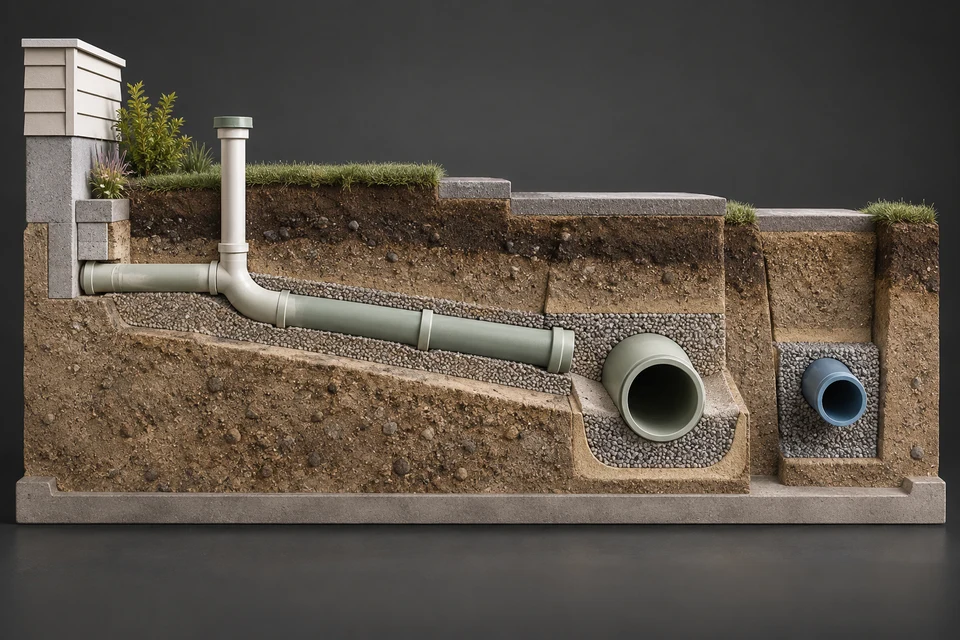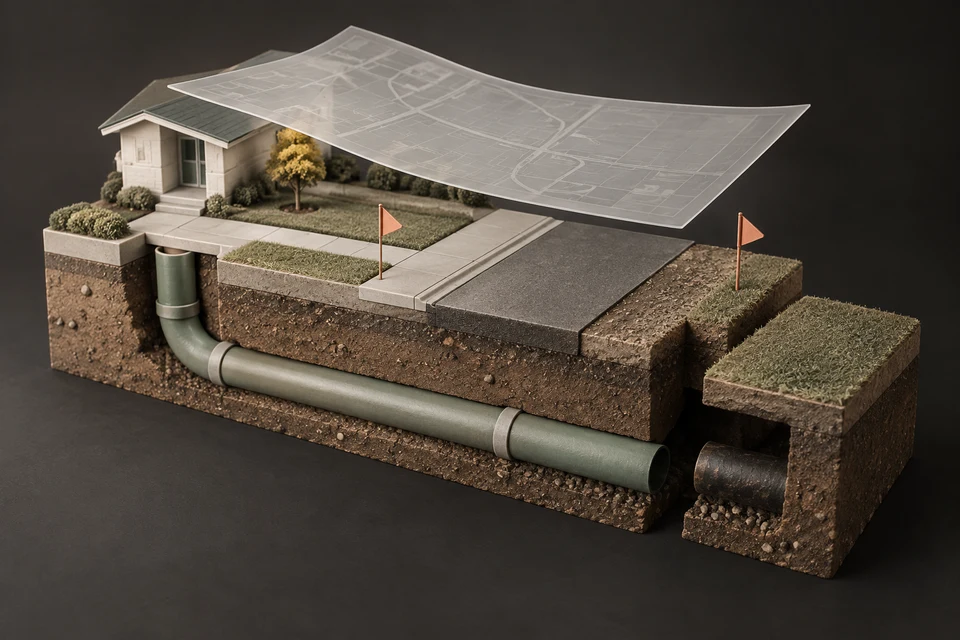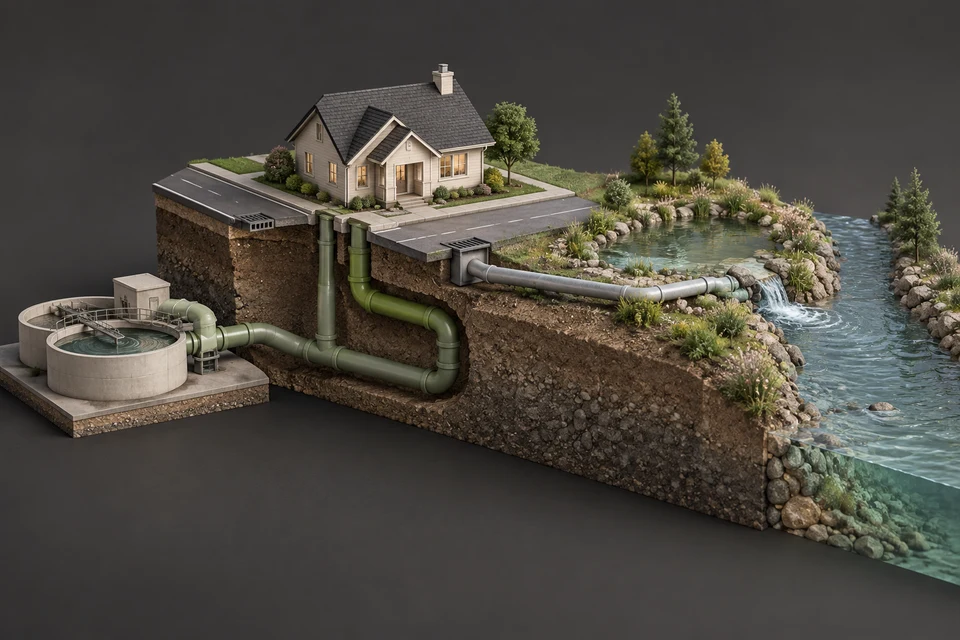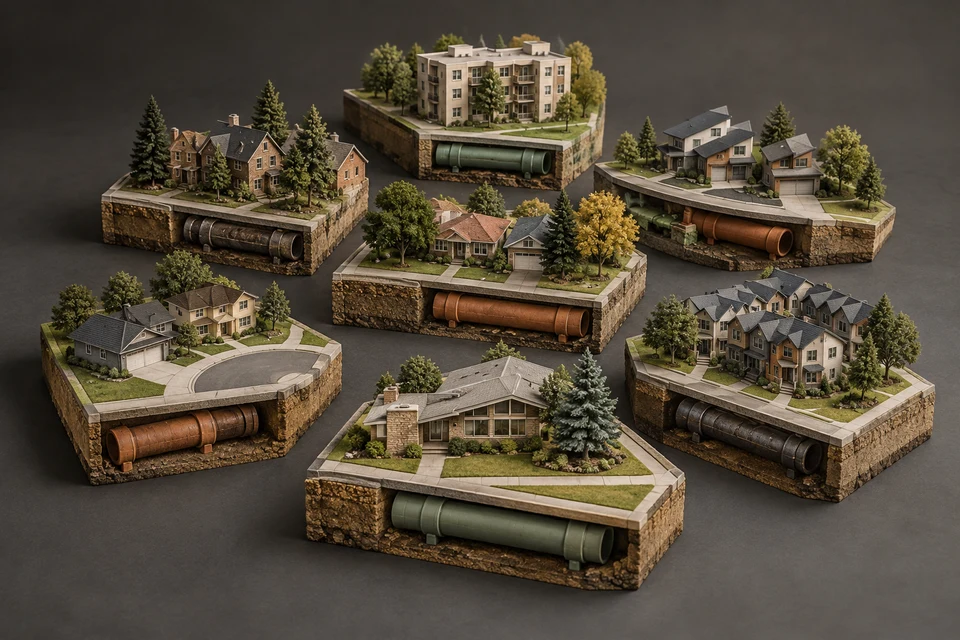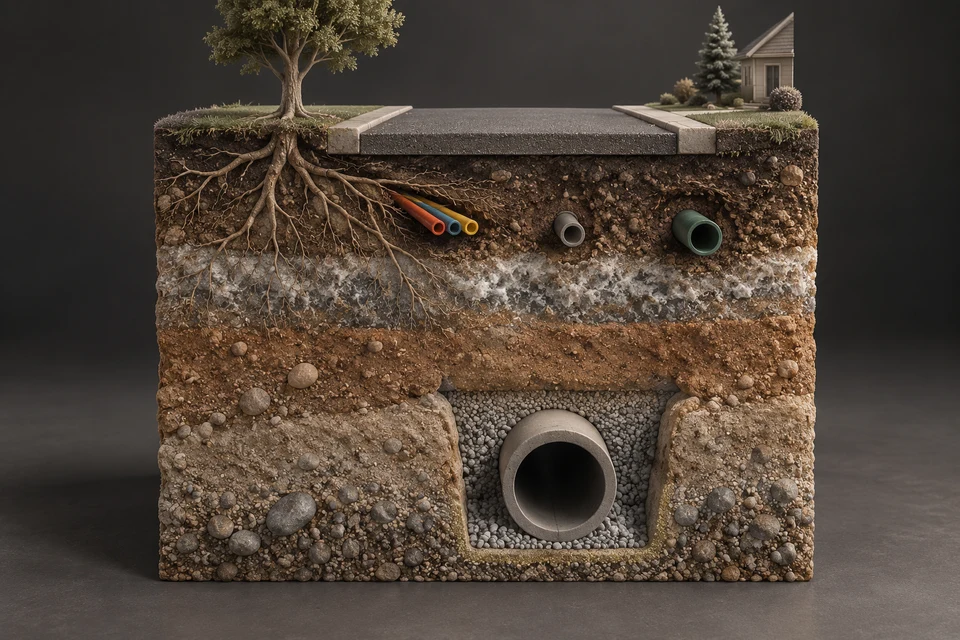
Calgary's sanitary sewer mains are laid deep: the City's design guidelines require at least 2.5 m of cover over sanitary pipe in the public right-of-way, and the City describes digging 8 to 24 feet to reach mains during repairs. A house's service line rises from the main toward the basement, so it is usually shallower near the house. Other utilities can be much shallower, and locate marks never show depth.
- City design guidelines call for at least 2.5 m of cover over sanitary sewers in the public right-of-way, compared with 1.2 m for storm sewers.
- On-site water service pipes need 2.7 m of cover in clay and 3.3 m in gravel under the same guidelines, a sign of how seriously frost is taken.
- The Alberta Geological Survey describes Calgary ground as till or lake sediment over quartzite gravel or very hard sandstone bedrock, which can make digging difficult.
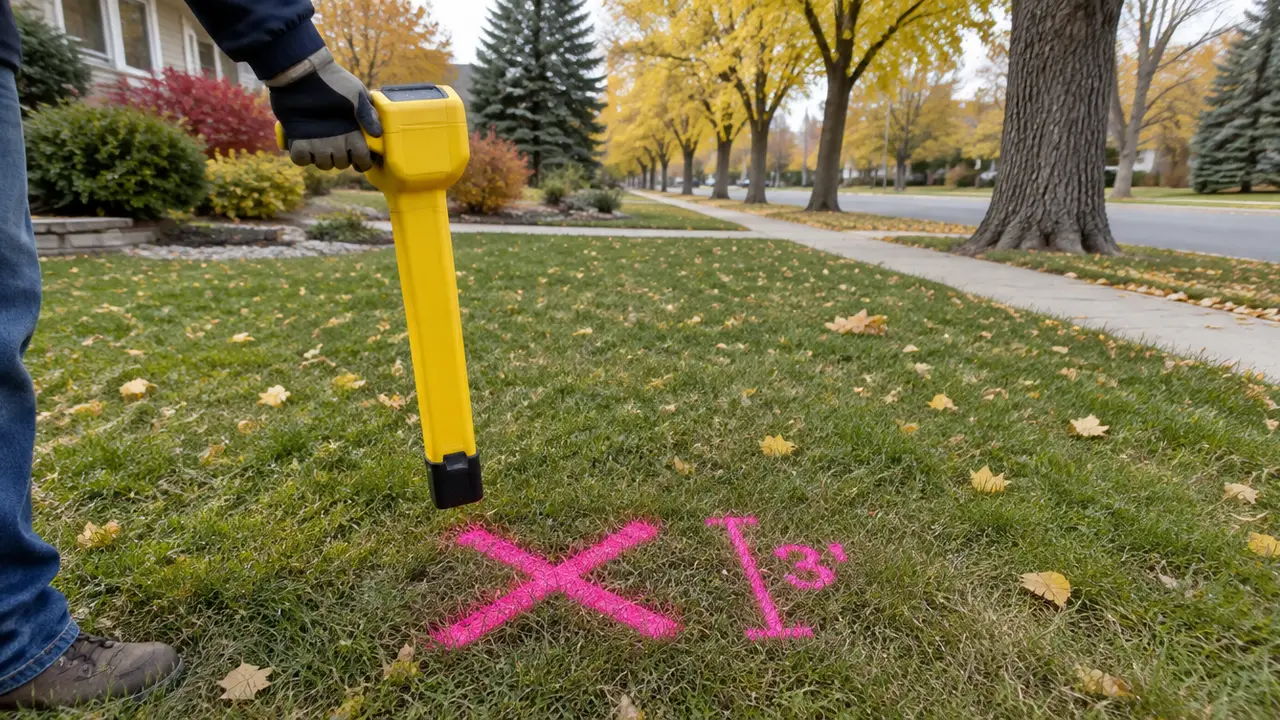
- Utility Safety Partners says locate marks show approximate location, not depth, and that some utilities lie only centimetres down.
- The depth of your own sewer line is measured with a camera and sonde during an inspection.
01 /How deep are sanitary sewer lines in Calgary?
Deeper than most people expect. The City's 2018 Design Guidelines for Development Site Servicing Plans set a minimum cover of 2.5 m for sanitary sewers in the public right-of-way, measured from the top of the pipe to finished grade. An earlier, 2014 edition of its subdivision guidelines gave a preferred depth range of 2.6 to 3 m for sanitary mains and barred service connections to mains deeper than 6 m to the crown.
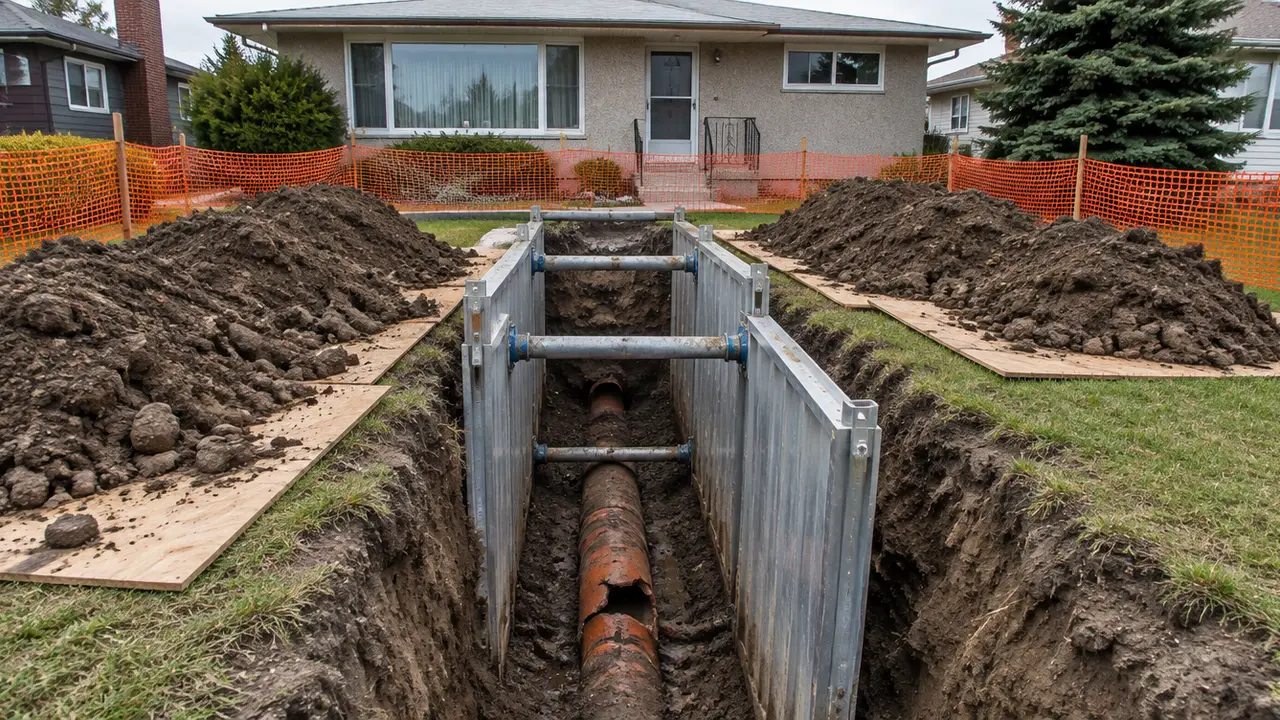
Repairs show the real range. On its page about sanitary main and sewer pipe breaks, the City describes excavating through between 8 and 24 feet of asphalt, dirt and other material to reach the pipe, roughly 2.4 to 7.3 m. Trunk sewers and mains on hilly streets can be far deeper than the minimum.
| Line | Depth guidance | Source and status |
|---|---|---|
| Sanitary main, public right-of-way | At least 2.5 m of cover; 2.6 to 3 m preferred in the 2014 edition | City design guidelines |
| Sanitary main during repairs | Crews dig 8 to 24 feet (about 2.4 to 7.3 m) | City sanitary main break page |
| Storm sewer, public right-of-way | At least 1.2 m of cover | City design guidelines |
| Water service on a development site | 2.7 m in clay, 3.3 m in gravel | City design guidelines |
| House sewer service line | Deepest at the main, rising toward the basement at a 2% minimum on the City side | Varies by lot; measure with a sonde |
| Gas, power and communication lines | Can be only centimetres below the surface | Utility Safety Partners guidance |
02 /Why are Calgary's sewers buried so deep?
Two physical constraints set the depth: gravity and frost. A sanitary sewer has to collect wastewater from basement fixtures and still slope downhill all the way to the main, so the main must sit below the lowest basement drain on the street, plus enough fall for the service line. Frost adds a second floor: wastewater flows all winter, and a pipe that freezes backs up.
Calgary winters make frost unpredictable. Frost depth changes from winter to winter and from lot to lot. Snow cover insulates the ground, so frost drives deepest under driveways, sidewalks and anywhere snow is cleared, and chinook thaws followed by hard freezes mean the ground near the surface can freeze, thaw and refreeze several times in one winter. The City's rules show how seriously it takes frost: water services on development sites must have 2.7 m of cover in clay and 3.3 m where the ground is gravel. The deeper gravel figure is consistent with frost penetrating coarse, well-drained ground more readily than clay.
The service line is the part most at risk. Near the house it may be well above the depth of the main, especially where a lot was regraded or a shallow line was run under a driveway. That is why frozen laterals, when they happen, are usually close to the house or under cleared hard surfaces rather than near the main.
03 /What is the ground like around Calgary sewer lines?
Variable, and often hard work. Mapping by the Alberta Geological Survey (Bulletin 53, S. Moran, 1986) found glacial till or old lake sediment sitting on quartzite gravel or very hard sandstone across the Calgary area. Where that surface layer is thin, the survey warned, excavation becomes difficult and construction costs can climb sharply.
- Clay-rich till: holds its shape in a trench when dry but can soften when wet; shrinks and swells with moisture, which moves joints in rigid old pipe.
- Gravel and cobble lenses: drain well and tend to let frost in deeper; cobbles slow excavation and can complicate trenchless methods.
- Sandstone bedrock: where it is close to the surface, excavation may need heavier equipment.
- Lake sediments near the valleys: the survey noted slope failures on steep slopes along the Bow River valley in thick lake deposits with saturated permeable beds.
Ground movement is a real cause of pipe failure, and the City lists soil types and ground conditions, temperature-driven ground shifting and vibration among the common causes of sanitary main breaks. The same forces act on private service lines, which is one reason older jointed pipe develops offsets and bellies. The design side is covered in Calgary sewer design standards.
04 /How deep are utility lines buried in Calgary, and how do you find them?
There is no single answer, which is exactly why locates exist. Utility Safety Partners, Alberta's one-call locate service, says locate markings identify the approximate location of buried utilities and do not identify depth, and that some utilities are buried only centimetres below the surface. Its homeowner guidance is to request a free locate at least three full working days before digging, online or at 1-800-242-3447.
- Request the one-call locate
Utility Safety Partners notifies member utilities, which mark their lines in your dig area. Allow extra time when it reports high request volumes.
- Hire a private locator for your own lines
Customer-owned water and sewer service lines are not located by the one-call service. A private locator or a drain contractor with a sonde finds them.
- Hand-dig near the marks
Within one metre on either side of a mark, or five metres from high-pressure pipelines, the one-call guidance is to expose the line carefully with hand tools.
- Record what you find
Photograph exposed lines with a tape measure for depth and keep the photos with your house records.
05 /How do you find the depth of your own sewer line?
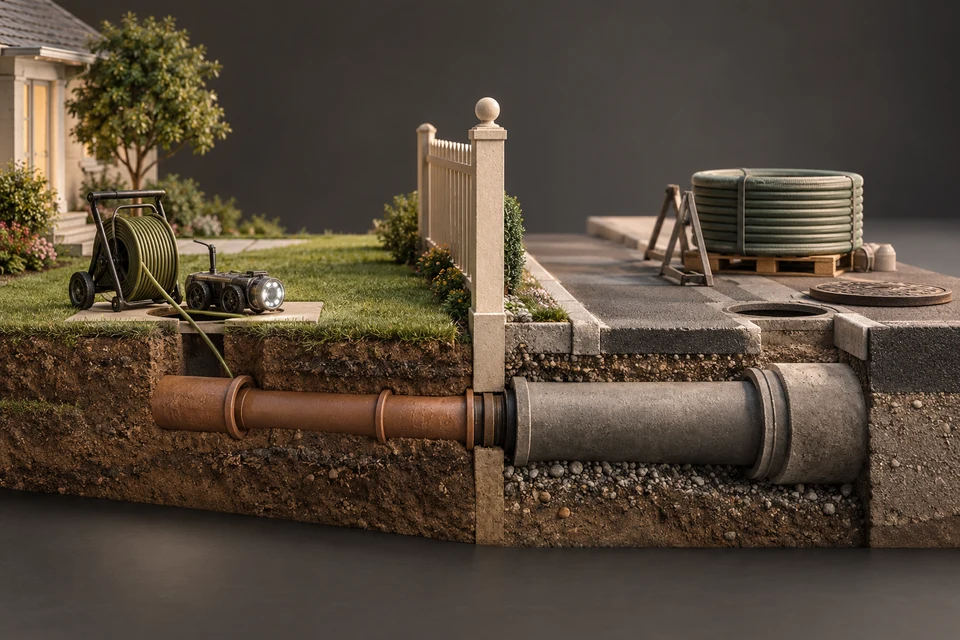
A camera inspection with a sonde gives depth readings along the run. The operator stops the camera at intervals, locates the sonde from the surface, and reads an estimated depth from the receiver. Ask for readings at the foundation, at any defect, at the property line and near the main.
| Point | Why it matters |
|---|---|
| Where the line leaves the foundation | Sets the shallowest point and the frost risk near the house |
| Under driveways and walkways | Cleared surfaces let frost in deeper; shallow pipe here is the usual freeze point |
| At each defect | Depth drives the cost and method of a repair |
| At the property line | Marks where the City's segment begins; the City's record gives its length but not its depth |
| Near the main | Usually the deepest point; affects any connection work |
Readings are estimates; accuracy depends on the equipment, the depth and interference from other metal nearby. Where precise depths of City mains are needed for design, the City points professionals to its Electronic Block Profile data, as noted in Calgary sewer maps. For a homeowner, the sonde readings are usually enough to plan. You can request quotes for a camera inspection with locating, and see the City's record for your connection with the Service Line Lookup.
FAQQuestions people ask
How deep are sanitary sewer lines in Calgary?
The City's design guidelines require at least 2.5 m of cover over sanitary sewers in the public right-of-way, and the City describes digging 8 to 24 feet to reach mains during repairs. House service lines are shallower near the house.
How deep are utility lines buried in Calgary?
It varies by utility and site. Utility Safety Partners warns that some lines are only centimetres below the surface and that locate marks do not show depth, so hand-dig within one metre of any mark.
How deep is the frost line in Calgary?
There is no fixed number; frost depth varies by winter, snow cover and soil. The City's design guidelines require 2.7 m of cover for on-site water services in clay and 3.3 m in gravel, which shows how deep designers plan for.
Why is my Calgary sewer line so deep at the street?
Mains must sit below the basements they drain and below frost. The City's guidelines set a 2.5 m minimum cover for sanitary pipe in the public right-of-way.
Can I find my sewer line depth without digging?
Yes. A camera inspection with a sonde transmitter lets a locator read estimated depths from the surface at points along the line.
NETWORKGo deeper across the HAUSE Sewer network
Sewer scope inspections in Edmonton: what to expect and who to call
Sewer scope and sewer line inspection in Edmonton: what mature and newer neighbourhoods show on camera, cold and clay soils, elms, EPCOR and 311 checks.
SewerRoots.caPlanting Distance Checker
Planting Distance Checker: pick a tree, shrub or perennial group, enter its distance from the sewer lateral, and see if the spot meets the guideline.
SewerCleaners.caWhere is my backwater valve? How to find it, recognize it and open the cover
Where is the backwater valve in a house? How to find it, what it looks like, what access box, sleeve and cover mean, how to open it safely, and valve alarms.