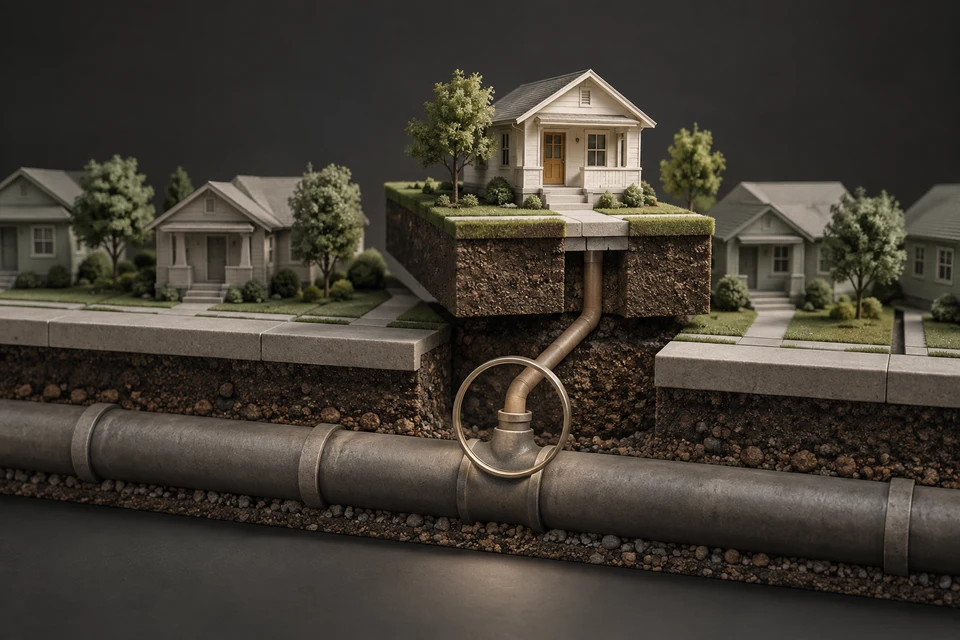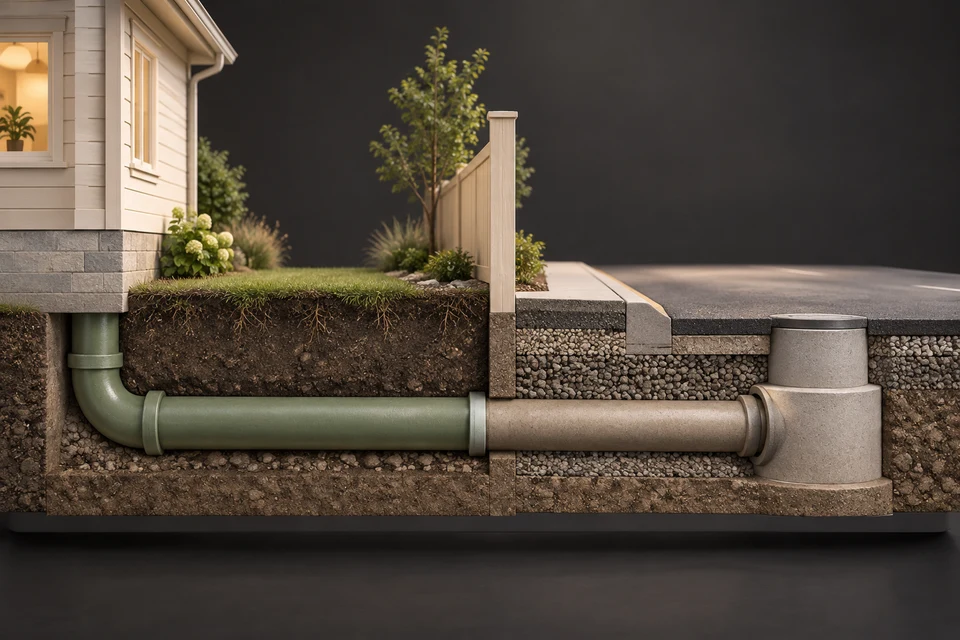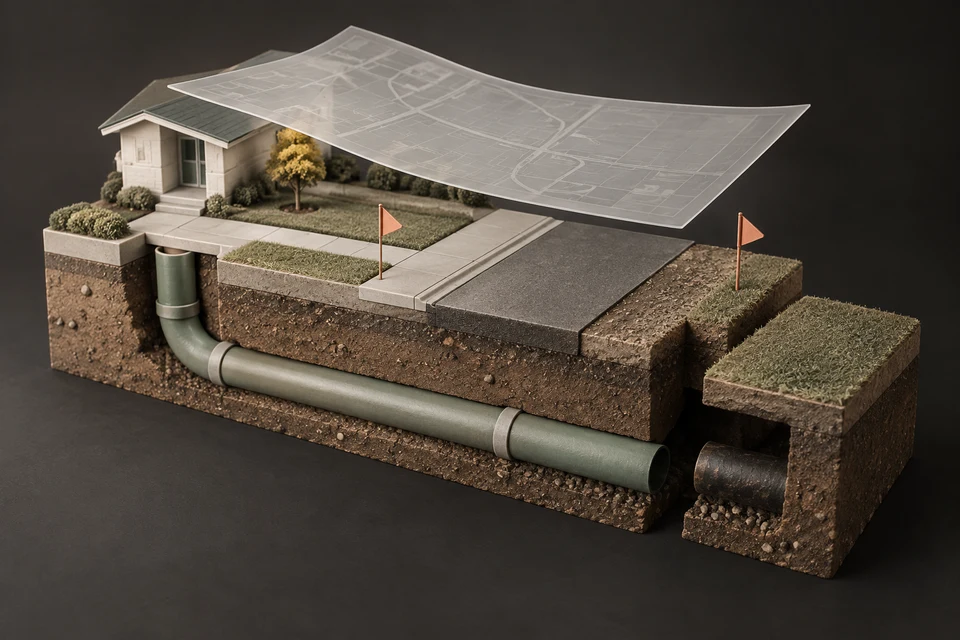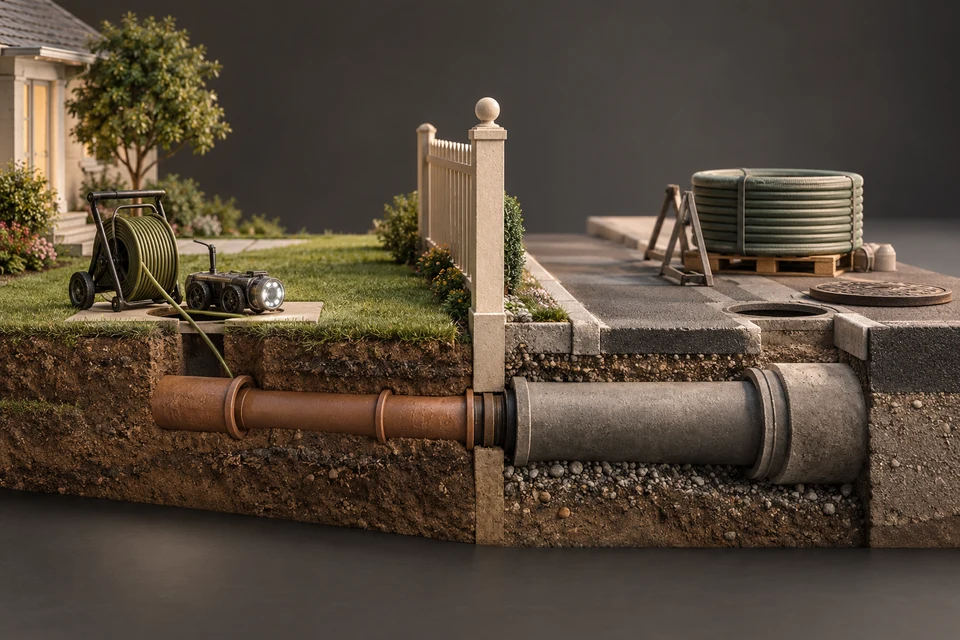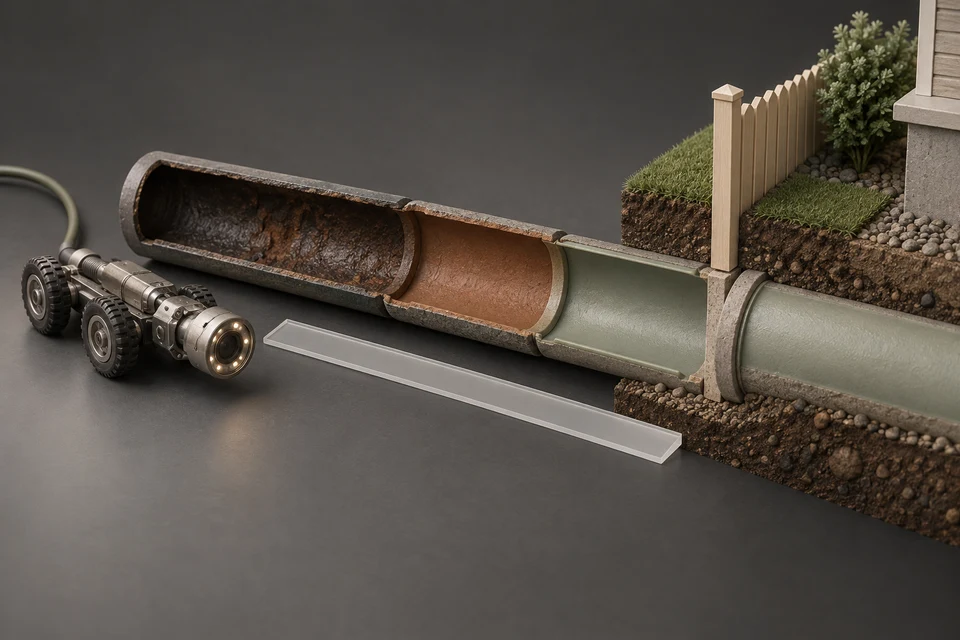
A sewer scope shows the condition of your whole line on video; the City of Calgary's service line record shows the material, date and length of the City-owned segment. Used together, they tell you where the property line falls on the video, which defects are on which side, and what to report to 311. Pull the City record before the scope and give it to the camera operator.
- The City record covers only the segment from the main to the property line; the scope is the only way to see the private segment.
- The City's public-side length lets you estimate where the property line falls on the footage counter.
- A material change on the video near that point usually marks the transition between private and City pipe.
- Defects at or past the property line should go to 311 with the video, distances and the access point used.
- A scope company that asks for your City record, locates defects and reaches the main gives you evidence you can use.
01 /What does each source tell you?
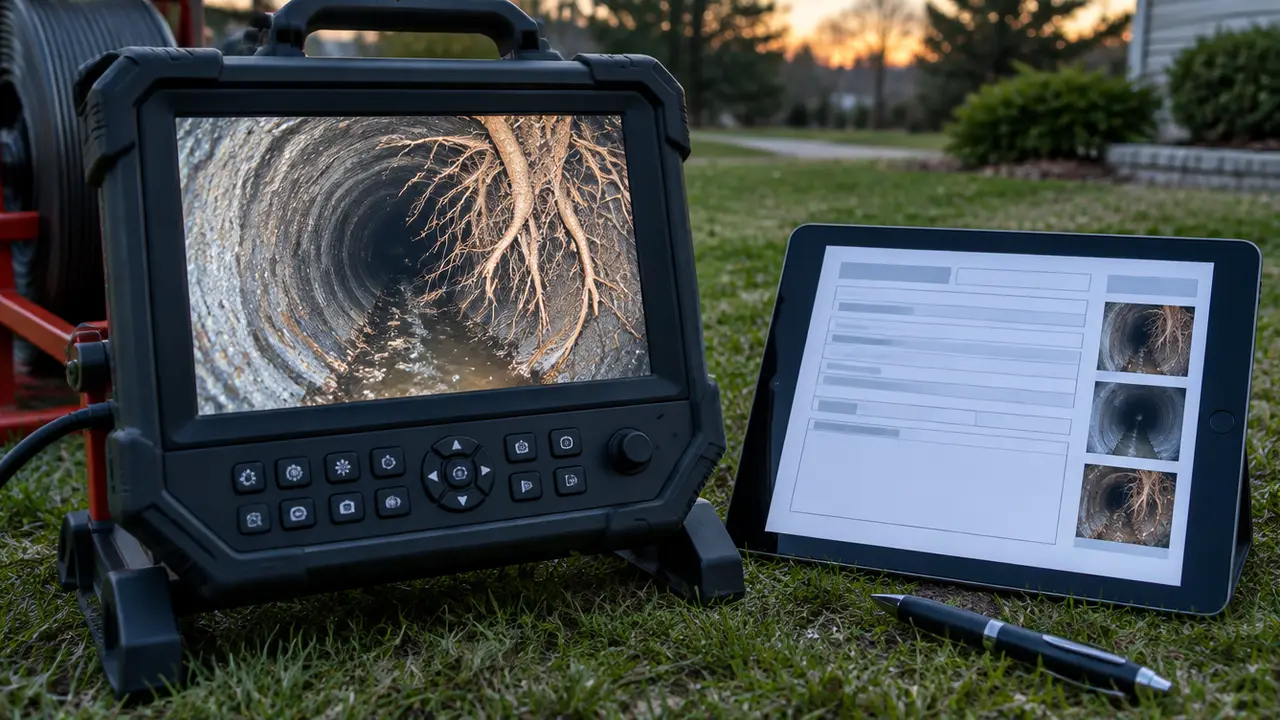
They answer different questions, and neither answers all of them. The City's record is an inventory entry; the scope is an inspection. Putting them side by side is what turns a video into a decision.
02 /How do you find the property line on a scope video?
Work backward from the main using the City's public-side length. The footage counter measures distance along the pipe from the access point; the City's record tells you roughly how long the City's segment is. Subtract one from the other and you have an estimate of where the property line falls on the counter.
- Get the City's numbers first
Use the Service Line Lookup to note the City-side material code and public-side length for your address.
- Note where the counter was zeroed
Ask the operator to state the access point, usually a basement cleanout, and confirm the counter was zeroed there.
- Find the main on the video
The distance where the camera enters the main is the total length from the access point.
- Subtract the public-side length
Total length minus the City's public-side length gives an approximate counter reading for the property line.
- Look for a transition nearby
A change of material, a joint of a different type or a repair coupling close to that reading usually marks where City and private pipe meet.
- Confirm on the surface
Have the operator locate the sonde at that point and measure to the property line on the ground.
Treat the result as an estimate. The public-side length is a mapped figure, the counter can drift on long runs, and a line rarely runs perfectly straight. The goal is to know whether a defect is clearly on one side or close enough to the line that the City should look.
The City's numbers help set expectations before the camera goes in. Citywide, the public-side length averages about 8.1 m, and 55.9% of recorded lengths are between 5 and 10 m. TIL-coded City segments average about 6.1 m and cast iron about 10.2 m. If your scope shows the main 30 m from a basement cleanout, most of that run is probably yours.
03 /What does a worked example look like?
Here is a hypothetical house, built in the early 1970s, to show the arithmetic. None of these numbers comes from a real address.
| Item | Source | Value |
|---|---|---|
| City-side material | City record | TIL (the City's tile code, generally clay tile) |
| Public-side length | City record | 7.0 m |
| Access point | Scope report | Basement cleanout, counter zeroed at the cap |
| Camera enters the main | Scope video | 22.5 m |
| Estimated property line on the counter | 22.5 m minus 7.0 m | About 15.5 m |
| Material change seen | Scope video | Cast iron to clay at 3.2 m (under the foundation); clay continues to the main |
| Root mass at a joint | Scope video | 11.8 m, private side |
| Offset joint | Scope video | 17.9 m, about 2.4 m past the estimated property line |
In this example, the root mass is clearly the owner's to deal with. The offset joint appears to be on the City side and is worth reporting to 311 with the video, the counter readings, the access point and the City record. The City assesses and makes the final determination on its own pipe.
04 /Does the City of Calgary inspect private sewer lines?
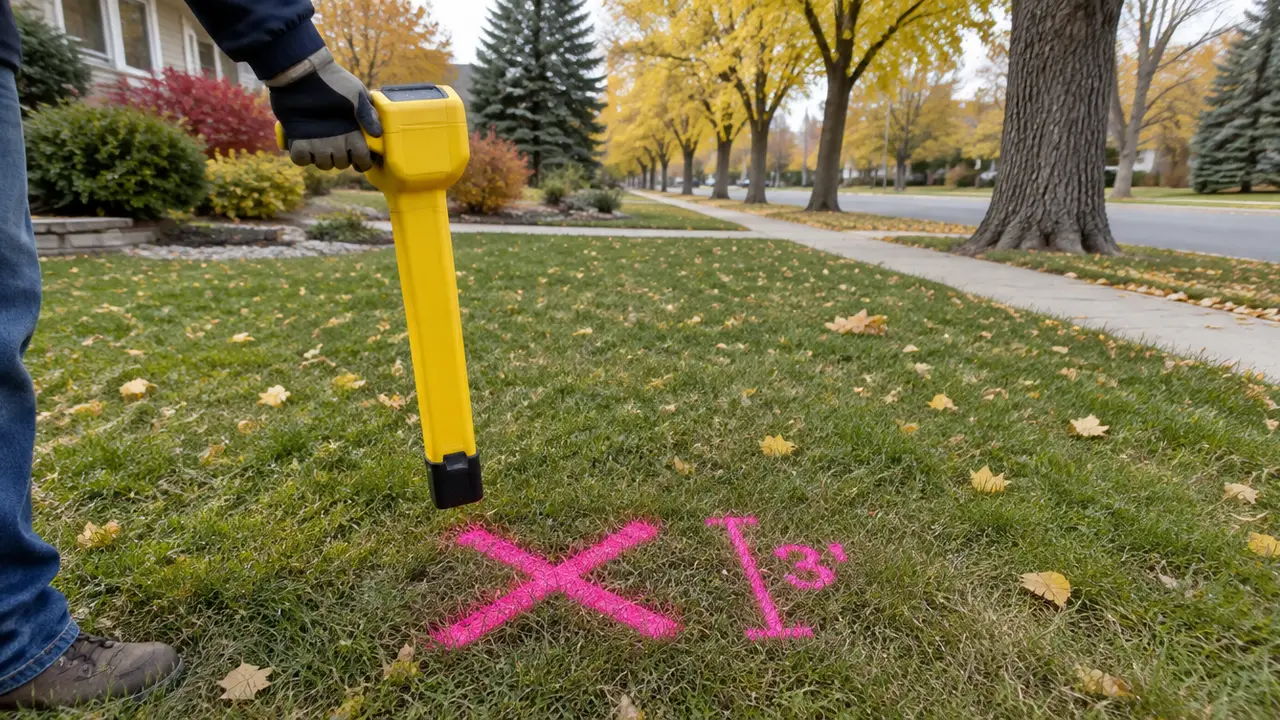
Not as a general service. The City's role on private property is narrower. Following a backup you report to 311, a crew may feed a steel snake into your cleanout to find out which side of the property line the blockage sits on, and if it is yours, the City points you to a plumber. The City also inspects new or replaced service connections against its specifications, and it maintains its own pipes, including a regular flushing schedule for some of them.
That means a camera inspection of your private line is something you arrange with a contractor. When the scope finds a problem that may be on the City side, the City becomes involved again through 311. The ownership rules are covered in who owns the sewer line in Calgary.
05 /What should a Calgary sewer scope include?
Enough to be used as evidence, by you, a contractor, an insurer or 311. Reviews of scope companies tend to praise speed and price; the deliverables matter more. Before booking, ask whether the scope will include each item below.
- Full recorded video with the footage counter visible throughout, not just a summary or screenshots.
- The access point and zero point stated in the report.
- Coverage to the main, or a clear note of where and why the camera stopped.
- Every material change called out with its distance.
- Locates and depth readings at defects and at the estimated property line.
- Your City record noted in the report, so the property line estimate is documented.
- Plain-language findings listed by distance, with photos of each.
For older records, those codes set expectations. A TIL City side suggests clay joints to examine; CI suggests scale and corrosion; TP and OTHER mean the record cannot tell you, so the scope must. The era guides explain each: the clay tile belt, 1950s communities and the inner city.
06 /What should you do after the scope?
- File the video and the record together
Keep the scope video, the report and the City record in your house file; they are the baseline for every later comparison.
- Report City-side findings
Send 311 the video, distances, access point and your estimate of the property line for anything at or beyond it.
- Plan private-side work
Use the findings to get comparable quotes. Planning ranges, which are estimates and not quotes, are on the Calgary sewer line costs page.
- Re-scope on a cycle if needed
Where roots or deposits were found, a follow-up camera after cleaning shows whether the pipe underneath is sound.
Buyers have their own timeline and negotiation questions; CalgarySewerReplacement.com covers the money side of buying and selling older Calgary homes. When you are ready for an inspection or repair prices, request quotes.
FAQQuestions people ask
Does the City of Calgary do sewer line inspections for homeowners?
No, not as a routine service. City involvement on private property is limited to checking where a reported blockage sits and inspecting new or replaced connections. A camera inspection of your private line is arranged with a contractor.
How do I know where my property line is on a sewer scope?
Subtract the City's public-side length, from its service line record, from the counter distance where the camera enters the main. A material change near that reading usually marks the transition. Confirm with a locate.
Should I give the scope company my City sewer record?
Yes. The City-side material and public-side length help the operator identify the transition to City pipe and document which defects are on which side.
My scope shows a problem near the street. Who pays?
It depends which side of the property line it is on. Report it to 311 with the video, counter readings and access point; the City assesses its own pipe and makes the final determination.
What makes a good Calgary sewer scope report?
A full video with a visible counter, the zero point, coverage to the main, every material change called out, locates and depths at defects, and findings listed by distance.
NETWORKGo deeper across the HAUSE Sewer network
How a sewer camera inspection works, step by step
How a sewer camera inspection works, start to finish: access points, push vs crawler cameras, the footage counter, sonde locating and what limits the view.
SewerCleaners.caWhat happens during a professional sewer cleaning visit
A step-by-step look at a professional sewer cleaning visit: arrival, questions, access, cleaning, flow testing, camera verification and the paperwork you keep.
SewerRoots.caWhose tree, whose pipe: who pays when roots block a sewer line
Who is responsible when a city or neighbour's tree sends roots into your sewer line: the general Canadian pattern, the evidence, and how to raise it.